Exploring
Accumulations of Change
Discover how definite integrals measure total accumulated quantities, connecting rate functions to net change through the power of integration.
What Is Accumulation?
In calculus, accumulation refers to the total quantity that builds up over an interval when we know the rate of change. If \( f(t) \) tells us how fast something changes at each moment, the accumulation from \( t = a \) to \( t = b \) is the total amount of that change.
Follow the salt through a working mixing rig
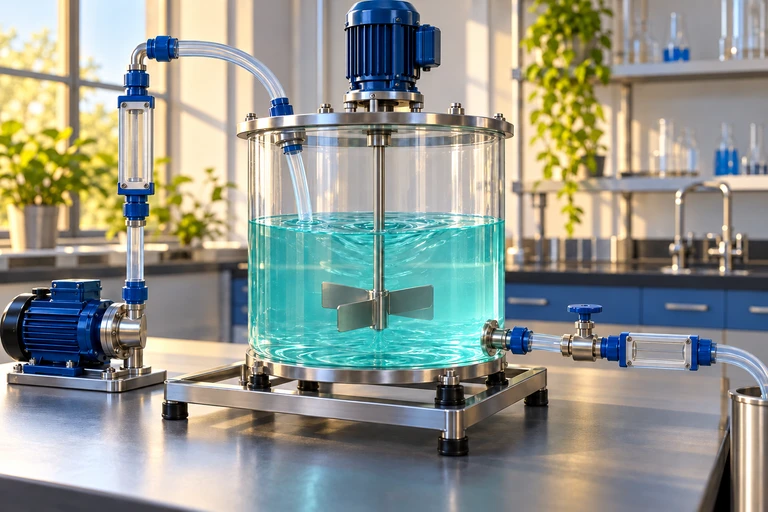 Suppose a tank receives and releases 4 gal/min for 5 minutes. Its 200 gal inventory stays constant while 20 gal enters and 20 gal leaves: net change is zero and total throughput is 40 gal.
Net inventory versus throughput
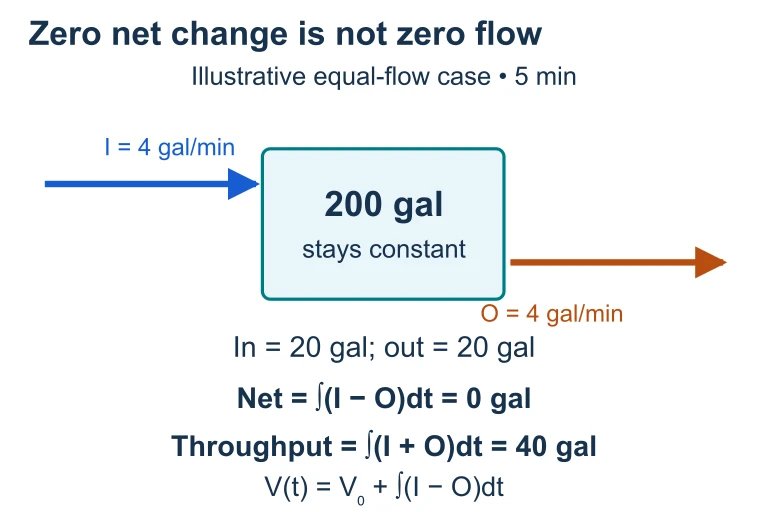 Suppose a tank receives and releases 4 gal/min for 5 minutes. Its 200 gal inventory stays constant while 20 gal enters and 20 gal leaves: net change is zero and total throughput is 40 gal.
Approximating with Riemann Sums
Before computing exact integrals, we approximate accumulation by slicing the interval into small rectangles. As the number of rectangles \( n \to \infty \), the sum approaches the exact integral.
Sum of rectangle areas \( \approx \displaystyle\int_a^b f(t)\,dt \)
The Definite Integral as Net Change
The definite integral \( \displaystyle\int_a^b f(t)\,dt \) gives the net accumulation of the quantity whose rate of change is \( f(t) \). This net change accounts for both positive and negative values of \( f \).
The Fundamental Theorem: Part 1
The First Fundamental Theorem of Calculus defines an accumulation function and states that differentiation undoes integration:
The Fundamental Theorem: Part 2
The Second Fundamental Theorem (Evaluation Theorem) provides the computational tool for evaluating definite integrals using antiderivatives:
This bridges the gap between accumulation (integral) and antiderivatives: find any \( F \) with \( F' = f \), then subtract endpoint values. The total accumulated change equals the difference of the antiderivative at the boundaries.
Net Change vs. Total Accumulation
A crucial distinction in accumulation problems: the signed integral gives net change, while the integral of the absolute value gives total accumulation.
| Net Change | Total Accumulation | |
|---|---|---|
| Formula | \( \displaystyle\int_a^b f(t)\,dt \) | \( \displaystyle\int_a^b |f(t)|\,dt \) |
| Sign | Can be negative | Always non-negative |
| Velocity example | Displacement | Distance traveled |
| Accounts for | Cancellation of + and − | All movement counted |
Graphing an Accumulation Function
Given a rate graph \( f(t) \), we can sketch \( F(x) = \displaystyle\int_a^x f(t)\,dt \) by tracking how area accumulates:
How to Solve Accumulation Problems
Example 1: Basic Accumulation
A tank is being filled at a rate of \( f(t) = 6t - t^2 \) liters per minute for \( 0 \leq t \leq 6 \). How many liters are added?
Example 2: Signed Accumulation
A particle has velocity \( v(t) = t^2 - 4t + 3 \) m/s. Find the net displacement and total distance traveled on \( [0, 4] \).
Example 3: FTC with Chain Rule
Find \( \displaystyle\frac{d}{dx}\int_1^{x^3} \sin(t^2)\,dt \).
Accumulation from Data Tables
When \( f(t) \) is given as a table of values (no formula), we approximate the integral using trapezoidal sums or Riemann sums.
| \( t \) (hrs) | 0 | 2 | 5 | 8 | 10 |
|---|---|---|---|---|---|
| \( r(t) \) (gal/hr) | 4 | 7 | 10 | 6 | 3 |
Key Properties of Definite Integrals
Common Mistakes to Avoid
Summary of Accumulation Concepts
| Concept | Formula | Interpretation |
|---|---|---|
| Net Change | \( \displaystyle\int_a^b f(t)\,dt \) | Signed total: + and − cancel |
| Total Accumulation | \( \displaystyle\int_a^b |f(t)|\,dt \) | All change counted positive |
| FTC Part 1 | \( \frac{d}{dx}\displaystyle\int_a^x f(t)\,dt = f(x) \) | Derivative undoes integral |
| FTC Part 2 | \( \displaystyle\int_a^b f(t)\,dt = F(b) - F(a) \) | Evaluate via antiderivative |
| Initial Value | \( F(b) = F(a) + \displaystyle\int_a^b f(t)\,dt \) | Start value + accumulated change |
Question 1 of 5
If \( \displaystyle\int_0^5 f(t)\,dt = 12 \) and \( \displaystyle\int_5^8 f(t)\,dt = -4 \), what is \( \displaystyle\int_0^8 f(t)\,dt \)?
Question 2 of 5
What is \( \displaystyle\frac{d}{dx}\int_2^{x^2} \cos(t)\,dt \)?
Question 3 of 5
A particle's velocity is \( v(t) = t - 3 \) m/s on \( [0, 6] \). What is the total distance traveled?
Question 4 of 5
If \( F(2) = 5 \) and \( \displaystyle\int_2^7 f(t)\,dt = -3 \), what is \( F(7) \)?
Question 5 of 5
The graph of \( f \) is shown below as a semicircle of radius 2 above the x-axis on \( [0, 4] \). What is \( \displaystyle\int_0^4 f(x)\,dx \)?