Evaluating
Improper Integrals
Master integrals with infinite limits and discontinuous integrands: convergence, divergence, and the limit techniques that connect them.
What Is an Improper Integral?
A definite integral is called improper when it violates one of the standard assumptions of the Riemann integral: either the interval of integration is infinite, or the integrand has an infinite discontinuity on the interval.
Type I: Infinite Limits
Type II: Infinite Discontinuities
Convergence vs Divergence
After replacing the problematic bound with a limit, we evaluate the resulting definite integral. The outcome falls into exactly one of two cases:
The Formal Definitions
The \(p\)-Integral Test
One of the most important reference results: the behavior of \(\displaystyle\int_1^{\infty}\frac{1}{x^p}\,dx\) depends entirely on \(p\).
Value: \(\displaystyle\frac{1}{p-1}\)
Includes the critical case \(p = 1\) (harmonic: \(\ln x \to \infty\)).
Type I vs Type II: Side by Side
| Type I (Infinite Bounds) | Type II (Discontinuity) | |
|---|---|---|
| Problem | Limit of integration is \(\pm\infty\) | Integrand undefined at a point in \([a,b]\) |
| Fix | Replace \(\infty\) with \(t\), take \(\lim_{t\to\infty}\) | Replace bad point \(c\) with \(t\), take \(\lim_{t\to c}\) |
| Classic example | \(\displaystyle\int_1^{\infty}\frac{1}{x^2}\,dx = 1\) | \(\displaystyle\int_0^1\frac{1}{\sqrt{x}}\,dx = 2\) |
| Both limits bad? | Split at any finite \(c\) | Split at the discontinuity |
Step-by-Step Evaluation
Example 1: \(\displaystyle\int_1^{\infty}\frac{1}{x^2}\,dx\)
Example 2: \(\displaystyle\int_0^{1}\frac{1}{\sqrt{x}}\,dx\)
Example 3: \(\displaystyle\int_1^{\infty}\frac{1}{x}\,dx\)
Example 4: \(\displaystyle\int_0^{\infty} e^{-x}\,dx\)
The Comparison Test for Integrals
Sometimes evaluating the antiderivative is hard or impossible. The comparison test lets you determine convergence by bounding the integrand against a simpler function.
Common Mistakes
Quick Reference Table
| Integral | Result | Why |
|---|---|---|
| \(\displaystyle\int_1^{\infty}\frac{1}{x^p}\,dx, p > 1\) | Converges to \(\frac{1}{p-1}\) | \(x^{1-p}\to 0\) |
| \(\displaystyle\int_1^{\infty}\frac{1}{x^p}\,dx, p \le 1\) | Diverges | \(x^{1-p}\to\infty\) or \(\ln x\to\infty\) |
| \(\displaystyle\int_0^{\infty}e^{-x}\,dx\) | Converges to \(1\) | Exponential decay |
| \(\displaystyle\int_0^{1}\frac{1}{x^p}\,dx, p < 1\) | Converges to \(\frac{1}{1-p}\) | \(x^{1-p}\to 0\) at \(0^+\) |
| \(\displaystyle\int_0^{1}\frac{1}{x^p}\,dx, p \ge 1\) | Diverges | Singularity too strong |
Worked practice: Practice Problems, Problem 4 — applied
Work through this original lesson problem, then reveal the solution and illustrations.
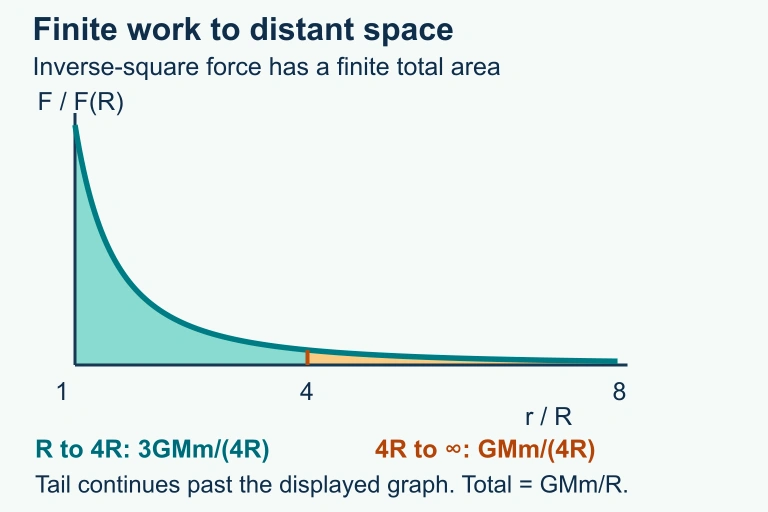
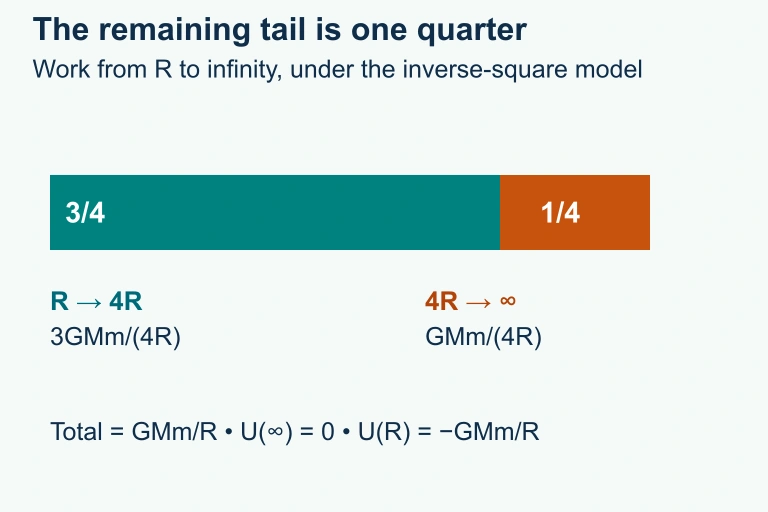
In a physics model, the gravitational potential energy of a satellite launched radially outward from Earth's surface (radius R) is modeled by the integral W = ∫ᵣ∞ (GMm/r²) dr, where G, M, and m are positive constants. (a) Classify this integral and explain why it is improper. (1 point) (b) Use proper limit notation to set up the evaluation. (1 point) (c) Find the antiderivative and evaluate the limit. (2 points) (d) Interpret your result: what does the finite value of this integral mean physically? (1 point)
Show answer and explanation
Point-by-point rubric: (a) [1 point] This is a Type I improper integral because the upper limit of integration is ∞. The integrand GMm/r² is continuous for r ≥ R > 0, so the only issue is the infinite bound. (b) [1 point] W = lim (b→∞) ∫ᵣᵇ (GMm/r²) dr. The student must explicitly write the limit notation with a finite upper bound b replacing ∞. (c) [2 points — 1 for antiderivative, 1 for limit evaluation] The antiderivative of GMm/r² = GMm · r⁻² is GMm · (−r⁻¹) = −GMm/r. Evaluating: lim (b→∞) [−GMm/b − (−GMm/R)] = lim (b→∞) [−GMm/b + GMm/R] = 0 + GMm/R = GMm/R. (d) [1 point] The finite value W = GMm/R represents the total work needed to move the satellite from the surface to infinitely far away — the escape energy. Because this integral converges, only a finite amount of energy is required to escape Earth's gravity, which is why escape velocity is a well-defined, finite quantity.
Question 1 of 5
Evaluate \(\displaystyle\int_1^{\infty}\frac{1}{x^3}\,dx\).
Question 2 of 5
Does \(\displaystyle\int_1^{\infty}\frac{1}{\sqrt{x}}\,dx\) converge or diverge?
Question 3 of 5
Evaluate \(\displaystyle\int_0^{4}\frac{1}{\sqrt{4-x}}\,dx\).
Question 4 of 5
Which statement about \(\displaystyle\int_{-\infty}^{\infty}\frac{1}{1+x^2}\,dx\) is correct?
Question 5 of 5
Using the Comparison Test, determine whether \(\displaystyle\int_1^{\infty}\frac{1}{x^2 + x}\,dx\) converges or diverges.