Disc Method
Revolving Around Axes
Learn to compute volumes of revolution by slicing solids into infinitely thin circular discs and integrating their areas along the x-axis or y-axis.
What Is a Solid of Revolution?
When you take a region in the plane and spin it around an axis, the resulting 3D shape is called a solid of revolution. Think of a potter's wheel: the profile curve sweeps out a full 360° to create the pot.
The Key Idea: Thin Circular Discs
Each disc is a cylinder with radius equal to the function value and thickness \( dx \) (or \( dy \)). The volume of one thin disc is:
Summing infinitely many such discs from \( x = a \) to \( x = b \) gives the total volume.
Why the Disc Method Matters
Disc Formula: Revolving Around the x-Axis
The radius of each disc equals \( f(x) \). Squaring it gives the disc area \( \pi[f(x)]^2 \), and integrating sums all disc volumes from \( a \) to \( b \).
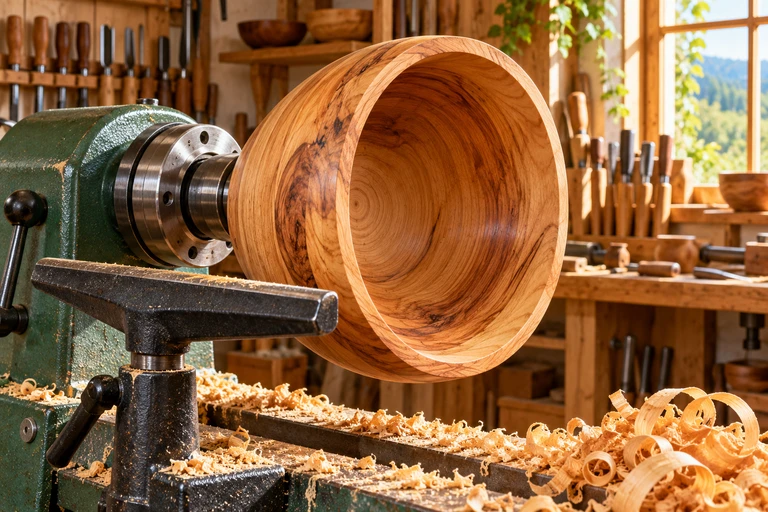
A transparent lathe reveals the hole inside a washer
 Rotating the region from y = 0 to y = x², for 0 ≤ x ≤ 2, about the x-axis gives disks with radius x². The volume is π∫₀²x⁴ dx = 32π/5.
The axis determines the radius
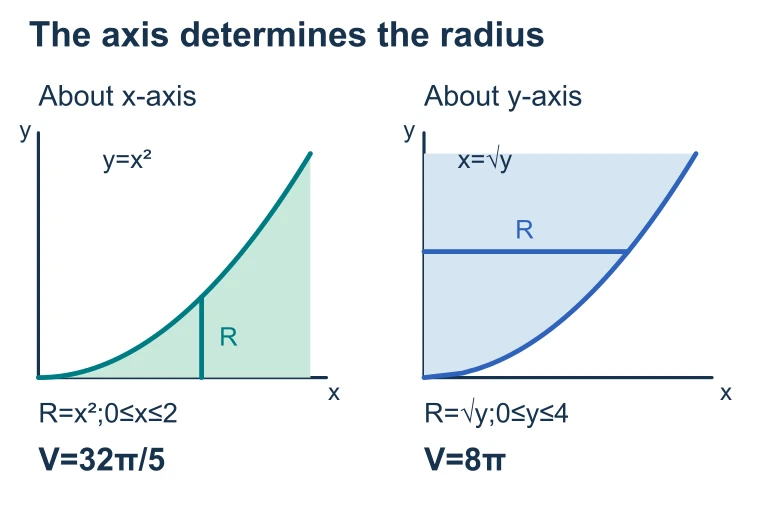 Rotating the region from y = 0 to y = x², for 0 ≤ x ≤ 2, about the x-axis gives disks with radius x². The volume is π∫₀²x⁴ dx = 32π/5.
Disc Formula: Revolving Around the y-Axis
When revolving around the y-axis, rewrite the curve as \( x = g(y) \). The radius of each disc is \( g(y) \), and we integrate with respect to \( dy \).
x-Axis vs y-Axis Revolution
| Revolve Around x-Axis | Revolve Around y-Axis | |
|---|---|---|
| Integrate w.r.t. | \( dx \) | \( dy \) |
| Radius is | \( f(x) \) | \( g(y) \) |
| Formula | \( \pi\!\int_a^b [f(x)]^2\,dx \) | \( \pi\!\int_c^d [g(y)]^2\,dy \) |
| Discs perpendicular to | x-axis (vertical slices) | y-axis (horizontal slices) |
| Must express curve as | \( y = f(x) \) | \( x = g(y) \) |
How to Apply the Disc Method
Example 1: \( y = \sqrt{x} \) Around the x-Axis
Find the volume when the region under \( y = \sqrt{x} \) from \( x = 0 \) to \( x = 4 \) is revolved about the x-axis.
Example 2: \( y = x^2 \) Around the y-Axis
Find the volume when the region bounded by \( y = x^2 \), \( y = 0 \), and \( y = 9 \) is revolved about the y-axis.
Example 3: \( y = \sin x \) Around the x-Axis
Find the volume obtained by revolving the region under \( y = \sin x \) from \( x = 0 \) to \( x = \pi \) about the x-axis.
When to Rewrite the Function
The axis of revolution determines whether you need \( y = f(x) \) or \( x = g(y) \). If the problem gives you one form but you need the other, solve for the opposite variable.
Visualizing the Radius
The radius of each disc is always the perpendicular distance from the curve to the axis of revolution. Drawing this line segment on your sketch is the most important step.
Why \( \pi r^2 \) Works: The Riemann Sum
The disc method is a direct application of the Riemann sum. We partition \( [a, b] \) into \( n \) subintervals of width \( \Delta x \). Each slice is approximately a cylinder:
Each term \( \pi [f(x_i^*)]^2 \Delta x \) is the volume of a thin disc: \( \pi r^2 \) for the circular face area times \( \Delta x \) for the thickness. The integral sums these infinitesimally thin discs exactly.
Common Mistakes to Avoid
Summary: Disc Method at a Glance
| Element | Detail |
|---|---|
| What it computes | Volume of a solid of revolution |
| Cross-section shape | Full circle (disc) |
| x-axis formula | \( V = \pi \int_a^b [f(x)]^2\,dx \) |
| y-axis formula | \( V = \pi \int_c^d [g(y)]^2\,dy \) |
| When to use | Region touches the axis of revolution (no gap) |
| When NOT to use | Gap between region and axis: use washer method |
Question 1 of 5
The region under \( y = x^2 \) from \( x = 0 \) to \( x = 3 \) is revolved about the x-axis. Which integral gives the volume?
Question 2 of 5
What is the volume when \( y = \sqrt{x} \) from \( x = 0 \) to \( x = 4 \) is revolved about the x-axis?
Question 3 of 5
The region bounded by \( y = x^3 \), \( y = 0 \), and \( x = 2 \) is revolved about the x-axis. Which integral gives the volume?
Question 4 of 5
When revolving around the y-axis, the variable of integration should be:
Question 5 of 5
Find the volume when \( y = e^x \) from \( x = 0 \) to \( x = 1 \) is revolved about the x-axis.