Disc Method:
Revolving Around Other Axes
Master the technique of computing volumes of revolution when the axis of rotation is not the \(x\)-axis or \(y\)-axis: horizontal lines \(y = k\) and vertical lines \(x = k\).
What Is the Disc Method?
When a region in the plane is revolved around an axis, it sweeps out a solid of revolution. The disc method slices this solid into thin circular discs perpendicular to the axis, then sums their volumes with an integral.
You already know the standard formulas for revolving around the \(x\)-axis and \(y\)-axis. Now we extend the method to any horizontal or vertical line.
Why Other Axes Matter
The Radius Is a Distance
A transparent lathe reveals the hole inside a washer
 For 0 ≤ x ≤ 2, rotate the region from y = −1 to y = x² about y = −1. Each full disk has radius x² + 1, so V = π∫₀²(x² + 1)² dx = 206π/15.
A disk reaches the shifted axis
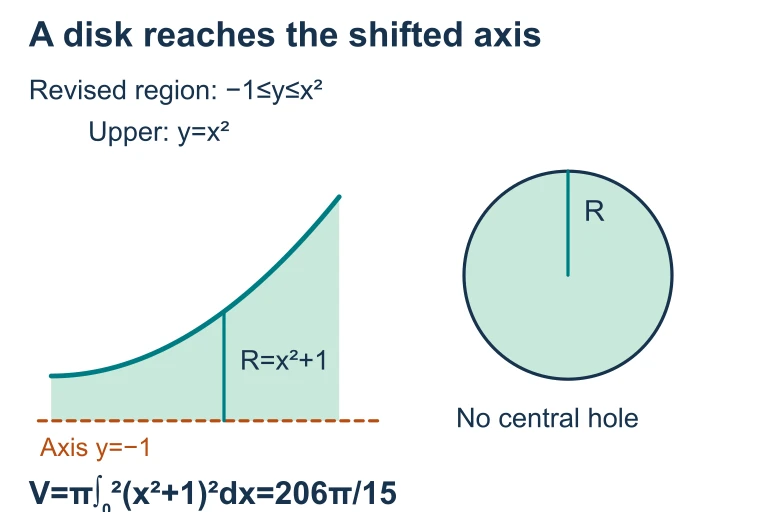 For 0 ≤ x ≤ 2, rotate the region from y = −1 to y = x² about y = −1. Each full disk has radius x² + 1, so V = π∫₀²(x² + 1)² dx = 206π/15.
Core Formula: Horizontal Axis \(y = k\)
When the axis is below the region (\(k < f(x)\)), the radius is \(f(x) - k\). When the axis is above (\(k > f(x)\)), the radius is \(k - f(x)\). Either way, squaring removes sign issues.
Core Formula: Vertical Axis \(x = k\)
When the axis of rotation is vertical, slices are horizontal discs. The radius of each disc is the horizontal distance from the curve to the line \(x = k\).
Standard vs. Shifted Axis
| Standard Axis | Shifted Axis | |
|---|---|---|
| Axis | \(y = 0\) or \(x = 0\) | \(y = k\) or \(x = k\) |
| Radius (horiz.) | \(r = f(x)\) | \(r = f(x) - k\) |
| Radius (vert.) | \(r = g(y)\) | \(r = g(y) - k\) |
| Formula | \(\pi \int [f(x)]^2 \, dx\) | \(\pi \int [f(x) - k]^2 \, dx\) |
| Common error | Forgetting to square | Using \(f(x)\) instead of \(f(x) - k\) |
Step-by-Step Approach
Example 1: Revolving Around \(y = -1\)
Find the volume when the region bounded by \(y = \sqrt{x}\), \(y = 0\), and \(x = 4\) is revolved about \(y = -1\).
Example 1: Solution
\(\displaystyle\int_0^4 (x + 2\sqrt{x} + 1)\,dx = \left[\frac{x^2}{2} + \frac{4x^{3/2}}{3} + x\right]_0^4\)
Example 2: Revolving Around \(y = 3\)
Find the volume when the region bounded by \(y = x^2\) and \(y = 0\) on \([0, 1]\) is revolved about \(y = 3\).
Example 2: Solution
Example 3: Revolving Around \(x = 2\)
Find the volume when the region bounded by \(x = y^2\) and \(x = 1\) (for \(0 \leq y \leq 1\)) is revolved about \(x = 2\).
Example 3: Solution
Common Mistakes to Avoid
Summary of Disc Formulas
| Scenario | Formula | Radius |
|---|---|---|
| About \(x\)-axis | \(\pi \int [f(x)]^2\,dx\) | \(r = f(x)\) |
| About \(y = k\) (below) | \(\pi \int [f(x) - k]^2\,dx\) | \(r = f(x) - k\) |
| About \(y = k\) (above) | \(\pi \int [k - f(x)]^2\,dx\) | \(r = k - f(x)\) |
| About \(y\)-axis | \(\pi \int [g(y)]^2\,dy\) | \(r = g(y)\) |
| About \(x = k\) | \(\pi \int [g(y) - k]^2\,dy\) | \(r = g(y) - k\) |
Question 1 of 5
The region bounded by \(y = x\), \(y = 0\), and \(x = 2\) is revolved about \(y = -2\). What is the radius of a typical disc?
Question 2 of 5
Which integral gives the volume when \(y = x^2\) on \([0, 2]\) is revolved about \(y = 5\)?
Question 3 of 5
The region under \(y = \sqrt{x}\) from \(x = 0\) to \(x = 4\) is revolved about \(y = -1\). What is \(V\)?
Question 4 of 5
When revolving a region about a vertical line \(x = k\), the discs are horizontal. What must you do with the curve equation?
Question 5 of 5
The region bounded by \(y = x^2\) and \(y = 0\) on \([0, 1]\) is revolved about \(y = 3\). What is the volume?