Differentiating
Inverse Trig Functions
Master the derivatives of \(\arcsin\), \(\arccos\), \(\arctan\), and more: the essential formulas and chain rule techniques for AP Calculus.
What Are Inverse Trig Functions?
An inverse trigonometric function reverses the role of input and output. If \(\sin\theta = x\), then \(\arcsin x = \theta\). These functions answer: "What angle produces this ratio?"
Range: \(\bigl[-\tfrac{\pi}{2},\,\tfrac{\pi}{2}\bigr]\)
Range: \([0,\,\pi]\)
Range: \(\bigl(-\tfrac{\pi}{2},\,\tfrac{\pi}{2}\bigr)\)
Why Differentiate Inverse Trig?
Inverse trig derivatives appear throughout calculus: related rates, implicit differentiation, and especially integration (they are the antiderivatives of key rational and radical expressions).
On the AP exam, these formulas are not provided: you must memorize them.
Graph of \(y = \arcsin x\)
The Big Three Derivative Formulas
The Other Three Formulas
\(\arcsin\) vs \(\arctan\): Key Distinction
| \(\arcsin x\) | \(\arctan x\) | |
|---|---|---|
| Derivative | \(\dfrac{1}{\sqrt{1-x^2}}\) | \(\dfrac{1}{1+x^2}\) |
| Denominator type | Square root | Polynomial |
| Sign in denominator | \(1 - x^2\) (minus) | \(1 + x^2\) (plus) |
| Domain of \(f'\) | \((-1, 1)\) | \((-\infty, \infty)\) |
| Mnemonic | "Sine Subtract" | "Tan aDd" |
Deriving \(\frac{d}{dx}[\arcsin x]\) by Implicit Differentiation
Chain Rule Extensions
When the argument is not simply \(x\), apply the chain rule. If \(u = g(x)\):
Step-by-Step Strategy
Example 1: \(\frac{d}{dx}[\arctan(3x)]\)
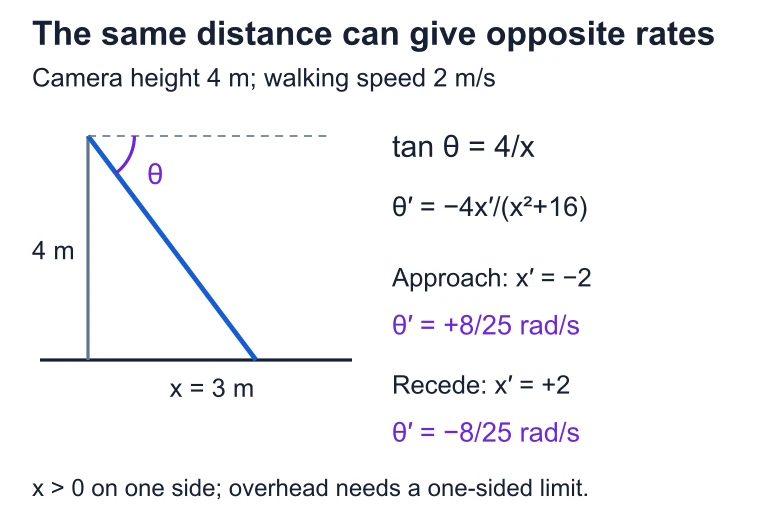
A ceiling camera follows a person beneath it
 For a camera 4 m above the path, tan θ = 4/x. At x = 3 m and walking speed 2 m/s, the angular-speed magnitude is 8/25 rad/s; the sign depends on direction.
Angle rate depends on the sign of the distance rate.
 For a camera 4 m above the path, tan θ = 4/x. At x = 3 m and walking speed 2 m/s, the angular-speed magnitude is 8/25 rad/s; the sign depends on direction.
Example 2: \(\frac{d}{dx}[\arcsin(x^2)]\)
Example 3: \(\frac{d}{dx}\bigl[x \cdot \arctan x\bigr]\)
This requires the product rule combined with the inverse trig derivative.
Example 4: \(\frac{d}{dx}\!\left[\arcsin\!\left(\frac{x}{3}\right)\right]\)
Common Mistakes to Avoid
Complete Reference Table
| Function | Derivative | Domain |
|---|---|---|
| \(\arcsin x\) | \(\frac{1}{\sqrt{1-x^2}}\) | \(|x| < 1\) |
| \(\arccos x\) | \(\frac{-1}{\sqrt{1-x^2}}\) | \(|x| < 1\) |
| \(\arctan x\) | \(\frac{1}{1+x^2}\) | All \(\mathbb{R}\) |
| \(\text{arccot}\, x\) | \(\frac{-1}{1+x^2}\) | All \(\mathbb{R}\) |
| \(\text{arcsec}\, x\) | \(\frac{1}{|x|\sqrt{x^2-1}}\) | \(|x| > 1\) |
| \(\text{arccsc}\, x\) | \(\frac{-1}{|x|\sqrt{x^2-1}}\) | \(|x| > 1\) |
Question 1 of 5
What is \(\dfrac{d}{dx}[\arctan(5x)]\)?
Question 2 of 5
What is \(\dfrac{d}{dx}[\arccos(2x)]\)?
Question 3 of 5
If \(f(x) = \arcsin(x^3)\), what is \(f'(x)\)?
Question 4 of 5
What is \(\dfrac{d}{dx}\!\left[\arcsin\!\left(\dfrac{x}{4}\right)\right]\)?
Question 5 of 5
If \(g(x) = x^2 \arctan x\), what is \(g'(x)\)?