01 / 22
\(\frac{d}{dx}\)
\(\sec\)

Derivatives of
Reciprocal Trig Functions

Master the derivatives of \(\tan x\), \(\cot x\), \(\sec x\), and \(\csc x\) using the quotient rule and fundamental identities.

AP Calculus BC

Why These Derivatives Matter

You already know the derivatives of \(\sin x\) and \(\cos x\). The four remaining trig functions: \(\tan x\), \(\cot x\), \(\sec x\), and \(\csc x\): are all built from sine and cosine.

That means their derivatives can be derived rather than memorized. Understanding how they arise from the quotient rule gives you a toolkit for chain rule compositions, implicit differentiation, and integration by substitution.

The Reciprocal Relationships

\(\tan x\)
\(\displaystyle\frac{\sin x}{\cos x}\)
\(\cot x\)
\(\displaystyle\frac{\cos x}{\sin x}\)
\(\sec x\)
\(\displaystyle\frac{1}{\cos x}\)
\(\csc x\)
\(\displaystyle\frac{1}{\sin x}\)

Quick Review: Quotient Rule

$$\frac{d}{dx}\left[\frac{f(x)}{g(x)}\right] = \frac{f'(x)\,g(x) - f(x)\,g'(x)}{\left[g(x)\right]^2}$$

This rule is the engine behind every derivation that follows. Remember: the denominator function squared always appears in the result, and the numerator subtracts in a specific order.

Deriving \(\frac{d}{dx}[\)\(\tan x\)\(]\)

1
Rewrite: \(\tan x = \dfrac{\sin x}{\cos x}\)
2
Apply quotient rule: \(\dfrac{\cos x \cdot \cos x - \sin x \cdot (-\sin x)}{\cos^2 x}\)
3
Simplify numerator: \(\dfrac{\cos^2 x + \sin^2 x}{\cos^2 x} = \dfrac{1}{\cos^2 x}\)
4
Result: \(\dfrac{d}{dx}[\tan x] = \sec^2 x\)

Deriving \(\frac{d}{dx}[\)\(\cot x\)\(]\)

1
Rewrite: \(\cot x = \dfrac{\cos x}{\sin x}\)
2
Apply quotient rule: \(\dfrac{(-\sin x)(\sin x) - (\cos x)(\cos x)}{\sin^2 x}\)
3
Simplify: \(\dfrac{-\sin^2 x - \cos^2 x}{\sin^2 x} = \dfrac{-1}{\sin^2 x}\)
4
Result: \(\dfrac{d}{dx}[\cot x] = -\csc^2 x\)

Deriving \(\frac{d}{dx}[\)\(\sec x\)\(]\)

1
Rewrite: \(\sec x = \dfrac{1}{\cos x}\)
2
Apply quotient rule: \(\dfrac{(0)(\cos x) - (1)(-\sin x)}{\cos^2 x}\)
3
Simplify: \(\dfrac{\sin x}{\cos^2 x} = \dfrac{1}{\cos x}\cdot\dfrac{\sin x}{\cos x}\)
4
Result: \(\dfrac{d}{dx}[\sec x] = \sec x \tan x\)

Deriving \(\frac{d}{dx}[\)\(\csc x\)\(]\)

1
Rewrite: \(\csc x = \dfrac{1}{\sin x}\)
2
Apply quotient rule: \(\dfrac{(0)(\sin x) - (1)(\cos x)}{\sin^2 x}\)
3
Simplify: \(\dfrac{-\cos x}{\sin^2 x} = -\dfrac{1}{\sin x}\cdot\dfrac{\cos x}{\sin x}\)
4
Result: \(\dfrac{d}{dx}[\csc x] = -\csc x \cot x\)

The Complete Formula Set

$$\frac{d}{dx}[\tan x] = \sec^2 x$$ $$\frac{d}{dx}[\cot x] = -\csc^2 x$$ $$\frac{d}{dx}[\sec x] = \sec x\,\tan x$$ $$\frac{d}{dx}[\csc x] = -\csc x\,\cot x$$

Squared vs Product Results

Squared Results
\(\frac{d}{dx}[\tan x] = \sec^2 x\)
\(\frac{d}{dx}[\cot x] = -\csc^2 x\)

These come from ratio-type functions \(\frac{\sin}{\cos}\) and \(\frac{\cos}{\sin}\), where the Pythagorean identity simplifies the numerator to \(\pm 1\).
Product Results
\(\frac{d}{dx}[\sec x] = \sec x\,\tan x\)
\(\frac{d}{dx}[\csc x] = -\csc x\,\cot x\)

These come from reciprocal-type functions \(\frac{1}{\cos}\) and \(\frac{1}{\sin}\), where the numerator is constant and the result factors into a product.

The Co-Function Sign Pattern

Function Derivative Sign
\(\sin x\) \(\cos x\) +
\(\cos x\) \(-\sin x\) −
\(\tan x\) \(\sec^2 x\) +
\(\cot x\) \(-\csc^2 x\) −
\(\sec x\) \(\sec x\,\tan x\) +
\(\csc x\) \(-\csc x\,\cot x\) −

How to Apply These Rules

1
Identify the outer function: Is it \(\tan\), \(\cot\), \(\sec\), or \(\csc\)?
2
Write down the derivative formula from the table. Remember the co-function sign rule.
3
Check for a chain rule: If the argument is not just \(x\), multiply by the derivative of the inner function.
4
Simplify using trig identities if the problem calls for it.

Example 1: Basic Derivative

Find \(\dfrac{d}{dx}[3\sec x + 2\tan x]\).

1
Differentiate term by term using linearity of the derivative.
2
\(\dfrac{d}{dx}[3\sec x] = 3\sec x\,\tan x\)
3
\(\dfrac{d}{dx}[2\tan x] = 2\sec^2 x\)

Example 2: Chain Rule

Find \(\dfrac{d}{dx}[\tan(3x^2)]\).

1
Outer function: \(\tan(u)\) where \(u = 3x^2\).
2
Derivative of outer: \(\sec^2(u)\).
3
Derivative of inner: \(u' = 6x\).
4
Multiply: \(\sec^2(3x^2)\cdot 6x\).

A moving spot outruns its rotating lamp
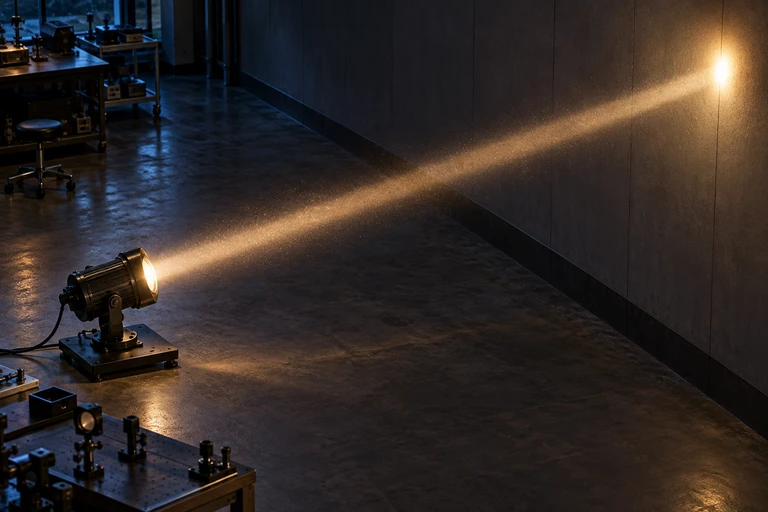
A floor-mounted spotlight casts one oblique beam to a spot on a laboratory wall.For a light 20 m from a wall rotating at 0.5 rad/s, y = 20 tan θ gives dy/dt = 10 sec²θ. At θ = π/3, the spot moves at 40 m/s.

A rotating beam accelerates its spot
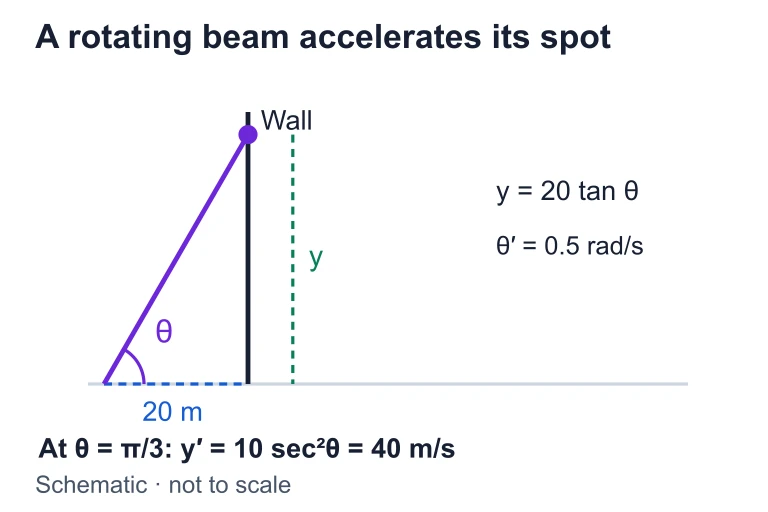
For a light 20 m from a wall rotating at 0.5 rad/s, y = 20 tan θ gives dy/dt = 10 sec²θ. At θ = π/3, the spot moves at 40 m/s.For a light 20 m from a wall rotating at 0.5 rad/s, y = 20 tan θ gives dy/dt = 10 sec²θ. At θ = π/3, the spot moves at 40 m/s.

Example 3: Product Rule Combo

Find \(\dfrac{d}{dx}[x^2\csc x]\).

1
Product rule: \(\dfrac{d}{dx}[f\cdot g] = f'\,g + f\,g'\)
2
Let \(f = x^2\), so \(f' = 2x\). Let \(g = \csc x\), so \(g' = -\csc x\,\cot x\).
3
Combine: \(2x\,\csc x + x^2(-\csc x\,\cot x)\)

Common Mistakes

✕ Forgetting the Negative
Writing \(\dfrac{d}{dx}[\cot x] = \csc^2 x\) instead of \(-\csc^2 x\). All co-function derivatives are negative.
✕ Missing the Chain Rule
Writing \(\dfrac{d}{dx}[\sec(5x)] = \sec(5x)\tan(5x)\) without the inner derivative factor of 5.
✕ Swapping Squared and Product
Writing \(\dfrac{d}{dx}[\sec x] = \sec^2 x\). That is the derivative of \(\tan x\), not \(\sec x\).

Complete Summary Table

Function \(f(x)\) Derivative \(f'(x)\) Mnemonic
\(\tan x\) \(\sec^2 x\) Squared (positive)
\(\cot x\) \(-\csc^2 x\) Squared (negative)
\(\sec x\) \(\sec x\,\tan x\) Self times partner
\(\csc x\) \(-\csc x\,\cot x\) Negative self times partner

Question 1 of 5

What is \(\dfrac{d}{dx}[\cot x]\)?

Question 2 of 5

Find \(\dfrac{d}{dx}[\sec(4x)]\).

Question 3 of 5

If \(f(x) = x\,\tan x\), what is \(f'(x)\)?

Question 4 of 5

Which rule explains why \(\dfrac{d}{dx}[\csc x]\) is negative?

Question 5 of 5

Find \(\dfrac{d}{dx}[\csc(x^3)]\).