Infinite Series:
Convergence & Divergence
Learn how to determine whether an infinite series settles to a finite sum or grows without bound: the foundation of all series analysis in calculus.
What Is an Infinite Series?
An infinite series is the sum of infinitely many terms from a sequence \( \{a_n\} \):
The big question: can you add infinitely many numbers and get a finite result? Sometimes yes, sometimes no. That distinction is the heart of this lesson.
The Partial Sum Sequence
We can't add infinitely many numbers directly. Instead, we build a sequence of partial sums:
Each \( S_N \) is a finite sum. As \( N \to \infty \), the behavior of the sequence \( \{S_N\} \) tells us whether the infinite series converges or diverges.
Visualizing Partial Sums
Consider \( \displaystyle\sum_{n=1}^{\infty} \frac{1}{2^n} \). The partial sums approach a limit:
Formal Definitions
The Geometric Series Theorem
This is the most important convergent series in calculus: it gives an exact closed-form sum.
A bouncing ball leaves a shrinking ladder of travel
 A ball falls 10 m and rebounds to 60% of its preceding height. Count the initial fall once and each rebound twice: the geometric series gives 40 m of total travel.
A bouncing ball leaves a shrinking ladder of travel
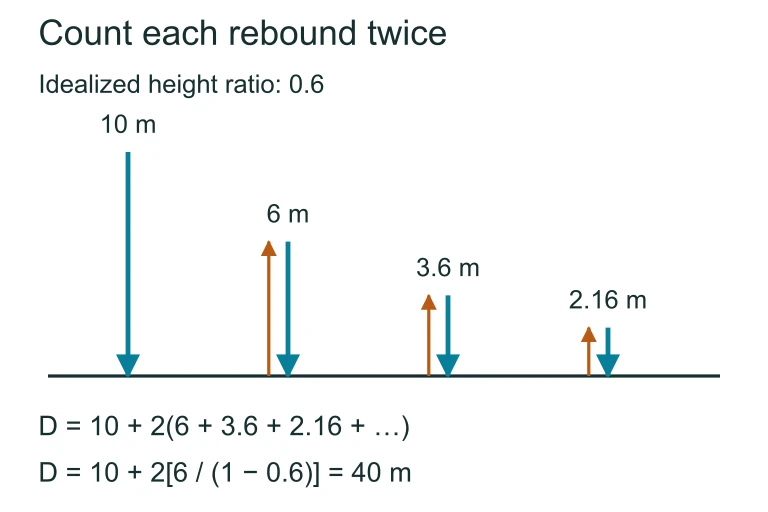 A ball falls 10 m and rebounds to 60% of its preceding height. Count the initial fall once and each rebound twice: the geometric series gives 40 m of total travel.
A Famous Divergent Series
The harmonic series \( \displaystyle\sum_{n=1}^{\infty} \frac{1}{n} \) diverges, even though \( a_n \to 0 \):
The nth-Term Test for Divergence
This is the simplest divergence test: if the terms don't approach zero, the series cannot converge. But be careful of the converse:
Sequence vs Series
| Sequence \(\{a_n\}\) | Series \(\sum a_n\) | |
|---|---|---|
| What it is | An ordered list of numbers | The sum of those numbers |
| Convergence means | \(a_n \to L\) (single number) | \(S_N \to S\) (partial sums) |
| Example | \(\frac{1}{n} \to 0\) ✓ | \(\sum \frac{1}{n} = \infty\) ✕ |
| Key insight | Sequence converging does not force the series to converge | |
Telescoping Series
A telescoping series is one where most terms in the partial sum cancel, making it easy to evaluate the limit:
After cancellation, \( S_N = 1 - \frac{1}{N+1} \). Since \( S_N \to 1 \), the series converges to 1.
How to Determine Convergence
Example 1: Geometric Series
Determine whether \( \displaystyle\sum_{n=0}^{\infty} 3\!\left(\frac{2}{5}\right)^n \) converges. If so, find its sum.
Example 2: Telescoping Series
Find \( \displaystyle\sum_{n=1}^{\infty} \frac{1}{n(n+1)} \).
Example 3: Divergence by nth-Term Test
Does \( \displaystyle\sum_{n=1}^{\infty} \frac{n}{2n+1} \) converge or diverge?
Common Mistakes
Series Summary Table
| Series | Converges? | Sum / Behavior |
|---|---|---|
| \( \sum ar^n \), \( |r| < 1 \) | Yes | \( \frac{a}{1-r} \) |
| \( \sum ar^n \), \( |r| \geq 1 \) | No | Diverges |
| \( \sum \frac{1}{n} \) (harmonic) | No | \( S_N \to \infty \) |
| \( \sum \frac{1}{n(n+1)} \) (telescoping) | Yes | 1 |
| \( a_n \not\to 0 \) (nth-term test) | No | Diverges (always) |
Question 1 of 5
What is the sum of the geometric series \( \displaystyle\sum_{n=0}^{\infty} 4\!\left(\frac{1}{3}\right)^n \)?
Question 2 of 5
Which of the following is true about the harmonic series \( \displaystyle\sum_{n=1}^{\infty} \frac{1}{n} \)?
Question 3 of 5
If \( \displaystyle\lim_{n\to\infty} a_n = 5 \), what can you conclude about \( \displaystyle\sum_{n=1}^{\infty} a_n \)?
Question 4 of 5
Find the sum of the telescoping series \( \displaystyle\sum_{n=1}^{\infty} \left(\frac{1}{n+1} - \frac{1}{n+2}\right) \).
Question 5 of 5
Which series converges?