01 / 20

Position, Velocity &
Acceleration

Master the calculus of straight-line motion: how derivatives and integrals connect where an object is, how fast it moves, and how its speed changes.

AP Calculus BC

What is a Position Function?

A position function \( s(t) \) tells you the location of a particle on a number line at any time \( t \). The value \( s(t) \) is measured from a fixed reference point (the origin).

-2 -1 0 1 2 3 \( s(t_0)=2 \) moving right

Velocity as the Derivative

Velocity is the rate of change of position with respect to time. It tells you both how fast and in which direction the particle moves.

\( v(t) > 0 \)
Moving in the positive direction (right)
\( v(t) < 0 \)
Moving in the negative direction (left)
\( v(t) = 0 \)
Particle is at rest (potential direction change)

Acceleration: The Second Derivative

Acceleration is the rate of change of velocity. It tells you how the velocity itself is changing over time.

Speeding Up
\( v(t) \) and \( a(t) \) have the same sign
Slowing Down
\( v(t) \) and \( a(t) \) have opposite signs

The Derivative Chain

Position \( s(t) \) \( \frac{d}{dt} \) Velocity \( v(t) = s'(t) \) \( \frac{d}{dt} \) Acceleration \( a(t) = v'(t) \) integrate integrate

Integral Relationships

Integration reverses differentiation. Given acceleration, you can recover velocity; given velocity, you can recover position: each requires an initial condition.

1
Velocity from acceleration: \( v(t) = v(t_0) + \displaystyle\int_{t_0}^{t} a(\tau)\, d\tau \)
2
Position from velocity: \( s(t) = s(t_0) + \displaystyle\int_{t_0}^{t} v(\tau)\, d\tau \)
3
Displacement over \([a,b]\): \( \displaystyle\int_a^b v(t)\, dt = s(b) - s(a) \)

Displacement vs. Total Distance

Displacement
Net change in position: \( \displaystyle\int_a^b v(t)\, dt \). Can be positive, negative, or zero.
Total Distance
Entire path length: \( \displaystyle\int_a^b |v(t)|\, dt \). Always non-negative.
\( t \) \( v(t) \) 0 1 2 3 4 + area − area Displacement = net signed area Total Dist. = sum of |areas|

Speed vs. Velocity

Velocity is a signed quantity (direction matters). Speed is the magnitude of velocity: always non-negative.

1
Speeding up: \( v(t) \) and \( a(t) \) have the same sign (both positive or both negative).
2
Slowing down: \( v(t) \) and \( a(t) \) have opposite signs.
3
Speed is increasing when \( \frac{d}{dt}|v(t)| > 0 \), which happens exactly when \( v(t) \cdot a(t) > 0 \).

Step-by-Step Strategy

1
Identify what you're given: \( s(t) \), \( v(t) \), or \( a(t) \)? Is there an initial condition?
2
Decide the direction: Need a derivative (going down the chain) or an integral (going up)?
3
Differentiate or integrate accordingly. If integrating, apply the initial condition to find \(C\).
4
Analyze the sign: Check where \( v(t) = 0 \) for direction changes. Compare signs of \( v \) and \( a \) for speed behavior.
5
Answer the question: Displacement uses \( \int v \), total distance uses \( \int |v| \), position needs \( s(t_0) + \int v \).

Follow the salt through a working mixing rig

A stirred transparent tank has one upper inlet and one lower outlet with a valve. The exact diagram links its 100 L salt balance to a computed approach to equilibrium.The distinction between net change and total movement also appears in flowing water. Suppose a tank receives and releases 4 gal/min for 5 minutes. Its 200 gal inventory stays constant while 20 gal enters and 20 gal leaves: net change is zero and total throughput is 40 gal.

Net inventory versus throughput
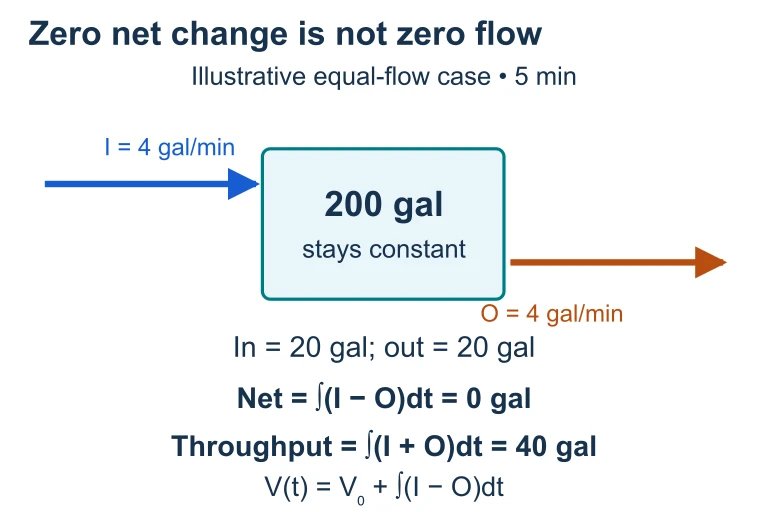
The distinction between net change and total movement also appears in flowing water. Suppose a tank receives and releases 4 gal/min for 5 minutes. Its 200 gal inventory stays constant while 20 gal enters and 20 gal leaves: net change is zero and total throughput is 40 gal.The distinction between net change and total movement also appears in flowing water. Suppose a tank receives and releases 4 gal/min for 5 minutes. Its 200 gal inventory stays constant while 20 gal enters and 20 gal leaves: net change is zero and total throughput is 40 gal.

Example 1: Finding Velocity

1
Differentiate: \( v(t) = s'(t) = 3t^2 - 12t + 9 \)
2
Factor: \( v(t) = 3(t^2 - 4t + 3) = 3(t-1)(t-3) \)
3
Set \( v(t) = 0 \): \( t = 1 \) and \( t = 3 \). The particle is at rest at these times.

Example 1: Visualizing Motion

Example 2: From Acceleration to Position

1
Integrate \( a(t) \): \( v(t) = \int(6t-4)\,dt = 3t^2 - 4t + C_1 \)
2
Apply \( v(0) = 5 \): \( C_1 = 5 \), so \( v(t) = 3t^2 - 4t + 5 \)
3
Integrate \( v(t) \): \( s(t) = \int(3t^2 - 4t + 5)\,dt = t^3 - 2t^2 + 5t + C_2 \)
4
Apply \( s(0) = 2 \): \( C_2 = 2 \), so \( s(t) = t^3 - 2t^2 + 5t + 2 \)

Example 3: Total Distance Traveled

1
Find zeros: \( v(t) = 0 \) at \( t = 1 \) and \( t = 3 \). Split the integral.
2
Compute each piece: \( \int_0^1 v(t)\,dt = 4 \), \( \int_1^3 v(t)\,dt = -4 \), \( \int_3^4 v(t)\,dt = 4 \)
3
Total distance: \( |4| + |-4| + |4| = 12 \) units
4
Displacement: \( 4 + (-4) + 4 = 4 \) units (net rightward movement)

Common Mistakes

✕ Confusing displacement and distance
Displacement uses \( \int v(t)\,dt \) (signed). Total distance uses \( \int |v(t)|\,dt \). They are equal only when velocity never changes sign.
✕ Forgetting the constant
When integrating \( a(t) \) to get \( v(t) \), or \( v(t) \) to get \( s(t) \), you must use the initial condition to find \( C \).
✕ Speed vs. velocity
Speed is \( |v(t)| \). "The particle is speeding up" does not mean \( a(t) > 0 \); it means \( v(t) \cdot a(t) > 0 \).

Summary Table

Quantity Definition Meaning
Position \( s(t) \) Given or \( \int v\,dt \) Where the particle is
Velocity \( v(t) \) \( s'(t) \) Direction and rate of movement
Acceleration \( a(t) \) \( v'(t) = s''(t) \) Rate of change of velocity
Speed \( |v(t)| \) \( |s'(t)| \) Magnitude of velocity (always \( \geq 0 \))
Displacement \( \int_a^b v\,dt \) Net change in position (signed)
Total Distance \( \int_a^b |v|\,dt \) Total path length (unsigned)

Question 1 of 5

A particle moves along the \( x \)-axis with position \( s(t) = 2t^3 - 9t^2 + 12t \). At what time(s) is the particle at rest?

Question 2 of 5

If \( v(t) = t^2 - 4t + 3 \), on which interval is the particle moving to the left?

Question 3 of 5

A particle has \( v(t) = 3t - 6 \). What is the total distance traveled from \( t = 0 \) to \( t = 4 \)?

Question 4 of 5

If \( v(t_0) = -2 \) and \( a(t_0) = -3 \) at time \( t_0 \), is the particle speeding up or slowing down?

Question 5 of 5

Given \( a(t) = 4 \) with \( v(0) = -6 \) and \( s(0) = 0 \), find the position at \( t = 3 \).