Accumulation Functions
and Area
Interpret how accumulation functions built from definite integrals encode the signed area under a curve, and connect their behavior to the original function.
What Is an Accumulation Function?
An accumulation function is defined as a definite integral with a variable upper limit:
As \( x \) changes, \( F(x) \) accumulates the signed area between the graph of \( f(t) \) and the \( t \)-axis from \( t = a \) to \( t = x \). When \( f(t) > 0 \), area is added; when \( f(t) < 0 \), area is subtracted.
Visualizing Signed Area
Why Accumulation Matters
In each case, the accumulation function translates a rate into a total quantity: exactly what \( F(x)=\int_a^x f(t)\,dt\) does.
Follow the salt through a working mixing rig
 Suppose a tank receives and releases 4 gal/min for 5 minutes. Its 200 gal inventory stays constant while 20 gal enters and 20 gal leaves: net change is zero and total throughput is 40 gal.
Net inventory versus throughput
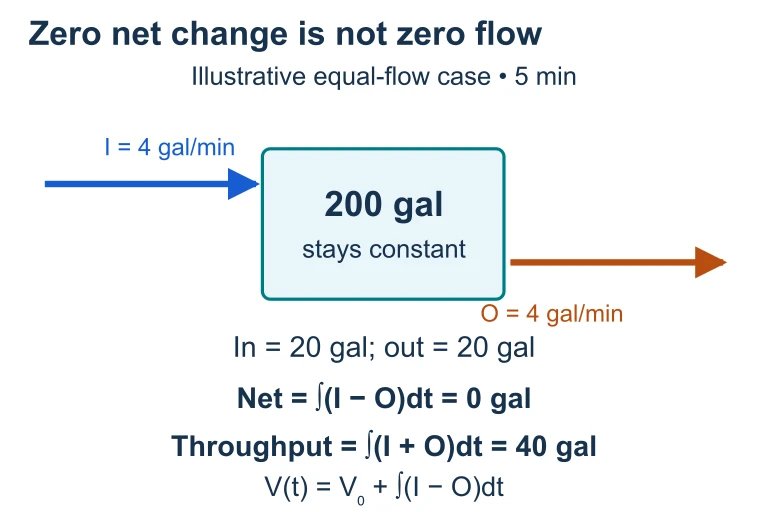 Suppose a tank receives and releases 4 gal/min for 5 minutes. Its 200 gal inventory stays constant while 20 gal enters and 20 gal leaves: net change is zero and total throughput is 40 gal.
The Fundamental Theorem (Part 1)
This is the bridge: the derivative of the accumulation function equals the original integrand evaluated at the upper limit. The rate at which area accumulates at \( x \) is exactly \( f(x) \).
FTC with the Chain Rule
When the upper limit is a function \( g(x) \) instead of just \( x \), we apply the chain rule:
Increasing vs. Concave Up
| F is increasing | F is concave up | |
|---|---|---|
| Condition | \( F'(x) = f(x) > 0 \) | \( F''(x) = f'(x) > 0 \) |
| Read from graph of \( f \) | \( f \) is above the \( t \)-axis | \( f \) is increasing |
| Meaning for area | Net area is growing | Area is growing at a faster rate |
How to Analyze \( F(x) \)
Example 1: Reading \( f \) to Sketch \( F \)
Given the graph of \( f(t) \) below, with \(\displaystyle F(x) = \int_0^x f(t)\,dt\), describe the behavior of \( F \).
Example 1: Computing \( F \) Values
Using the same piecewise-linear \( f(t) \) from the previous slide, compute \( F(3) \) and \( F(5) \).
Example 2: Concavity of \( F \)
Example 3: Chain Rule in Action
Find \(\displaystyle \frac{d}{dx}\int_1^{x^2} \sqrt{t^3+1}\,dt\).
Example 4: Full Analysis from a Graph
The graph of \( f \) consists of line segments. Let \(\displaystyle F(x) = \int_0^x f(t)\,dt\). Find where \( F \) has a relative minimum.
Common Mistakes to Avoid
Summary: Reading \( f \) for \( F \)
| If \( f(x) \) is... | Then \( F(x) \) is... | Because... |
|---|---|---|
| Positive | Increasing | \( F' = f > 0 \) |
| Negative | Decreasing | \( F' = f < 0 \) |
| Zero (sign change + to -) | Local max | \( F' \) changes + to - |
| Zero (sign change - to +) | Local min | \( F' \) changes - to + |
| Increasing | Concave up | \( F'' = f' > 0 \) |
| Decreasing | Concave down | \( F'' = f' < 0 \) |
| Local max or min | Inflection point | \( F'' = f' \) changes sign |
Question 1 of 5
Let \(\displaystyle F(x) = \int_0^x f(t)\,dt\). If \( f(x) > 0 \) and \( f \) is decreasing on \((2, 5)\), which statement about \( F \) is true on \((2, 5)\)?
Question 2 of 5
What is \(\displaystyle \frac{d}{dx}\int_2^{x^3} \cos(t)\,dt\)?
Question 3 of 5
Let \(\displaystyle G(x)=\int_0^x f(t)\,dt\). If \( f \) crosses the \( t \)-axis from positive to negative at \( t = 4 \), what happens to \( G \) at \( x = 4 \)?
Question 4 of 5
The graph of \( f \) on \([0, 6]\) consists of a semicircle of radius 2 above the axis from \( t = 0 \) to \( t = 4 \) and a triangle with base 2 and height 3 below the axis from \( t = 4 \) to \( t = 6 \). What is \(\displaystyle \int_0^6 f(t)\,dt\)?
Question 5 of 5
Let \(\displaystyle H(x) = \int_1^x (3t^2 - 6t)\,dt\). At what value of \( x \) does \( H \) have a relative minimum for \( x > 0 \)?