Area of a
Polar Region
Learn to compute the area enclosed by polar curves using the integral formula \( A = \frac{1}{2}\int_{\alpha}^{\beta} [r(\theta)]^2\, d\theta \).
What Are Polar Coordinates?
In Cartesian coordinates we locate a point with \( (x, y) \). In polar coordinates, we use a distance \( r \) from the origin and an angle \( \theta \) from the positive \( x \)-axis. The conversion is:
Why Area in Polar Is Different
In Cartesian coordinates, we sum thin rectangular strips of width \( dx \). In polar coordinates, we sweep through angles: each thin slice is a circular sector, not a rectangle.
Building the Area Integral
Partition the angle from \( \alpha \) to \( \beta \) into \( n \) sub-angles of width \( \Delta\theta \). Each sector has approximate area \( \frac{1}{2}[r(\theta_k)]^2 \Delta\theta \). Taking the limit as \( n \to \infty \) gives the Riemann sum turning into a definite integral.
The Polar Area Formula
Sectors vs. Rectangles
| Cartesian | Polar | |
|---|---|---|
| Slice shape | Thin rectangle | Thin sector |
| Width element | \( dx \) or \( dy \) | \( d\theta \) |
| Height/radius | \( f(x) \) | \( r(\theta) \) |
| Area element | \( f(x)\,dx \) | \( \tfrac{1}{2}r^2\,d\theta \) |
| Total area | \( \int_a^b f(x)\,dx \) | \( \frac{1}{2}\int_\alpha^\beta r^2\,d\theta \) |
How to Find Polar Area
Useful Trig Identities
When you square polar functions you often get \( \cos^2\theta \) or \( \sin^2\theta \). These power-reduction identities are essential:
Example 1: Circle \( r = 3 \)
Example 2: Cardioid \( r = 1 + \cos\theta \)
Cardioid Solution
Example 3: One Petal of \( r = \cos 2\theta \)
Using Symmetry
Many polar curves are symmetric about the polar axis, the line \( \theta = \frac{\pi}{2} \), or the origin. Exploit this to halve your work:
Total Area: Rose Curves
For \( r = \cos n\theta \) or \( r = \sin n\theta \):
Common Mistakes
Quick Reference Table
| Curve | Bounds | Area |
|---|---|---|
| \( r = a \) | \( 0 \) to \( 2\pi \) | \( \pi a^2 \) |
| \( r = a\cos\theta \) | \( -\frac{\pi}{2} \) to \( \frac{\pi}{2} \) | \( \frac{\pi a^2}{4} \) |
| \( r = 1 + \cos\theta \) | \( 0 \) to \( 2\pi \) | \( \frac{3\pi}{2} \) |
| \( r = \cos 2\theta \) (1 petal) | \( -\frac{\pi}{4} \) to \( \frac{\pi}{4} \) | \( \frac{\pi}{8} \) |
| \( r = \sin 3\theta \) (1 petal) | \( 0 \) to \( \frac{\pi}{3} \) | \( \frac{\pi}{12} \) |
Worked practice: Practice Problems, Problem 4 — applied
Work through this original lesson problem, then reveal the solution and illustrations.
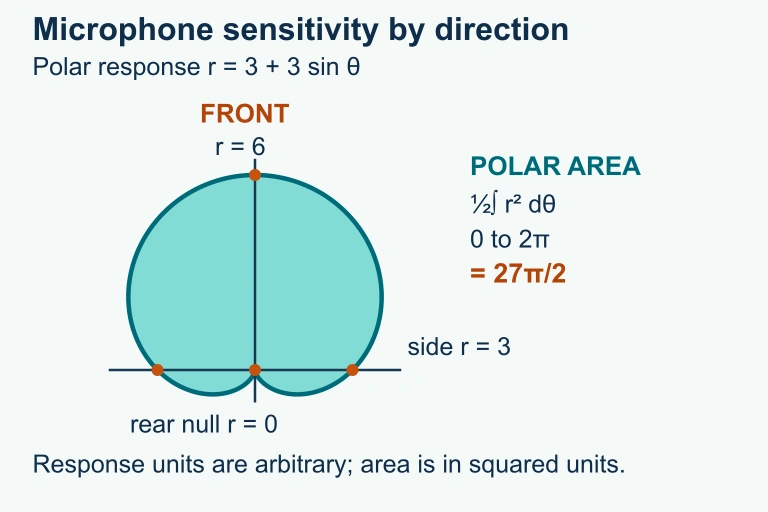
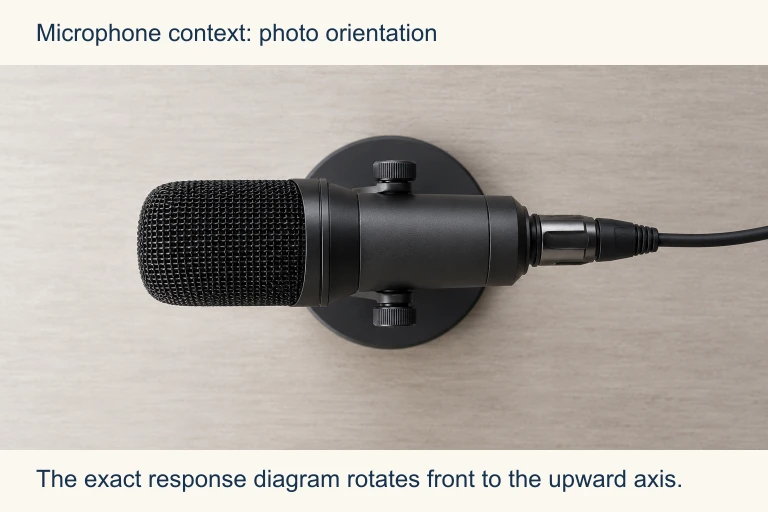
A microphone has a polar pickup pattern modeled by r = 3 + 3 sin θ, where r represents the sensitivity (in arbitrary units) in the direction θ. (a) Sketch the curve and identify it by name. (b) Set up, but do not evaluate, an integral expression for the total area enclosed by this pickup pattern. (c) Evaluate the integral from part (b) to find the total enclosed area. (d) The manufacturer claims the microphone covers an area of 45 square units. Is this claim correct? Justify your answer.
Show answer and explanation
Rubric (5 points): Point 1 (Part a): The curve r = 3 + 3 sin θ is a cardioid (since the constant equals the coefficient of sin θ). It is oriented vertically with the cusp at the origin when θ = 3π/2 (where sin θ = −1 gives r = 0). Award 1 point for correctly identifying the curve as a cardioid and providing a reasonable sketch showing symmetry about the line θ = π/2. Point 2 (Part b): The full cardioid is traced for θ ∈ [0, 2π]. The area integral is A = ½ ∫₀^(2π) [3 + 3 sin θ]² dθ = ½ ∫₀^(2π) 9(1 + sin θ)² dθ. Award 1 point for the correct integral with correct bounds and the ½ factor. Point 3 (Part c — expansion): Expand (1 + sin θ)² = 1 + 2 sin θ + sin² θ = 1 + 2 sin θ + (1 − cos 2θ)/2 = 3/2 + 2 sin θ − ½ cos 2θ. Award 1 point for correct algebraic expansion and use of the power-reduction identity. Point 4 (Part c — evaluation): ∫₀^(2π) [3/2 + 2 sin θ − ½ cos 2θ] dθ = 3π + 0 + 0 = 3π. Therefore A = (9/2)(3π) = 27π/2. Award 1 point for correct antidifferentiation and final answer. Point 5 (Part d): 27π/2 ≈ 42.41 square units, which is less than 45. The manufacturer's claim is incorrect. Award 1 point for a correct numerical comparison with a clear justification statement.
Question 1 of 5
What is the area enclosed by the circle \( r = 4 \)?
Question 2 of 5
Which integral gives the area of one petal of \( r = \sin 2\theta \)?
Question 3 of 5
The area enclosed by the cardioid \( r = 2(1 + \sin\theta) \) is:
Question 4 of 5
How many petals does \( r = \cos 3\theta \) have, and what is the total area?
Question 5 of 5
In the polar area formula \( A = \frac{1}{2}\int_\alpha^\beta [r(\theta)]^2\,d\theta \), the factor \( \frac{1}{2} \) comes from: