Area Bounded by
Two Polar Curves
Learn how to compute the area between two polar curves using definite integrals, a key skill for the AP Calculus BC exam.
What Are Polar Curves?
In polar coordinates, every point in the plane is described by a distance \( r \) from the origin and an angle \( \theta \) measured from the positive \( x \)-axis. A polar curve is defined by a function \( r = f(\theta) \).
Area Under a Single Polar Curve
Before tackling two curves, recall how to find the area enclosed by one polar curve \( r = f(\theta) \) between angles \( \alpha \) and \( \beta \):
Visualizing the Region Between Two Curves
The Core Formula
If \( f(\theta) \geq g(\theta) \geq 0 \) on the interval \( [\alpha, \beta] \), the area of the region between the two curves is:
Why Does It Work?
Rectangular vs. Polar Area
| Rectangular | Polar | |
|---|---|---|
| Element of area | \( [f(x) - g(x)]\,dx \) | \( \tfrac{1}{2}[f(\theta)^2 - g(\theta)^2]\,d\theta \) |
| Shape of slice | Thin rectangle | Thin circular sector |
| Integration variable | \( x \) (horizontal) | \( \theta \) (angle) |
| Squaring? | Not squared | \( r \) is squared |
| Factor | None | \( \frac{1}{2} \) |
Step-by-Step Approach
Example 1: Two Circles
Find the area of the region inside \( r = 4\cos\theta \) and outside \( r = 2 \).
Example 1: Solution
Outer: \( f(\theta) = 4\cos\theta \). Inner: \( g(\theta) = 2 \). Limits: \( \alpha = -\frac{\pi}{3} \), \( \beta = \frac{\pi}{3} \).
Example 2: Cardioid and Circle
Find the area inside \( r = 1 + \cos\theta \) and outside \( r = 1 \).
Example 2: Solution
Outer: \( f(\theta) = 1 + \cos\theta \). Inner: \( g(\theta) = 1 \). Limits: \( -\frac{\pi}{2} \) to \( \frac{\pi}{2} \).
Example 3: Rose and Circle
Find the area inside \( r = \sin 2\theta \) and outside \( r = \frac{1}{\sqrt{2}} \) in the first quadrant.
Using Symmetry to Simplify
Many polar regions have symmetry about the polar axis (\( \theta = 0 \)) or the line \( \theta = \frac{\pi}{2} \). When this happens, you can integrate over half the region and multiply by 2.
Common Mistakes to Avoid
Formula Summary
| Scenario | Formula |
|---|---|
| Single polar curve | \( \frac{1}{2}\int_\alpha^\beta [f(\theta)]^2\,d\theta \) |
| Between two curves | \( \frac{1}{2}\int_\alpha^\beta \bigl[f(\theta)^2 - g(\theta)^2\bigr]\,d\theta \) |
| With symmetry | \( 2 \cdot \frac{1}{2}\int_0^\beta \bigl[f(\theta)^2 - g(\theta)^2\bigr]\,d\theta \) |
| Full enclosed region | May require splitting: sum integrals on subintervals |
Worked practice: Practice Problems, Problem 4 — applied
Work through this original lesson problem, then reveal the solution and illustrations.
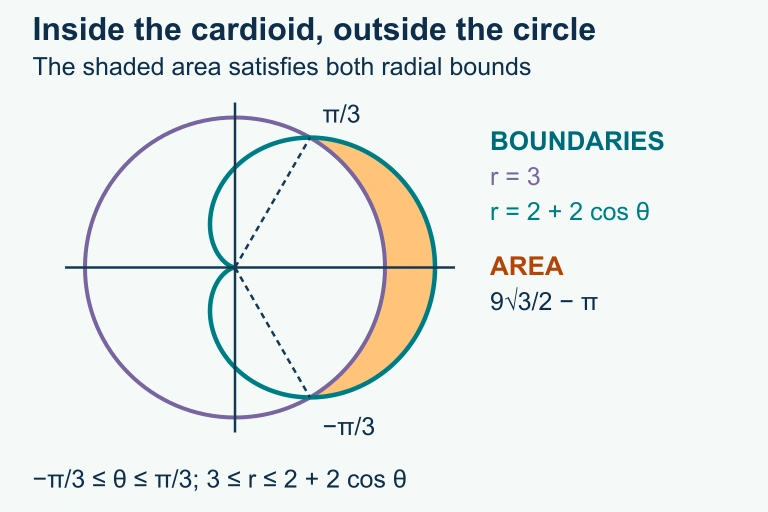
A satellite's radar sweeps a region bounded by the cardioid r = 2 + 2 cos θ and the circle r = 3. (a) Find all angles θ in [0, 2π] where the two curves intersect. (b) Determine which curve is farther from the origin for θ ∈ (0, θ₁), where θ₁ is the smaller intersection angle. (c) Set up, but do not evaluate, an integral expression for the total area of the region inside the cardioid and outside the circle. (d) Now evaluate the integral from part (c) to find the exact area.
Show answer and explanation
Rubric (5 points): Point 1 (Intersection points): Set 2 + 2 cos θ = 3, so cos θ = ½, giving θ = π/3 and θ = 5π/3 (equivalently θ = −π/3). Award 1 point for both correct angles. Point 2 (Identifying outer/inner): Test θ = 0: cardioid gives r = 4, circle gives r = 3. Since 4 > 3, the cardioid is outer on (−π/3, π/3). Award 1 point. Point 3 (Integral setup): By symmetry about the polar axis, A = 2 × ½ ∫ from 0 to π/3 [(2 + 2 cos θ)² − 9] dθ = ∫ from 0 to π/3 [(2 + 2 cos θ)² − 9] dθ. Award 1 point for a correct integral with correct limits and the factor of 2 from symmetry. Point 4 (Expansion and simplification): (2 + 2 cos θ)² = 4 + 8 cos θ + 4 cos²θ. Subtracting 9: −5 + 8 cos θ + 4 cos²θ. Using cos²θ = (1 + cos 2θ)/2: −5 + 8 cos θ + 2 + 2 cos 2θ = −3 + 8 cos θ + 2 cos 2θ. Award 1 point for correct simplification. Point 5 (Evaluation): ∫ from 0 to π/3 (−3 + 8 cos θ + 2 cos 2θ) dθ = [−3θ + 8 sin θ + sin 2θ] from 0 to π/3 = (−π + 8(√3/2) + √3/2) − 0 = −π + 4√3 + √3/2 = −π + 9√3/2. So A = −π + 9√3/2 = (9√3 − 2π)/2. Award 1 point for the correct final answer.
Question 1 of 5
Which integral represents the area between \( r = f(\theta) \) (outer) and \( r = g(\theta) \) (inner) from \( \alpha \) to \( \beta \)?
Question 2 of 5
To find the area inside \( r = 3 \) and outside \( r = 2 + \cos\theta \), the first step is to find the limits of integration. What equation do you solve?
Question 3 of 5
What is the area inside \( r = 2 \) and outside \( r = 2(1 - \cos\theta) \) for \( 0 \leq \theta \leq \frac{\pi}{2} \)?
Question 4 of 5
A student writes the area between two polar curves as \( \frac{1}{2}\int_\alpha^\beta\bigl[f(\theta) - g(\theta)\bigr]^2\,d\theta \). What is wrong with this setup?
Question 5 of 5
The curves \( r = 4\sin\theta \) and \( r = 2 \) intersect at \( \theta = \frac{\pi}{6} \) and \( \theta = \frac{5\pi}{6} \). On \( \bigl[\frac{\pi}{6}, \frac{5\pi}{6}\bigr] \), which is the outer curve?