01 / 20

Area Between Curves
Functions of \( y \)

Learn how to compute the area between two curves by integrating with respect to \( y \), a powerful technique when curves are easier to express as functions of \( y \).

AP Calculus BC

Why Integrate with Respect to \( y \)?

Sometimes the region between two curves is bounded by functions that are naturally expressed as \( x = f(y) \) rather than \( y = f(x) \). In these cases, horizontal slicing (integrating in \( y \)) gives a single, clean integral instead of splitting into multiple integrals.

Horizontal Slicing Visualized

x y
\( x = g(y) \)
\( x = f(y) \)
\( dy \)
\( g(y) - f(y) \)

When to Use Functions of \( y \)

✓ Use \( dy \) when:
Curves are given as \( x = f(y) \), or solving for \( x \) in terms of \( y \) is simpler. One integral replaces two or more \( dx \) integrals.
✕ Stick with \( dx \) when:
Curves are naturally \( y = f(x) \) and the "top" and "bottom" functions don't swap over the interval.

The Core Formula

1
\( x_{\text{right}}(y) \): the curve farther to the right (larger \( x \) values)
2
\( x_{\text{left}}(y) \): the curve farther to the left (smaller \( x \) values)
3
\( c \) and \( d \): the \( y \)-coordinates where the curves intersect (limits of integration)

Understanding the Geometry

x y
\( y = c \)
\( y = d \)
\( x = f(y) \)
\( x = g(y) \)
right - left

The integrand \( x_{\text{right}} - x_{\text{left}} \) measures the horizontal distance between the curves at each \( y \)-level. Integrating from \( y = c \) to \( y = d \) sums all those horizontal strips.

Integrating in \( x \) vs \( y \)

With respect to \( x \) With respect to \( y \)
Slicing direction Vertical rectangles Horizontal rectangles
Integrand \( y_{\text{top}} - y_{\text{bot}} \) \( x_{\text{right}} - x_{\text{left}} \)
Limits \( x \)-values of intersection \( y \)-values of intersection
Best when Top/bottom are single functions Left/right are single functions
Risk May need to split integrals May need to split integrals

Step-by-Step Approach

1
Sketch the region. Plot both curves and shade the enclosed area.
2
Express curves as \( x = f(y) \). Solve each equation for \( x \) in terms of \( y \).
3
Find intersection \( y \)-values. Set \( f(y) = g(y) \) and solve for \( y = c \) and \( y = d \).
4
Identify right vs. left. For \( c \leq y \leq d \), determine which curve gives larger \( x \).
5
Set up and evaluate: \( A = \displaystyle\int_{c}^{d} [x_{\text{right}}(y) - x_{\text{left}}(y)]\, dy \)

Example 1: Setup

Find the area enclosed by \( x = y^2 \) and \( x = y + 2 \).

x y (1, -1) (4, 2)
\( x = y^2 \)
\( x = y + 2 \)

Example 1: Solution

For \( -1 \leq y \leq 2 \), the line \( x = y + 2 \) lies to the right and the parabola \( x = y^2 \) lies to the left:

1
Expand: \( \displaystyle\int_{-1}^{2} (y + 2 - y^2)\, dy \)
2
Antiderivative: \( \dfrac{y^2}{2} + 2y - \dfrac{y^3}{3} \)
3
Evaluate at bounds: At \( y=2 \): \( 2 + 4 - \tfrac{8}{3} = \tfrac{10}{3} \). At \( y=-1 \): \( \tfrac{1}{2} - 2 + \tfrac{1}{3} = -\tfrac{7}{6} \).
4
Subtract: \( \tfrac{10}{3} - \bigl(-\tfrac{7}{6}\bigr) = \tfrac{20}{6} + \tfrac{7}{6} = \dfrac{27}{6} = \dfrac{9}{2} \)

Example 2: Why \( dy \) is Better

Find the area between \( x = y^2 - 1 \) and \( x = 3 - y^2 \).

x y
\( (1, \sqrt{2}) \)
\( (1, -\sqrt{2}) \)
\( x = y^2 - 1 \)
\( x = 3 - y^2 \)

Example 2: Solution

Intersections: set \( y^2 - 1 = 3 - y^2 \), so \( 2y^2 = 4 \), giving \( y = \pm\sqrt{2} \).

1
Use symmetry: the integrand is even, so \( A = 2\displaystyle\int_{0}^{\sqrt{2}} (4 - 2y^2)\, dy \).
2
Antiderivative: \( 4y - \dfrac{2y^3}{3} \). At \( y = \sqrt{2} \): \( 4\sqrt{2} - \dfrac{4\sqrt{2}}{3} = \dfrac{8\sqrt{2}}{3} \).
3
Multiply: \( A = 2 \cdot \dfrac{8\sqrt{2}}{3} = \dfrac{16\sqrt{2}}{3} \).

Example 3: Cubic Curves

Find the area between \( x = y^3 \) and \( x = y \) for \( 0 \leq y \leq 1 \).

Common Mistakes

✕ Wrong Subtraction Order
Subtracting left minus right instead of right minus left, producing a negative area.
✕ Using \( x \)-Limits
Using the \( x \)-coordinates of intersection as limits instead of the \( y \)-coordinates.
✕ Not Checking Which is Right
Assuming one curve is always to the right without testing a point. The roles can swap at intersection points.

Quick Reference Summary

Step What to Do Watch Out For
1. Sketch Graph both curves Identify enclosed region
2. Rewrite Express as \( x = f(y) \) May need \( \pm\sqrt{\,} \)
3. Intersections Solve \( f(y) = g(y) \) Use \( y \)-values as limits
4. Order Right minus left Test a sample \( y \)
5. Integrate Evaluate \( \int_c^d [\cdots]\, dy \) Exploit symmetry if possible

Worked practice: Practice Problems, Problem 4 — applied

Work through this original lesson problem, then reveal the solution and illustrations.

A landscape architect is designing a decorative pond whose horizontal plan is bounded on the left by the curve x = y² − 1 and on the right by the curve x = 3 − y². (a) Find the y-coordinates of the points where the two curves intersect. (b) Set up, but do not evaluate, a dy-integral for the area of the plan. (c) Evaluate the integral from part (b). (d) The architect wants the pond to be 2 meters deep vertically, perpendicular to the xy plan. If the plan area you found is in square meters, determine the ratio of the maximum width to the depth. (e) Explain why dy-integration requires only one integral for this region, whereas dx-integration would require two.

Show answer and explanation

Rubric (5 points): (a) [1 point] Set y² − 1 = 3 − y², yielding 2y² = 4, so y² = 2, thus y = −√2 and y = √2. Award 1 point for both correct y-values. (b) [1 point] A = ∫ from −√2 to √2 [(3 − y²) − (y² − 1)] dy = ∫ from −√2 to √2 (4 − 2y²) dy. Award 1 point for the correct integrand and correct limits. (c) [1 point] The antiderivative is 4y − (2y³)/3. Evaluating: F(√2) = 4√2 − (2(2√2))/3 = 4√2 − 4√2/3 = 8√2/3. By symmetry (even integrand), A = 2 × 8√2/3 = 16√2/3 ≈ 7.54 square meters. Alternatively, F(√2) − F(−√2) = 8√2/3 − (−8√2/3) = 16√2/3. Award 1 point for the correct numerical answer. (d) [1 point] The maximum width occurs at y = 0: x_right − x_left = 3 − (−1) = 4 meters. The independently specified vertical depth is 2 meters, perpendicular to the plan, so the ratio of maximum width to depth is 4/2 = 2. Award 1 point for the correct ratio. (e) [1 point] In the dy-direction, the right curve (x = 3 − y²) and left curve (x = y² − 1) do not switch roles over the interval, so a single integral suffices. In the dx-direction, the region spans from x = −1 to x = 3, but for −1 ≤ x ≤ 1 both upper and lower boundaries come from x = y² − 1, while for 1 ≤ x ≤ 3 both come from x = 3 − y². The first pair is y = ±√(x + 1), and the second pair is y = ±√(3 − x). This boundary change forces a split into two separate integrals. Award 1 point for a clear, correct explanation.
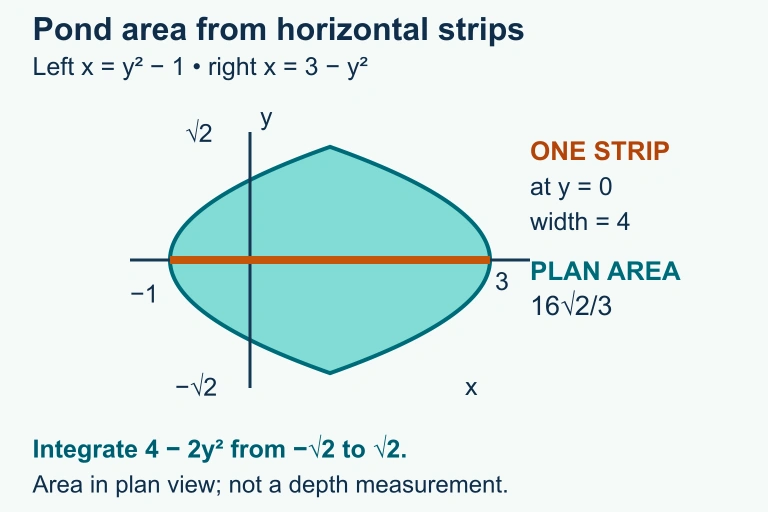
Plan region between x=y²−1 and x=3−y² for −√2≤y≤√2. Maximum horizontal width is 4 and area is 16√2/3.
Horizontal strips span the lens-shaped pond plan without changing formulas; their sum gives plan area rather than water depth. The coordinate diagram is a separate idealized plan; the landscape illustration supplies context.

Question 1 of 5

What is the area between \( x = y^2 \) and \( x = y + 2 \)?

Question 2 of 5

When integrating with respect to \( y \), the integrand represents:

Question 3 of 5

The curves \( x = 4 - y^2 \) and \( x = y^2 - 4 \) intersect at which \( y \)-values?

Question 4 of 5

To find the area between \( x = y \) and \( x = y^3 \) for \( 0 \leq y \leq 1 \), which integral is correct?

Question 5 of 5

What is the area between \( x = 4 - y^2 \) and \( x = y^2 - 4 \)?