Area Between Curves
Functions of \( x \)
Master the technique of computing enclosed areas between two curves using definite integrals of functions of \( x \).
What Does "Area Between Curves" Mean?
When two continuous functions \( f(x) \) and \( g(x) \) are defined on the same interval, they may enclose a bounded region. The "area between curves" is the total positive area of that region, regardless of whether the curves are above or below the \( x \)-axis.
Signed Area vs. Actual Area
A definite integral \( \int_a^b f(x)\,dx \) gives signed area: regions below the \( x \)-axis count as negative. But the area between two curves is always non-negative. We achieve this by always subtracting the lower curve from the upper curve.
Why Does This Matter?
Computing the area between curves is one of the most fundamental applications of integration. It appears throughout physics, economics, and engineering, and is a core skill on the AP Calculus exam.
The Core Formula
Think of it as summing infinitely many thin rectangular strips of height \( f(x) - g(x) \) and width \( dx \).
When Curves Cross
If the curves switch which is on top, you must split the integral at each intersection point. On each sub-interval, identify which function is greater and integrate accordingly.
The General Formula
In practice, you don't integrate the absolute value directly. Instead, you find all intersection points, then on each sub-interval you determine which function is larger and write the integrand as (upper) - (lower).
Area Under a Curve vs. Area Between Curves
| Area Under a Curve | Area Between Curves | |
|---|---|---|
| Formula | \( \int_a^b f(x)\,dx \) | \( \int_a^b [f(x)-g(x)]\,dx \) |
| Reference | The \( x \)-axis (\( g(x)=0 \)) | Another function \( g(x) \) |
| Sign | Can be negative (signed area) | Always non-negative (use \( |f-g| \)) |
| Special case | When \( g(x) = 0 \) | General: any two functions |
How to Apply the Formula
Example 1: Parabola and Line
Find the area enclosed between \( f(x) = x^2 \) and \( g(x) = x + 2 \).
Example 1: Solution
Example 2: Crossing Curves
Find the area between \( f(x) = x^3 \) and \( g(x) = x \) on \([-1, 1]\).
Example 2: Solution
The curves cross at \( x = -1, 0, 1 \). We must split the integral:
Example 3: Two Parabolas
Find the area enclosed between \( f(x) = 2x - x^2 \) and \( g(x) = x^2 - 4x + 4 \).
Common Mistakes to Avoid
Summary Cheat Sheet
| Scenario | Setup | Key Action |
|---|---|---|
| \( f \geq g \) everywhere | \( \int_a^b [f-g]\,dx \) | Single integral |
| Curves cross once at \( c \) | Split at \( x = c \) | Two integrals |
| Curves cross multiple times | Split at each crossing | Sum all pieces |
| Bounds not given | Solve \( f = g \) | Find intersections first |
Worked practice: Practice Problems, Problem 4 — applied
Work through this original lesson problem, then reveal the solution and illustrations.
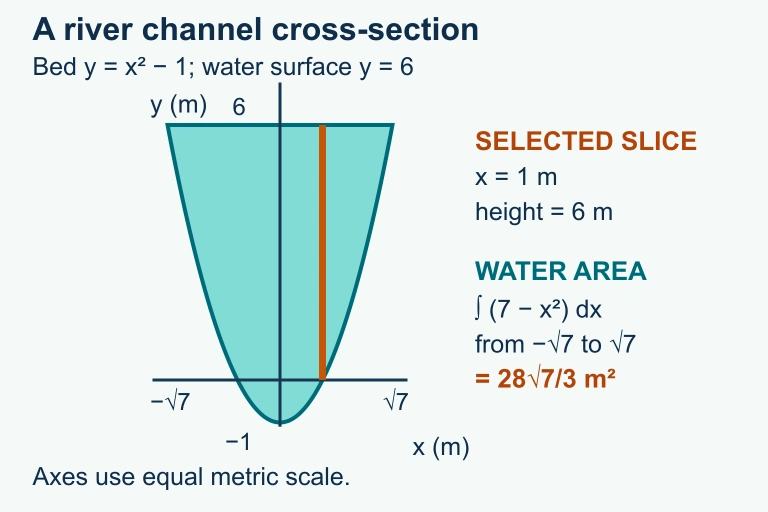
A civil engineer models the cross-section of a river channel. The river surface is at height y = 6 and the riverbed follows y = x² − 1 for −√7 ≤ x ≤ √7 (all measurements in meters). Set up and evaluate a definite integral to find the cross-sectional area of the water in the channel. Show all work, including finding the limits of integration, setting up the integral, and evaluating it. Then interpret the result in context.
Show answer and explanation
Point 1 (Limits of Integration): Set x² − 1 = 6 → x² = 7 → x = ±√7. The water fills the cross-section from x = −√7 to x = √7. Point 2 (Integral Setup): The top curve is y = 6 (the water surface) and the bottom curve is y = x² − 1 (the riverbed). The cross-sectional area is A = ∫₋√₇^√7 [6 − (x² − 1)] dx = ∫₋√₇^√7 (7 − x²) dx. Point 3 (Antidifferentiation and Evaluation): By the even symmetry of the integrand, A = 2 ∫₀^√7 (7 − x²) dx = 2 [7x − x³/3] from 0 to √7 = 2 [7√7 − (√7)³/3] = 2 [7√7 − 7√7/3] = 2 · 7√7 · (1 − 1/3) = 2 · 7√7 · (2/3) = 28√7/3 ≈ 24.69 square meters. Point 4 (Interpretation): The cross-sectional area of approximately 24.69 m² represents the area of water visible in a vertical slice perpendicular to the river's flow. This value can be multiplied by the river's flow speed to estimate volumetric discharge rate (m³/s), a key quantity in hydrology and flood management.
Question 1 of 5
What is the area between \( f(x) = x^2 \) and \( g(x) = x \) on \([0, 1]\)?
Question 2 of 5
To find the area between two curves that cross within the interval, you must:
Question 3 of 5
Find the area enclosed by \( f(x) = 4 - x^2 \) and \( g(x) = 0 \) (the \( x \)-axis).
Question 4 of 5
If \( \int_1^4 [f(x) - g(x)]\,dx = -5 \), which of the following must be true on \([1, 4]\)?
Question 5 of 5
Which integral represents the area between \( y = \sin x \) and \( y = \cos x \) on \(\bigl[\frac{\pi}{4}, \frac{5\pi}{4}\bigr]\)?