Arc Lengths of Curves
Parametric Equations
Learn to compute the exact length of a curve defined by parametric equations using integration and the arc length formula.
What Are Parametric Curves?
Instead of writing \( y = f(x) \), we can describe a curve by letting both coordinates depend on a third variable called a parameter, usually \( t \):
This representation is powerful because it can describe curves that loop back, self-intersect, or trace paths that fail the vertical line test.
Why Measure Arc Length?
The Infinitesimal Approach
Deriving the Arc Length Formula
The Core Formula
The green arc between \( t = a \) and \( t = b \) has length \( L \).
When Does the Formula Apply?
Parametric vs. Rectangular Arc Length
| Parametric | Rectangular \( y = f(x) \) | |
|---|---|---|
| Formula | \( \displaystyle\int_a^b \sqrt{\left(\frac{dx}{dt}\right)^2 + \left(\frac{dy}{dt}\right)^2}\, dt \) | \( \displaystyle\int_a^b \sqrt{1 + \left(\frac{dy}{dx}\right)^2}\, dx \) |
| Variable | Integrate with respect to \( t \) | Integrate with respect to \( x \) |
| Handles loops? | Yes | No (fails vertical line test) |
| Connection | Set \( x = t \), \( y = f(t) \): then \( dx/dt = 1 \) recovers the rectangular formula | |
How to Apply the Formula
Example 1: Line Segment
Find the arc length of \( x = 1 + 3t \), \( y = 2 + 4t \) for \( 0 \leq t \leq 1 \).
Example 2: Circle of Radius \( r \)
Verify the circumference formula using \( x = r\cos t \), \( y = r\sin t \) for \( 0 \leq t \leq 2\pi \).
Example 3: Cycloid
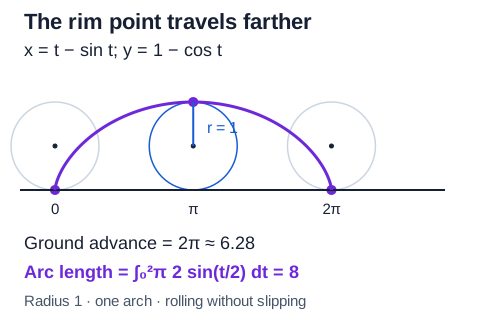
Find the arc length of one arch of the cycloid: \( x = t - \sin t \), \( y = 1 - \cos t \), for \( 0 \leq t \leq 2\pi \).
Key Identity: Half-Angle Trick
In the cycloid example, simplifying the integrand required a crucial identity. Here is the chain of reasoning:
A rolling wheel traces a cycloid

A radius-one wheel rolling without slipping traces x = t − sin t and y = 1 − cos t. Over 0 ≤ t ≤ 2π, the wheel advances 2π units while its rim point travels an arch of length 8.A rolling wheel traces a cycloid
Example 4: Astroid
Find the total arc length of the astroid: \( x = \cos^3 t \), \( y = \sin^3 t \), for \( 0 \leq t \leq 2\pi \).
Common Mistakes to Avoid
Summary of Arc Length Formulas
| Curve Type | Formula | Variable |
|---|---|---|
| Parametric | \( \displaystyle\int_a^b \sqrt{\left(\frac{dx}{dt}\right)^2 + \left(\frac{dy}{dt}\right)^2}\, dt \) | \( t \) |
| Rectangular | \( \displaystyle\int_a^b \sqrt{1 + \left(\frac{dy}{dx}\right)^2}\, dx \) | \( x \) |
| Polar | \( \displaystyle\int_\alpha^\beta \sqrt{r^2 + \left(\frac{dr}{d\theta}\right)^2}\, d\theta \) | \( \theta \) |
Worked practice: Practice Problems, Problem 4 — applied
Work through this original lesson problem, then reveal the solution and illustrations.
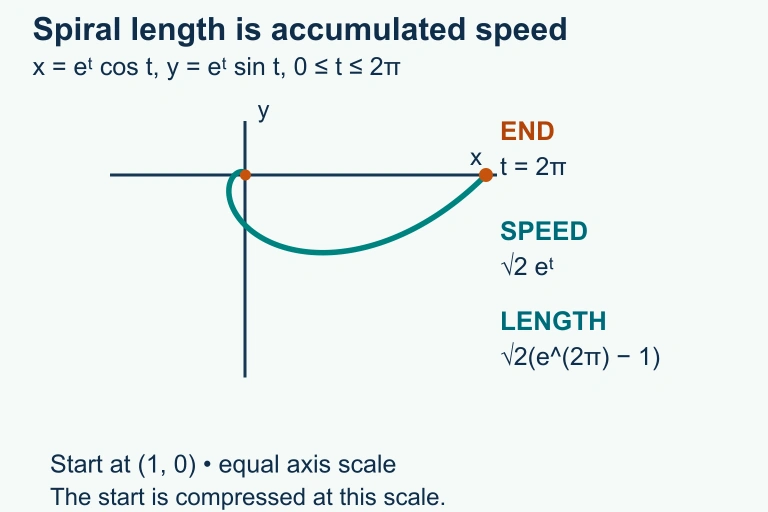
A particle moves along a path defined by x(t) = e^t cos t and y(t) = e^t sin t for 0 ≤ t ≤ 2π. (a) Show that (dx/dt)² + (dy/dt)² = 2e^(2t). (b) Set up the integral for the arc length of the path. (c) Evaluate the integral exactly. (d) Interpret the result in terms of the spiral's geometry.
Show answer and explanation
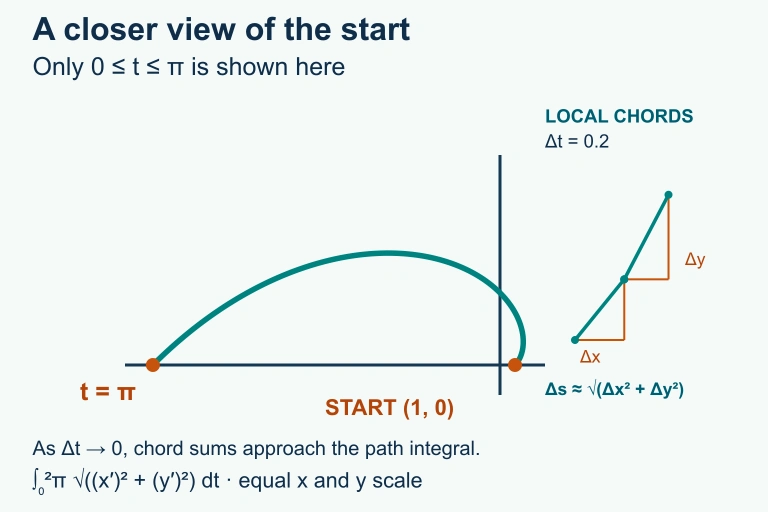
Point 1 (Derivatives): dx/dt = e^t cos t − e^t sin t = e^t(cos t − sin t). dy/dt = e^t sin t + e^t cos t = e^t(sin t + cos t). Point 2 (Simplification): (dx/dt)² = e^(2t)(cos t − sin t)² = e^(2t)(cos²t − 2sin t cos t + sin²t) = e^(2t)(1 − sin 2t). (dy/dt)² = e^(2t)(sin t + cos t)² = e^(2t)(1 + sin 2t). Sum: e^(2t)(1 − sin 2t + 1 + sin 2t) = 2e^(2t). ✓ Point 3 (Integral setup): L = ∫₀²π √(2e^(2t)) dt = ∫₀²π √2 · e^t dt. Point 4 (Evaluation): L = √2 · [e^t]₀²π = √2(e^(2π) − 1). Point 5 (Interpretation): The curve is a logarithmic (equiangular) spiral. The speed e^t√2 increases exponentially, so the spiral winds outward with each revolution covering dramatically more distance than the previous one. The factor e^(2π) ≈ 535.5 reflects this exponential growth over one full revolution.
Question 1 of 5
What is the arc length of the curve \( x = 5\cos t \), \( y = 5\sin t \) for \( 0 \leq t \leq \pi \)?
Question 2 of 5
For \( x = t^2 \), \( y = t^3 \), what expression goes under the radical in the arc length integral?
Question 3 of 5
The arc length of one arch of the cycloid \( x = t - \sin t \), \( y = 1 - \cos t \) from \( t = 0 \) to \( t = 2\pi \) is:
Question 4 of 5
Which condition is not required for the parametric arc length formula to apply on \( [a, b] \)?
Question 5 of 5
For \( x = e^t \cos t \), \( y = e^t \sin t \) on \( [0, \pi] \), which simplification is correct after computing \( \left(\frac{dx}{dt}\right)^2 + \left(\frac{dy}{dt}\right)^2 \)?