Accumulation Functions
Applied Contexts
Master how definite integrals model real-world accumulation: from net change and displacement to total quantities built from rates of change.
What Is an Accumulation Function?
An accumulation function captures the total quantity that builds up as we integrate a rate function from a fixed starting point \(a\) to a variable endpoint \(x\):
The variable upper limit \(x\) makes \(F\) a function, not just a number. As \(x\) moves, the accumulated area changes continuously.
Follow the salt through a working mixing rig
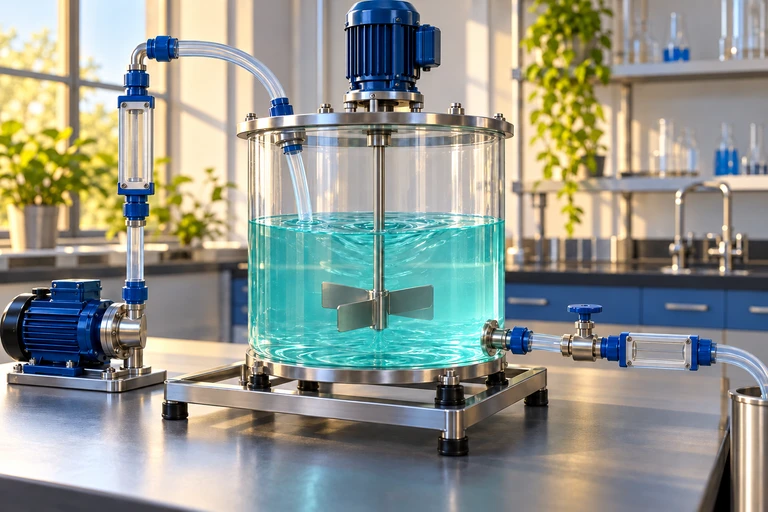
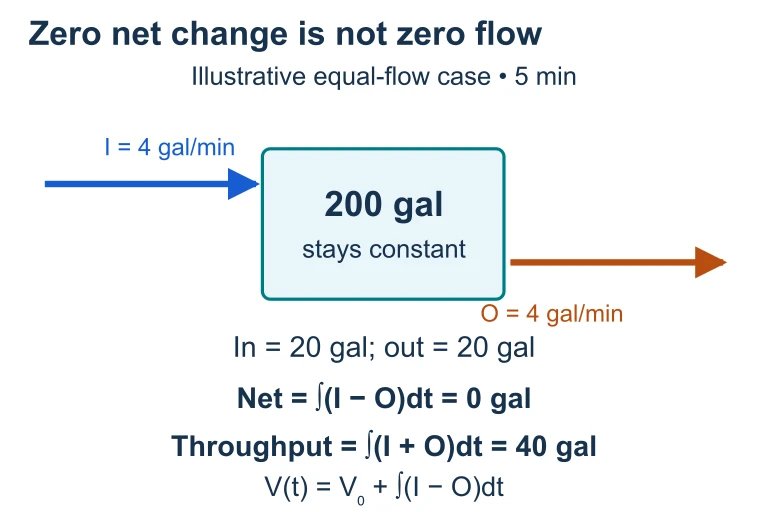
Suppose a tank receives and releases 4 gal/min for 5 minutes. Its 200 gal inventory stays constant while 20 gal enters and 20 gal leaves: net change is zero and total throughput is 40 gal.Net inventory versus throughput
Suppose a tank receives and releases 4 gal/min for 5 minutes. Its 200 gal inventory stays constant while 20 gal enters and 20 gal leaves: net change is zero and total throughput is 40 gal.Visualizing Signed Area
Why Accumulation Matters in the Real World
Every time you integrate a rate over an interval, you're computing an accumulation: the total net change in the underlying quantity.
FTC Part 1: The Derivative of an Accumulation
In words: differentiating an accumulation function gives back the original rate function. The integral and derivative are inverse operations.
FTC Part 2: The Net Change Theorem
Net Change vs. Total Change
| Net Change | Total Accumulated | |
|---|---|---|
| Formula | \(\int_a^b f(t)\,dt\) | \(\int_a^b |f(t)|\,dt\) |
| Signed? | Yes: cancellation occurs | No: always positive |
| Motion example | Displacement | Total distance traveled |
| When equal? | Only when \(f(t) \geq 0\) on entire \([a,b]\) | |
Connecting Rate and Quantity
The Net Change Theorem lets us write the quantity at any time \(t\) using its initial value plus accumulated change:
How to Apply Accumulation in Context
Example 1: Water Tank
Water flows into a tank at a rate of \(r(t) = 6t - t^2\) liters per minute for \(0 \leq t \leq 6\). The tank initially contains 10 liters. How much water is in the tank at \(t = 6\)?
Example 1: Graph of the Rate
Example 2: Velocity and Displacement
A particle moves along a line with velocity \(v(t) = t^2 - 4t + 3\) m/s for \(0 \leq t \leq 4\). Find the net displacement and the total distance traveled.
Example 3: Table-Based Approximation
A factory produces waste at rate \(w(t)\) kg/hr. Use the data below and a trapezoidal sum with 4 subintervals to approximate \(\int_0^8 w(t)\,dt\).
| \(t\) (hr) | 0 | 2 | 4 | 6 | 8 |
|---|---|---|---|---|---|
| \(w(t)\) | 3 | 5 | 8 | 6 | 4 |
Common Mistakes to Avoid
Summary of Key Formulas
| Concept | Formula | Meaning |
|---|---|---|
| Accumulation Function | \(F(x) = \int_a^x f(t)\,dt\) | Running total of signed area |
| FTC Part 1 | \(\frac{d}{dx}\int_a^x f(t)\,dt = f(x)\) | Derivative undoes integral |
| Net Change | \(F(b) - F(a) = \int_a^b f(t)\,dt\) | Total signed change on \([a,b]\) |
| Quantity at \(b\) | \(Q(b) = Q(a) + \int_a^b Q'(t)\,dt\) | Initial + accumulated change |
| Total Accumulation | \(\int_a^b |f(t)|\,dt\) | Unsigned total (e.g., distance) |
Worked practice: Practice Problems, Problem 4 — applied
Work through this original lesson problem, then reveal the solution and illustrations.
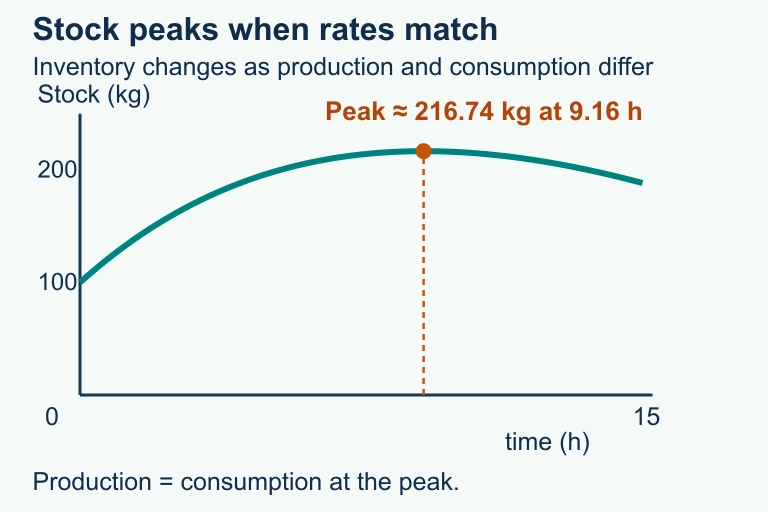
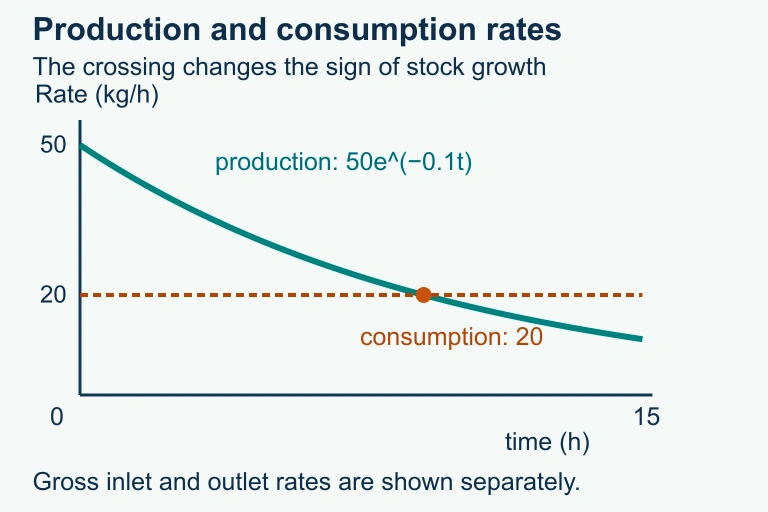
A factory produces a chemical at a rate of P(t) = 50e^(−0.1t) kilograms per hour, where t is measured in hours. Simultaneously, the chemical is consumed at a constant rate of 20 kilograms per hour. At t = 0, the factory has 100 kilograms of the chemical in storage. (a) Write, but do not evaluate, an integral expression for the net amount of chemical in storage at time t = T. (b) Evaluate the expression from part (a) for T = 10 to find the amount of chemical in storage at t = 10. Round to the nearest kilogram. (c) Find the time t at which the amount of chemical in storage is at a maximum. Justify your answer. (d) As t → ∞, will the storage eventually be depleted? Use a limit argument to justify.
Show answer and explanation
Point-by-point rubric: (a) [1 point] The net rate of change of storage is P(t) − 20 = 50e^(−0.1t) − 20. The accumulation equation is S(T) = 100 + ∫₀ᵀ (50e^(−0.1t) − 20) dt. Award 1 point for correct integrand with initial condition. (b) [1 point] ∫₀¹⁰ (50e^(−0.1t) − 20) dt = [−500e^(−0.1t) − 20t]₀¹⁰ = (−500e⁻¹ − 200) − (−500 − 0) = −500/e − 200 + 500 = 300 − 500/e ≈ 300 − 183.94 = 116.06. So S(10) = 100 + 116.06 ≈ 216 kilograms. Award 1 point for correct evaluation and rounding. (c) [2 points] S′(t) = 50e^(−0.1t) − 20. Set S′(t) = 0: 50e^(−0.1t) = 20, so e^(−0.1t) = 2/5, giving −0.1t = ln(2/5), hence t = −10 ln(2/5) = 10 ln(5/2) ≈ 9.163 hours. For t < 10 ln(5/2), S′(t) > 0 (production exceeds consumption); for t > 10 ln(5/2), S′(t) < 0 (consumption exceeds production). Since S′ changes from positive to negative, S has an absolute maximum at t = 10 ln(5/2). Award 1 point for finding the critical time, 1 point for the sign-change justification. (d) [1 point] As T → ∞, ∫₀^∞ (50e^(−0.1t) − 20) dt = [−500e^(−0.1t) − 20t]₀^∞ = (0 − ∞) − (−500) → −∞. Therefore S(T) = 100 + (−∞) → −∞. Since S is eventually strictly decreasing and unbounded below, the storage will eventually be depleted (S reaches 0 at some finite time). Award 1 point for recognizing that the integral diverges to −∞ and concluding depletion occurs.
Question 1 of 5
Water flows into a tank at \(r(t) = 4t\) liters/min. If the tank starts with 20 liters, how many liters are in the tank at \(t = 3\) minutes?
Question 2 of 5
If \(\displaystyle F(x) = \int_2^x (3t^2 + 1)\,dt\), what is \(F'(5)\)?
Question 3 of 5
A particle has velocity \(v(t) = t - 2\) on \([0, 4]\). What is the total distance traveled?
Question 4 of 5
If \(\displaystyle G(x) = \int_1^{x^2} \sin(t)\,dt\), what is \(G'(x)\)?
Question 5 of 5
A population grows at rate \(P'(t) = 100e^{0.02t}\) people/year. If \(P(0) = 5000\), which expression gives the population at \(t = 10\)?