
SECTION 1
Historical Context & Motivation
Long before calculus formalized the idea of integration, ancient mathematicians grappled with the problem of computing volumes of irregular solids. The Greek geometer Archimedes pioneered the method of exhaustion, slicing solids into thin layers whose areas could be estimated, then summing these areas to approximate total volume. This intuitive strategy — slice, measure the cross section, accumulate — is precisely what the modern integral formalizes.
~250 BC • Archimedes' Method of Exhaustion
1635 • Cavalieri's Principle
1666–1687 • Newton & Leibniz Formalize Calculus
Modern Era • AP Curriculum & Engineering Applications
The central question this lesson addresses is: given a region in the plane and a rule prescribing the shape (triangle, semicircle, etc.) of every perpendicular cross section, how do we set up and evaluate the integral that yields the solid's exact volume? Mastering this technique equips you to handle AP free-response problems that specify non-circular cross sections — a classic and frequently tested scenario.
SECTION 2
Core Principles & Definitions
The volume-by-cross-sections method rests on a simple but powerful idea: if you know the area A(x) of every cross-sectional slice perpendicular to an axis, you can integrate that area function over the interval of interest to obtain the volume. The shape of each slice — square, equilateral triangle, isosceles right triangle, semicircle, or any other prescribed geometry — determines how you express A(x) in terms of the base length of the region at position x.
The Slicing Principle
Base Region Determines the Side Length
Shape Dictates the Area Formula
Orientation Matters
SECTION 3
Visual Explanation
Solid with Equilateral-Triangle Cross Sections
In the diagram above, observe that each equilateral triangle sits with one side embedded in the base region. As x moves from a to b, the side length s(x) changes according to the gap between the two bounding curves. The integral ∫ₐᵇ A(x) dx sums the continuously varying triangular areas into the total volume of this non-trivial solid.
SECTION 4
Mathematical Framework
General Slicing Formula
VOLUME BY CROSS SECTIONS
A(x) = area of the cross section at position x; [a, b] = interval over which the base region extends along the slicing axis.
The key step is expressing A(x) in terms of the side length s(x) = f(x) − g(x) (or the appropriate distance across the base at position x). Each cross-sectional shape has its own area formula in terms of s.
Equilateral Triangle Cross Sections
EQUILATERAL TRIANGLE
s(x) is the side length of the equilateral triangle. Height of the triangle = (√3/2)s, so area = (1/2)(s)(√3 s/2) = (√3/4)s².
Isosceles Right Triangle Cross Sections
ISOSCELES RIGHT TRIANGLE (LEG = s)
When the leg of the isosceles right triangle equals the base span s(x). Area = (1/2)(leg)(leg) = s²/2.
ISOSCELES RIGHT TRIANGLE (HYPOTENUSE = s)
When the hypotenuse equals s(x), each leg = s/√2, so area = (1/2)(s/√2)² = s²/4.
Semicircle Cross Sections
SEMICIRCLE (DIAMETER = s)
When the diameter of the semicircle equals s(x), the radius r = s/2. Area of a semicircle = (1/2)πr² = (π/8)s².
SECTION 5
Cross-Section Shape Catalog
The following table collects every cross-section area formula you may encounter on the AP exam in terms of the base span s(x). Memorizing these expressions — particularly the constant coefficients — allows you to set up volume integrals quickly under time pressure.
| Cross-Section Shape | Relationship of s(x) | A(x) |
|---|---|---|
| Square | side = s | s² |
| Equilateral triangle | side = s | (√3/4)s² |
| Isosceles right △ (leg) | leg = s | (1/2)s² |
| Isosceles right △ (hyp) | hypotenuse = s | (1/4)s² |
| Semicircle | diameter = s | (π/8)s² |
| Semicircle | radius = s | (π/2)s² |
Cross-section area formulas in terms of base span s(x)
SECTION 6
Worked Example
Let R be the region bounded by y = √x and y = x/2. Cross sections perpendicular to the x-axis are semicircles whose diameters lie in R. Find the volume of the resulting solid.
Worked example
- 1
Step 1 — Find the intersection points
Set √x = x/2. Squaring: x = x²/4, so x² − 4x = 0, giving x(x − 4) = 0. The curves intersect at x = 0 and x = 4.Limits: a = 0, b = 4 - 2
Step 2 — Determine the base span s(x)
On [0, 4], √x ≥ x/2. The diameter of each semicircle is s(x) = √x − x/2.s(x) = √x − x/2 - 3
Step 3 — Write the cross-sectional area
For a semicircle with diameter s, A(x) = (π/8)[s(x)]² = (π/8)(√x − x/2)².A(x) = (π/8)(√x − x/2)² - 4
Step 4 — Expand the integrand
(√x − x/2)² = x − 2(√x)(x/2) + x²/4 = x − + x²/4.(√x − x/2)² = x − + x²/4 - 5
Step 5 — Integrate term by term
V = (π/8) ∫₀⁴ [x − + x²/4] dx. Evaluate each term: ∫₀⁴ x dx = [x²/2]₀⁴ = 8; ∫₀⁴ dx = [/5]₀⁴ = 2(32)/5 = 64/5; ∫₀⁴ x²/4 dx = [x³/12]₀⁴ = 64/12 = 16/3.Sum = 8 − 64/5 + 16/3 = (120 − 192 + 80)/15 = 8/15 - 6
Step 6 — Multiply by the constant
V = (π/8)(8/15) = π/15.V = π/15
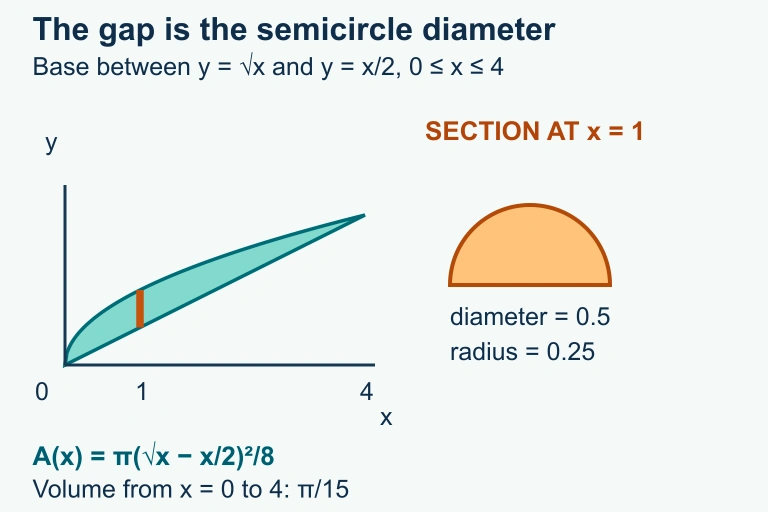 A semicircle’s diameter is the gap √x−x/2, so its radius is half that gap and the solid’s volume isπ/15.
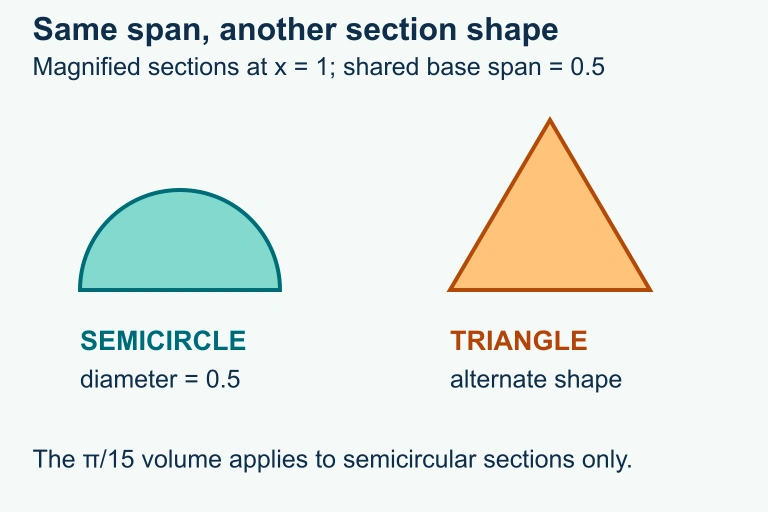 Equilateral-triangular and semicircular sections on the same diameter span 0.5. The volume π/15 applies to the semicircular-section solid.
SECTION 7
Strengths, Limitations & Comparisons
Volumes by cross sections is one of several integration-based volume techniques. Understanding when to apply each method — and how they differ — is essential for selecting the most efficient approach on exam day.
| Method | Best For | Limitation |
|---|---|---|
| Cross Sections | Solids with prescribed non-circular slice shapes (triangles, semicircles, squares) | Requires a known, simple area formula for each slice |
| Disk / Washer | Solids of revolution about an axis parallel to the integration variable | Applicable only when the solid has rotational symmetry |
| Cylindrical Shells | Revolution about an axis perpendicular to the natural integration variable | Also requires rotational symmetry; sometimes harder to visualize |
Comparison of integration-based volume methods
Key takeaway
SECTION 8
Connection to Advanced Theory
The cross-section method is a one-dimensional integral that accumulates area along a single axis. In multivariable calculus, this idea generalizes naturally: double and triple integrals let you compute volumes (and higher-dimensional analogs) by iterating the slicing process across two or three axes. Fubini's theorem guarantees that these iterated integrals yield the same result regardless of the order of integration, provided the integrand is continuous.
| Concept | Single-Variable (This Lesson) | Multivariable Extension |
|---|---|---|
| Slicing dimension | Integrate A(x) along one axis | Iterate integrals across 2 or 3 axes |
| Cross-section area | Computed from geometry (known shape) | Computed as an inner integral |
| Applications | Volumes with prescribed slices | Mass, center of mass, moments of inertia over arbitrary regions |
For AP Calculus BC students, the cross-section technique also reinforces the broader Riemann-sum philosophy: any quantity that can be expressed as a product of a rate (or density or area) and a small increment dx can be integrated to find the total. This same logic drives applications like arc length (∫ ds), work (∫ F dx), and accumulation functions — all standard BC topics.
SECTION 9
Practice Problems
Question 1: CONCEPTUAL
- A. (1/2)[f(x) − g(x)]²
- B. (π/4)[f(x) − g(x)]²
- C. (π/8)[f(x) − g(x)]²
- D. (π/2)[f(x) − g(x)]²
- E. (√3/4)[f(x) − g(x)]²
Show answer (C)
Question 2: BASIC CALCULATION
- A. ∫₋₂² (4 − x²)² dx
- B. (√3/4) ∫₋₂² (4 − x²)² dx
- C. (√3/4) ∫₀⁴ (4 − x²)² dx
- D. (π/8) ∫₋₂² (4 − x²)² dx
- E. (1/2) ∫₋₂² (4 − x²)² dx
Show answer (B)
Question 3: INTERMEDIATE
- A. π/4
- B. π/2
- C. √3π/8
- D. π/8
- E. π/16
Show answer (D)
Question 4: APPLIED
Show answer
Question 5: CRITICAL THINKING