

SECTION 1
Historical Context & Motivation
The problem of computing volumes of irregular solids has fascinated mathematicians for over two millennia. Ancient Greek geometers developed ingenious exhaustion methods to approximate volumes that eluded straightforward formula-based computation. The core insight—slicing a solid into thin, manageable pieces and summing their contributions—is precisely the idea that modern cross-sectional volume integrals formalize with the power of the definite integral. Understanding this history reveals that the technique you are about to learn is not a mere textbook exercise but the culmination of a profound intellectual journey from geometric intuition to rigorous analysis.
~250 BCE • Archimedes' Method of Exhaustion
1635 • Cavalieri's Principle
1666–1676 • Newton & Leibniz Develop Calculus
1800s • Riemann Formalization
The central question this lesson addresses is: given a region in the plane that serves as the base of a three-dimensional solid, and given that every cross section perpendicular to some axis has a known geometric shape (such as a square or rectangle), how do we compute the solid's exact volume? The answer lies in expressing the cross-sectional area as a function of position and integrating over the base.
SECTION 2
Core Principles & Definitions
The method of computing volumes by known cross sections rests on a small number of powerful ideas. Before diving into computations, it is essential to internalize these foundational principles, because every problem you encounter—regardless of the specific cross-sectional shape—reduces to the same workflow. The differences lie only in how you express the area function A(x) for the given geometry.
The Slicing Principle
Base Region Determines Side Length
Square Cross Sections
Rectangular Cross Sections
Direction of Slicing
KEY TAKEAWAY
SECTION 3
Visual Explanation: Stacking Cross Sections
Visualization is paramount when working with cross-sectional volumes. The diagram below shows a planar base region bounded by two curves, with several representative square cross sections drawn perpendicular to the x-axis. Notice how the side length of each square varies with x, shrinking as the bounding curves converge and expanding where they diverge. This variable side length is precisely the function s(x) = f(x) − g(x), and the area of each square slab is [s(x)]².
Each thin slab at position x has volume approximately equal to A(x) Δx, where A(x) = [f(x) − g(x)]² for squares. Summing all such slabs from x = a to x = b and taking the limit as Δx → 0 produces the definite integral that gives the exact volume. The key geometric insight is that the two-dimensional base region completely determines the side length function, and therefore the entire volume, once the cross-sectional shape is specified.
SECTION 4
Mathematical Framework
The general volume formula by cross sections follows directly from the definition of the definite integral as a limit of Riemann sums. Suppose a solid lies between x = a and x = b, and at each x the cross section perpendicular to the x-axis has area A(x). Partition [a, b] into n subintervals of width Δx = (b − a)/n, and in each subinterval choose a sample point xk. The volume of the k-th slab is approximately A(xk) Δx, so the total volume is approximated by the sum Σ A(xk) Δx. In the limit as n → ∞, this Riemann sum converges to the definite integral.
GENERAL VOLUME BY CROSS SECTIONS
where A(x) is the area of the cross section perpendicular to the x-axis at position x, and [a, b] is the interval over which the solid extends.
SQUARE CROSS SECTIONS
The side length of each square is s(x) = f(x) − g(x), where f(x) ≥ g(x) on [a, b]. The area of a square with side s is s², so A(x) = [f(x) − g(x)]².
RECTANGULAR CROSS SECTIONS (HEIGHT = k × BASE)
When the rectangle's height is k times its base width s(x), the area is A(x) = k · [s(x)]² = k · [f(x) − g(x)]². If the height is a fixed constant h, then A(x) = h · [f(x) − g(x)].
RECTANGULAR CROSS SECTIONS (FIXED HEIGHT h)
If every rectangular cross section has a fixed height h regardless of position, the area is simply A(x) = h · s(x). Notice this reduces to h times the area of the base region.
Choosing the Axis of Integration
SECTION 5
Detailed Breakdown: Squares vs. Rectangles
Although the general slicing framework is the same for both squares and rectangles, the distinction lies in how the cross-sectional area function A(x) is formed. With square cross sections, both dimensions of the cross section are equal to the base distance s(x), so A(x) = [s(x)]². With rectangular cross sections, one dimension is s(x) while the other is specified by the problem—commonly as a fixed constant or as a scalar multiple of s(x). The diagram below contrasts these two cases side by side for the same base region.
| Property | Square Cross Section | Rectangular Cross Section |
|---|---|---|
| Dimensions of cross section | s(x) × s(x) | s(x) × h(x), where h(x) is given |
| Area formula A(x) | [s(x)]² | s(x) · h(x) |
| Common h(x) forms | N/A (all sides equal) | h = constant, h = k · s(x), h = ½s(x) |
| Volume integral | ∫ₐᵇ [f(x) − g(x)]² dx | ∫ₐᵇ h(x) · [f(x) − g(x)] dx |
Comparison of area formulas for square and rectangular cross sections
SECTION 6
Worked Example: Square Cross Sections
Consider the region R in the xy-plane bounded by y = √x and y = 0 from x = 0 to x = 4. A solid has base R, and every cross section perpendicular to the x-axis is a square. Find the volume of the solid.
Volume with Square Cross Sections
- 1
Step 1 — Identify the base and side length
The base region is bounded above by f(x) = √x and below by g(x) = 0 on the interval [0, 4]. At each x, the vertical distance across the base is s(x) = f(x) − g(x) = √x − 0 = √x. This distance is the side length of the square cross section at position x.s(x) = √x - 2
Step 2 — Write the cross-sectional area function
Since the cross sections are squares with side length s(x), the area of each cross section is A(x) = [s(x)]² = (√x)² = x.A(x) = x - 3
Step 3 — Set up the definite integral
The solid extends from x = 0 to x = 4, so the volume is V = ∫₀⁴ A(x) dx = ∫₀⁴ x dx.V = ∫₀⁴ x dx - 4
Step 4 — Evaluate the integral
The antiderivative of x is x²/2. Evaluating from 0 to 4: V = [x²/2]₀⁴ = (4²/2) − (0²/2) = 16/2 − 0 = 8.V = 8 cubic units
Rectangular Variation
SECTION 7
Common Pitfalls & Exam Strategies
Cross-sectional volume problems are frequent on the AP Calculus BC exam, both in the multiple-choice and free-response sections. Recognizing common pitfalls and strategically avoiding them can be the difference between a correct solution and a frustrating algebraic error. The table below catalogs the most frequent mistakes and the corresponding best practices.
| Common Pitfall | Why It Happens | How to Avoid It |
|---|---|---|
| Forgetting to square the side length for squares | Students write A(x) = f(x) − g(x) instead of [f(x) − g(x)]² | Always write the area formula before integrating: A = s² |
| Confusing cross-section shape with base shape | The base may be bounded by parabolas, but the cross section is a square or rectangle | Sketch both the base region and a representative cross section |
| Using the wrong axis of integration | Cross sections perpendicular to y-axis require integrating with respect to y | Identify the slicing direction first; match the variable of integration |
| Incorrect limits of integration | Using y-limits when integrating with respect to x, or vice versa | Find the intersection points of the bounding curves in the correct variable |
| Misidentifying the rectangle's height | The height may be a constant, a multiple of s(x), or a separate function | Re-read the problem and write h(x) explicitly before forming A(x) |
Common pitfalls in cross-sectional volume problems and how to avoid them
EXAM STRATEGY
SECTION 8
Connection to Other Volume Methods
The cross-section method sits alongside two other major techniques for computing volumes in AP Calculus BC: the disk/washer method and the shell method. Understanding how these methods relate to each other deepens your conceptual flexibility and helps you choose the most efficient approach on exam day. All three are, at their core, special cases of the general slicing principle V = ∫A(x) dx; they differ only in the shape of the cross section and the geometry of the solid.
| Feature | Known Cross Sections | Disk/Washer | Shell |
|---|---|---|---|
| Type of solid | Arbitrary base; cross sections are specified shapes (squares, rectangles, triangles, semicircles, etc.) | Solid of revolution; cross sections are circles or annuli (washers) | Solid of revolution; uses cylindrical shells instead of planar cross sections |
| Area formula | Depends on shape: s², s·h, ½s², (π/2)(s/2)², etc. | π[R(x)]² − π[r(x)]² | 2π · (radius) · (height) |
| When to use | Cross-sectional shape is explicitly stated in the problem | Region is revolved about an axis; slicing ⊥ to axis of revolution is convenient | Region is revolved about an axis; slicing ∥ to axis of revolution is more convenient |
Comparison of the three main volume-by-integration techniques in AP Calculus
Looking beyond AP Calculus BC, the cross-section method generalizes naturally to multivariable calculus, where volumes of three-dimensional regions are computed as double or triple integrals. The single-variable technique you master here—determining a cross-sectional area as a function of one variable and integrating—serves as the conceptual template for iterated integrals in higher dimensions. Solids with more complex cross sections, including those defined by polar curves or parametric boundaries, build directly on the same slicing principle.
SECTION 9
Practice Problems
Question 1: CONCEPTUAL
- A. ∫₀¹ (x − x²) dx
- B. ∫₀¹ (x − x²)² dx
- C. ∫₀¹ π(x − x²)² dx
- D. ∫₀¹ (√x − x²)² dx
- E. ∫₀¹ 2(x − x²) dx
Show answer (B)
Question 2: BASIC CALCULATION
- A. 256/15
- B. 512/15
- C. 32/3
- D. 128/5
- E. 64/3
Show answer (B)
Question 3: INTERMEDIATE
- A. 3π/2
- B. 3π/4
- C. π/4
- D. 6
- E. 3
Show answer (A)
Question 4: APPLIED
4 ptsShow answer
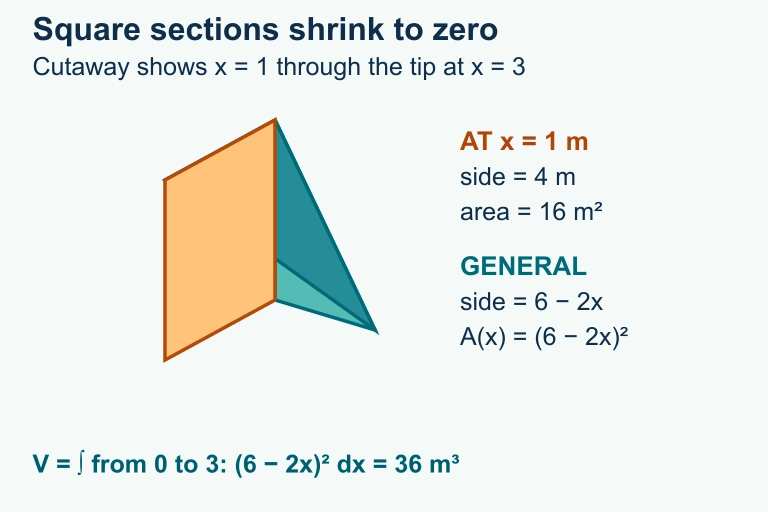 The square sections shrink with side 6−2 x; their areas integrate to 36 m³.
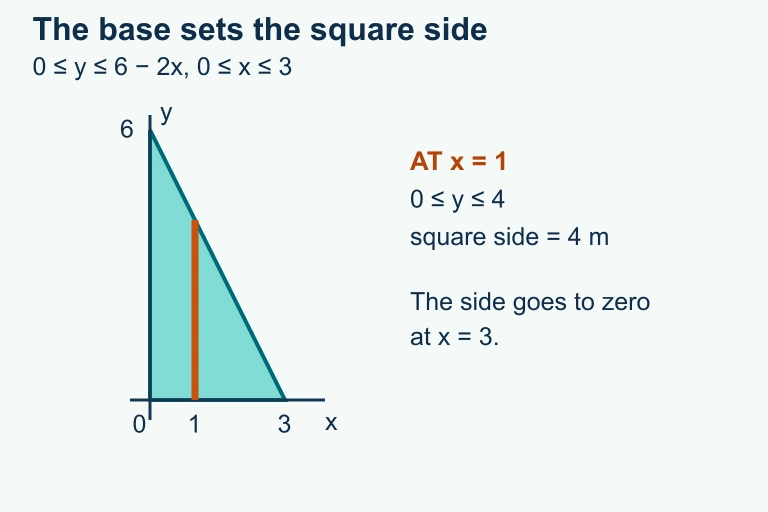 Triangular base 0≤y≤6−2x, 0≤x≤3, with a width-4 section at x=1 and width zero at x=3.
Question 5: CRITICAL THINKING
3 ptsShow answer
SUMMARY
Lesson Summary
Summary
Computing volumes with known cross sections relies on the slicing principle: express the cross-sectional area A(x) as a function of position and integrate over the base interval. For square cross sections, the area is A(x) = [f(x) − g(x)]², where f(x) − g(x) is the distance across the base at position x. For rectangular cross sections, one dimension is determined by the base distance and the other is specified by the problem, giving A(x) = s(x) · h(x). The volume integral is then V = ∫ₐᵇ A(x) dx.
The workflow is always the same: (1) sketch the base region and identify the bounding curves, (2) determine the side length function s(x) (or s(y) if slicing perpendicular to the y-axis), (3) write A(x) using the appropriate geometry formula, and (4) evaluate the definite integral. This technique connects to the disk/washer and shell methods for solids of revolution and extends naturally to multivariable integration in later courses.