

SECTION 1
Historical Context & Motivation
The relationship between position, velocity, and acceleration lies at the very heart of calculus—indeed, it was the problem that gave birth to the subject. In the late seventeenth century, Isaac Newton and Gottfried Wilhelm Leibniz independently developed the methods of calculus primarily to describe the motion of objects under the influence of forces. Newton's laws of motion required a precise language for expressing how the rate of change of velocity (acceleration) determined by a force could be "undone" to recover the velocity itself, and how velocity in turn could be integrated to recover position. This inverse relationship—differentiation and integration as reverse processes—is the Fundamental Theorem of Calculus in physical disguise.
1638 • Galileo's Kinematics
1669 • Newton's Fluxions
1686 • Leibniz Publishes Integral Notation
1687 • Principia Mathematica
The central question this lesson addresses is both elegant and practical: if you know the acceleration of a particle at every instant—or its velocity at every instant—how do you use integration to recover the quantities that the derivative "erased"? Specifically, how do you compute displacement, total distance, and the actual position function from a given rate function? Mastering these techniques is essential for the AP Calculus BC exam, where motion problems appear frequently in both the multiple-choice and free-response sections.
SECTION 2
Core Principles & Definitions
Before diving into integral techniques, it is essential to have a crisp understanding of the three kinematic quantities and how differentiation and integration connect them. Throughout this lesson, we consider a particle moving along a straight line, so position, velocity, and acceleration are all scalar-valued functions of time. The derivative moves "down" the chain—from position to velocity to acceleration—while integration moves "up."
Position s(t)
Velocity v(t) = s′(t)
Acceleration a(t) = v′(t)
Displacement vs. Total Distance
The Fundamental Theorem of Calculus
KEY TAKEAWAY
SECTION 3
Visual Explanation — The Derivative/Integral Chain
The diagram above captures the fundamental architecture of rectilinear motion problems. Moving downward via differentiation is straightforward—apply the power rule, chain rule, or other derivative techniques. Moving upward via integration requires you to perform an antiderivative and then determine the constant of integration using a given initial condition such as s(0) = 3 or v(2) = −5. Without that initial condition, you can still compute net change (via a definite integral), but you cannot determine the absolute value of the function at a specific time.
SECTION 4
Mathematical Framework
The equations below formalize the integral relationships among position, velocity, and acceleration. Each equation is a direct consequence of the Fundamental Theorem of Calculus, which states that if f is continuous on [a, b] and F is any antiderivative of f, then ∫ₐᵇ f(t) dt = F(b) − F(a).
DISPLACEMENT (NET CHANGE IN POSITION)
The definite integral of velocity over [a, b] gives displacement—the net change in position. This value can be positive, negative, or zero depending on whether the particle ends to the right, left, or at the same point where it started.
POSITION AT TIME t
Given an initial position s(t₀), you recover the entire position function by adding the accumulated displacement from t₀ to t. The dummy variable τ distinguishes the variable of integration from the upper limit.
TOTAL DISTANCE TRAVELED
To compute total distance (always ≥ 0), integrate the absolute value of velocity. In practice, split the interval at points where v(t) = 0, integrate separately, and sum the absolute values of each piece.
VELOCITY FROM ACCELERATION
Integrating acceleration yields the change in velocity. Together with an initial velocity v(t₀), this fully determines the velocity function, which can then be integrated again to find position.
AP Exam Tip
SECTION 5
Displacement vs. Total Distance — A Detailed Comparison
The distinction between displacement and total distance is subtle but critical, and the AP exam tests it relentlessly. Consider a particle whose velocity is positive on part of an interval and negative on the rest—meaning the particle reverses direction. The signed integral of velocity accounts for cancellations and yields displacement, while the integral of the absolute value of velocity accumulates every meter traveled, regardless of direction.
| Quantity | Integral Expression | Sign | Interpretation |
|---|---|---|---|
| Displacement | ∫ₐᵇ v(t) dt | Can be +, −, or 0 | Net change in position from t = a to t = b |
| Total Distance | ∫ₐᵇ |v(t)| dt | Always ≥ 0 | Odometer reading; every meter counts regardless of direction |
| Change in Velocity | ∫ₐᵇ a(t) dt | Can be +, −, or 0 | How much the velocity has increased (or decreased) over the interval |
Summary of integral expressions for rectilinear motion
SECTION 6
Worked Example — From Acceleration to Position
A particle moves along the x-axis with acceleration a(t) = 6t − 4 for t ≥ 0. At time t = 0, the velocity is v(0) = 5 m/s and the position is s(0) = 2 m. Find: (a) the velocity function v(t), (b) the position function s(t), (c) the displacement from t = 0 to t = 3, and (d) the total distance traveled from t = 0 to t = 3.
Complete Kinematic Integration
- 1
Step 1 — Integrate acceleration to find v(t)
v(t) = v(0) + ∫₀ᵗ a(τ) dτ = 5 + ∫₀ᵗ (6τ − 4) dτ = 5 + [3τ² − 4τ]₀ᵗ = 5 + 3t² − 4t.v(t) = 3t² − 4t + 5 - 2
Step 2 — Integrate velocity to find s(t)
s(t) = s(0) + ∫₀ᵗ v(τ) dτ = 2 + ∫₀ᵗ (3τ² − 4τ + 5) dτ = 2 + [τ³ − 2τ² + 5τ]₀ᵗ = 2 + t³ − 2t² + 5t.s(t) = t³ − 2t² + 5t + 2 - 3
Step 3 — Compute displacement from t = 0 to t = 3
Displacement = s(3) − s(0) = ∫₀³ v(t) dt. We already have s(t), so s(3) = 27 − 18 + 15 + 2 = 26, and s(0) = 2. Therefore displacement = 26 − 2 = 24 m. Alternatively, ∫₀³ (3t² − 4t + 5) dt = [t³ − 2t² + 5t]₀³ = (27 − 18 + 15) − 0 = 24.Displacement = 24 m - 4
Step 4 — Determine zeros of v(t) on [0, 3]
Set v(t) = 3t² − 4t + 5 = 0. The discriminant is (−4)² − 4(3)(5) = 16 − 60 = −44 < 0, so v(t) has no real zeros. Since v(0) = 5 > 0, the velocity is strictly positive on [0, 3], meaning the particle never reverses direction.v(t) > 0 on [0, 3] — no direction change - 5
Step 5 — Compute total distance traveled
Because v(t) ≥ 0 on the entire interval, |v(t)| = v(t). Therefore the total distance traveled equals the displacement.Total Distance = 24 m
Why Check for Zeros?
SECTION 7
Common Pitfalls & Comparisons
Students often lose points on the AP exam not because they cannot integrate but because they misidentify which quantity the problem is asking for or they mishandle the sign conventions. The table below catalogs the most frequent errors alongside the correct reasoning.
| Common Mistake | Why It's Wrong | Correct Approach |
|---|---|---|
| Using ∫ v(t) dt for total distance | The signed integral gives displacement, which allows positive and negative areas to cancel. | Use ∫ |v(t)| dt for total distance. Split at zeros of v(t). |
| Forgetting the initial condition | An indefinite integral yields a family of antiderivatives. Without s(t₀) or v(t₀), the particular function is unknown. | Always add the initial value: s(t) = s(t₀) + ∫ v(τ) dτ. |
| Confusing speed and velocity | Speed is |v(t)|, always non-negative. Velocity carries a sign indicating direction. | Use speed = |v(t)|. If asked "is the particle speeding up," check whether v and a share the same sign. |
| Integrating acceleration to get position directly | ∫ a(t) dt gives change in velocity, not position. You must integrate twice. | First integrate a(t) to get v(t), then integrate v(t) to get s(t), using an initial condition at each step. |
Common errors on AP motion problems
KEY TAKEAWAY
SECTION 8
Connections to Advanced Topics
The techniques in this lesson extend naturally to several more advanced topics in AP Calculus BC and beyond. Understanding how integration recovers a function from its derivative is the gateway to parametric and vector-valued motion, differential equations, and accumulation functions defined by integrals.
| This Lesson | Advanced Extension |
|---|---|
| Rectilinear motion: particle on a line, v(t) is a scalar | Parametric/vector motion: position is (x(t), y(t)); velocity and acceleration are vectors. Arc length replaces total distance: L = ∫ √(x′² + y′²) dt |
| Integrating a(t) = given function | Differential equations: a(t) may depend on v or s, leading to separable or linear ODEs (e.g., air resistance models) |
| s(t) = s(0) + ∫₀ᵗ v(τ) dτ as an accumulation function | FTC Part 1 applications: d/dt [∫₀ᵗ f(τ) dτ] = f(t). Also connects to analysis of functions defined by integrals on the AP exam |
| Splitting ∫ |v(t)| dt at zeros of v | Improper integrals & piecewise analysis: handling discontinuities and infinite intervals in more complex rate problems |
From rectilinear motion to advanced calculus concepts
In multivariable calculus and physics, the same principle—integration as the inverse of differentiation—underpins line integrals, work-energy theorems, and conservation laws. Every time you compute ∫ F · dr to find work done by a force, you are performing the higher-dimensional analog of integrating acceleration to recover velocity. Mastering the one-dimensional case here builds the conceptual foundation that carries through all of these contexts.
 The distinction between net change and total movement also appears in flowing water. Suppose a tank receives and releases 4 gal/min for 5 minutes. Its 200 gal inventory stays constant while 20 gal enters and 20 gal leaves: net change is zero and total throughput is 40 gal.
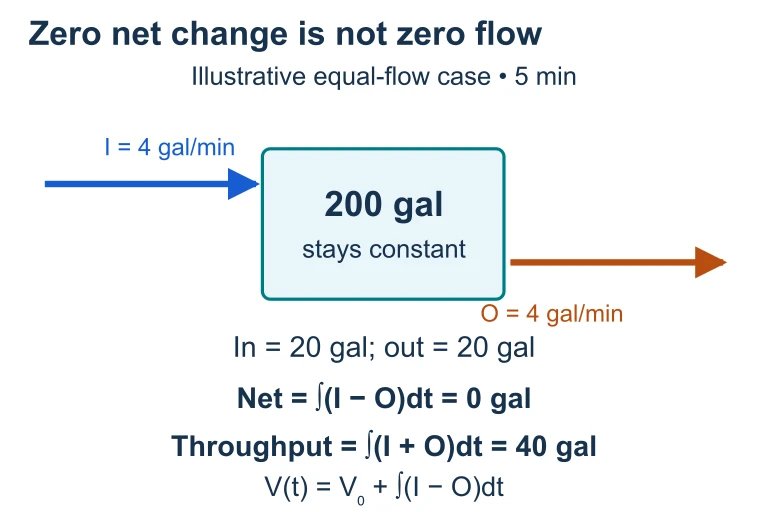 The distinction between net change and total movement also appears in flowing water. Suppose a tank receives and releases 4 gal/min for 5 minutes. Its 200 gal inventory stays constant while 20 gal enters and 20 gal leaves: net change is zero and total throughput is 40 gal.
SECTION 9
Practice Problems
Question 1: CONCEPTUAL
- A. The displacement from t = 0 to t = 5 is positive.
- B. The total distance traveled from t = 0 to t = 5 is zero.
- C. The total distance traveled from t = 0 to t = 5 is greater than or equal to the absolute value of the displacement.
- D. The particle returns to its starting position at t = 5.
- E. The displacement and total distance are equal.
Show answer (C)
Question 2: BASIC CALCULATION
- A. 4/3
- B. 4
- C. -4/3
- D. 16/3
- E. 28/3
Show answer (A)
Question 3: INTERMEDIATE
- A. 0
- B. 2/π
- C. 4/π
- D. 2
- E. π
Show answer (C)
Question 4: APPLIED
5 ptsShow answer
Question 5: CRITICAL THINKING
3 ptsShow answer
SUMMARY
Lesson Summary
Summary
The integral relationships among position, velocity, and acceleration form the core of rectilinear motion analysis in calculus. Integration reverses differentiation: integrating acceleration yields velocity (plus an initial condition), and integrating velocity yields position (plus another initial condition). The Fundamental Theorem of Calculus guarantees that the definite integral ∫ₐᵇ v(t) dt computes the displacement s(b) − s(a).
The critical distinction between displacement (net change, signed) and total distance (∫ |v(t)| dt, always non-negative) must be addressed by checking where v(t) = 0 and splitting the integral. Remember that an initial condition is required each time you integrate upward in the chain. Speed is |v(t)|, and a particle is speeding up when v(t) and a(t) share the same sign, and slowing down when they have opposite signs. These techniques appear across multiple question types on the AP Calculus BC exam and serve as the foundation for parametric and vector-valued motion.