

SECTION 1
Historical Context & Motivation
The study of motion has been a central pursuit of mathematics and physics for centuries. When an object moves along a curve in the plane—a projectile arcing through the air, a planet tracing an elliptical orbit, or a particle spiraling along a spring—a single function y = f(x) is often insufficient to capture the full picture. The need to describe both the path of motion and the timing of motion led mathematicians to develop parametric representations, where the x- and y-coordinates are each expressed as functions of an independent parameter—most commonly time t. This framework allows us to track where an object is, how fast it is moving, and how its direction changes, all as functions of a single variable.
1637 • Descartes & Coordinate Geometry
1687 • Newton's Principia
1740s • Euler & Vector Analysis
1880s • Gibbs & Modern Vector Calculus
The central question that parametric and vector-valued function analysis addresses is this: given a particle whose position at time t is described by the coordinates x(t) and y(t), how do we rigorously determine its velocity, speed, acceleration, direction of motion, and the total distance it travels? The AP Calculus BC exam tests these ideas extensively, requiring fluency with differentiation, integration, and geometric interpretation in the parametric and vector settings.
SECTION 2
Core Principles & Definitions
Before diving into computations, it is essential to establish the key definitions that underpin parametric motion analysis. A parametric curve is defined by a pair of functions x(t) and y(t) over some interval of the parameter t. When we interpret t as time, the parametric equations describe the trajectory of a particle. Equivalently, we can package both components into a single vector-valued function r(t) = ⟨x(t), y(t)⟩, which assigns a position vector to each instant t. The derivative r′(t) = ⟨x′(t), y′(t)⟩ is the velocity vector, and its magnitude |r′(t)| gives the speed. The second derivative r″(t) = ⟨x″(t), y″(t)⟩ is the acceleration vector.
Position Vector r(t)
Velocity Vector v(t)
Speed |v(t)|
Acceleration Vector a(t)
Arc Length
KEY TAKEAWAY
SECTION 3
Visual Explanation — Parametric Motion in the Plane
The diagram above illustrates the fundamental geometric relationship among the three key vectors in parametric motion. Notice that the velocity vector is always tangent to the curve—it points in the direction the particle is instantaneously heading. The acceleration vector, by contrast, need not be tangent; it has both a tangential component (which changes the particle's speed) and a normal component (which changes its direction). On the AP exam, you will frequently be asked to evaluate these vectors at specific values of t, compute the speed, or determine whether the particle is speeding up or slowing down by examining the sign of the dot product v(t) · a(t). When that dot product is positive, the particle is speeding up; when negative, it is slowing down.
SECTION 4
Mathematical Framework
The mathematical toolkit for parametric motion rests on straightforward applications of single-variable differentiation and integration applied component-wise to vector-valued functions. The following equations constitute the core framework you need for the AP Calculus BC exam.
VELOCITY VECTOR
Differentiate each component of the position vector with respect to t. The velocity vector is tangent to the curve at the point (x(t), y(t)).
SPEED (MAGNITUDE OF VELOCITY)
Speed is the scalar magnitude of the velocity vector. It is always non-negative and represents how fast the particle traverses the curve, measured in distance units per time unit.
ACCELERATION VECTOR
The acceleration vector is the derivative of the velocity vector. It captures how velocity changes in both magnitude and direction.
ARC LENGTH (TOTAL DISTANCE TRAVELED)
Integrate the speed function over the interval [a, b]. This gives the total distance the particle travels along the curve—not the displacement. If the particle doubles back, the arc length still accumulates.
Slope of the Tangent Line (dy/dx)
SLOPE VIA CHAIN RULE
The slope of the parametric curve in Cartesian terms is obtained by dividing the component derivatives. A vertical tangent occurs where x′(t) = 0 and y′(t) ≠ 0; a horizontal tangent occurs where y′(t) = 0 and x′(t) ≠ 0.
Displacement vs. Distance
SECTION 5
Analyzing Speed, Direction, and Particle Behavior
Beyond computing velocity and acceleration vectors, the AP exam frequently asks you to interpret the motion qualitatively. Is the particle moving to the left or to the right? Is it speeding up or slowing down? When does it change direction? These questions demand careful analysis of the components and their signs. A particle moves to the right when x′(t) > 0 and to the left when x′(t) < 0. Similarly, it moves upward when y′(t) > 0. The particle is at rest (momentarily stopped) when both x′(t) = 0 and y′(t) = 0 simultaneously. A direction change in the horizontal component occurs when x′(t) changes sign.
| Condition | Meaning | AP Exam Implication |
|---|---|---|
| x′(t) > 0 | Particle moves to the right | x-coordinate is increasing |
| x′(t) < 0 | Particle moves to the left | x-coordinate is decreasing |
| y′(t) = 0, x′(t) ≠ 0 | Horizontal tangent to the curve | dy/dx = 0 at this instant |
| x′(t) = 0, y′(t) ≠ 0 | Vertical tangent to the curve | dy/dx is undefined |
| x′(t) = 0 and y′(t) = 0 | Particle is at rest (speed = 0) | Possible cusp or direction reversal |
| v(t) · a(t) > 0 | Particle is speeding up | Speed is increasing |
| v(t) · a(t) < 0 | Particle is slowing down | Speed is decreasing |
Summary of sign conditions and their physical interpretations
SECTION 6
Worked Example — Complete Motion Analysis
A particle moves in the xy-plane so that its position at time t is given by x(t) = t³ − 3t and y(t) = t² − 4, for 0 ≤ t ≤ 3. Find: (a) the velocity vector at t = 1, (b) the speed at t = 1, (c) the acceleration vector at t = 1, (d) all times when the particle has a horizontal tangent, (e) the total distance traveled from t = 0 to t = 3.
Full Motion Analysis for r(t) = ⟨t³ − 3t, t² − 4⟩
- 1
Step 1 — Find the velocity vector v(t)
Differentiate each component: x′(t) = 3t² − 3 and y′(t) = 2t. Therefore, v(t) = ⟨3t² − 3, 2t⟩.v(t) = ⟨3t² − 3, 2t⟩ - 2
Step 2 — Evaluate v(1) and speed at t = 1
At t = 1: x′(1) = 3(1)² − 3 = 0 and y′(1) = 2(1) = 2. So v(1) = ⟨0, 2⟩. The speed is |v(1)| = √(0² + 2²) = √4 = 2.v(1) = ⟨0, 2⟩; speed = 2 - 3
Step 3 — Find the acceleration vector a(t) and evaluate at t = 1
Differentiate the velocity components: x″(t) = 6t and y″(t) = 2. So a(t) = ⟨6t, 2⟩. At t = 1: a(1) = ⟨6, 2⟩.a(1) = ⟨6, 2⟩ - 4
Step 4 — Find all times with a horizontal tangent
A horizontal tangent occurs when dy/dx = y′(t)/x′(t) = 0, which requires y′(t) = 0 and x′(t) ≠ 0. Setting y′(t) = 2t = 0 gives t = 0. Check: x′(0) = 3(0)² − 3 = −3 ≠ 0. So there is a horizontal tangent at t = 0, where the position is (0, −4).Horizontal tangent at t = 0, at point (0, −4) - 5
Step 5 — Note the vertical tangent
A vertical tangent occurs when x′(t) = 0 and y′(t) ≠ 0. Setting 3t² − 3 = 0 gives t = ±1. On [0, 3], t = 1 qualifies. Since y′(1) = 2 ≠ 0, there is a vertical tangent at t = 1 at position (1 − 3, 1 − 4) = (−2, −3). Note: at t = 1 the velocity is ⟨0, 2⟩—the particle is moving purely vertically.Vertical tangent at t = 1, at point (−2, −3) - 6
Step 6 — Set up and compute the arc length integral
The total distance traveled is L = ∫₀³ √[(3t² − 3)² + (2t)²] dt = ∫₀³ √[9t⁴ − 18t² + 9 + 4t²] dt = ∫₀³ √[9t⁴ − 14t² + 9] dt. This integral does not have a simple closed form, so on the AP exam you would use a graphing calculator. Evaluating numerically: L ≈ 18.125 units.Total distance ≈ 18.125 units
SECTION 7
Parametric vs. Cartesian vs. Polar — Strengths and Limitations
Parametric and vector-valued representations are not the only way to describe curves and motion. The Cartesian form y = f(x) and the polar form r = f(θ) each have their own advantages and limitations. Understanding when to use each representation is an important part of mathematical fluency on the AP exam.
| Feature | Parametric / Vector | Cartesian y = f(x) | Polar r = f(θ) |
|---|---|---|---|
| Handles multi-valued curves | Yes — can trace loops, cusps, self-intersections | No — must pass vertical line test | Yes — rose curves, limaçons, spirals |
| Encodes timing / direction | Yes — parameter t gives order and speed | No — only shape, no timing | Partially — θ orders the curve |
| Velocity / acceleration | Directly computed as r′(t), r″(t) | Only dy/dx; no velocity vector | Requires conversion to Cartesian components |
| Arc length | ∫√[(x′)² + (y′)²] dt | ∫√[1 + (dy/dx)²] dx | ∫√[r² + (dr/dθ)²] dθ |
| Best suited for | Motion, projectiles, space curves | Standard function analysis | Symmetric curves, rotational problems |
Comparison of curve representations on the AP Calculus BC exam
KEY TAKEAWAY
SECTION 8
Connection to Multivariable Calculus and Physics
The parametric and vector-valued function techniques you master in AP Calculus BC form the foundation for a wide range of topics in higher mathematics and physics. In multivariable calculus, you will extend these ideas to three-dimensional space curves r(t) = ⟨x(t), y(t), z(t)⟩, where the same differentiation and arc length formulas apply with an additional component. The Frenet–Serret formulas introduce the concepts of curvature κ and torsion τ, which measure how sharply a space curve bends and how it twists out of a plane, respectively. In physics, these tools are indispensable for analyzing everything from orbital mechanics to electrodynamics.
| AP Calculus BC Topic | Advanced Extension |
|---|---|
| r(t) = ⟨x(t), y(t)⟩ in the plane | r(t) = ⟨x(t), y(t), z(t)⟩ in 3D; curvature and torsion |
| Speed |v(t)| and arc length ∫|v| dt | Arc length parameterization s(t); unit tangent vector T(s) |
| Acceleration a(t) = r″(t) | Tangential and normal components: a = aₜT + aₙN |
| dy/dx = y′(t)/x′(t) | Directional derivatives; gradient ∇f for scalar fields |
| Arc length integral | Line integrals ∫_C F · dr for work and circulation |
How BC topics extend into higher-level coursework
Looking ahead, the decomposition of acceleration into tangential and normal components—which you encounter briefly in BC—becomes essential in courses on differential geometry and classical mechanics. The tangential component aₜ = d|v|/dt measures how the speed changes, while the normal component aₙ = κ|v|² measures how the direction changes. Mastering the two-dimensional framework now provides a robust foundation for these extensions, and the conceptual approach—differentiating vector-valued functions component-wise, computing magnitudes, and integrating for cumulative quantities—transfers directly.
SECTION 9
Practice Problems
Question 1: CONCEPTUAL
- A. The particle is at rest.
- B. The particle is moving to the left, and the curve has a horizontal tangent.
- C. The particle is moving to the right, and the curve has a vertical tangent.
- D. The curve has a vertical tangent because x′(3) ≠ 0.
- E. The speed of the particle is zero.
Show answer (B)
Question 2: BASIC CALCULATION
- A. √5
- B. √(2 + 9/2)
- C. √(13/2)
- D. √13
- E. 5/2
Show answer (C)
Question 3: INTERMEDIATE
- A. At rest at t = 1; slope at t = 2 is 9/2
- B. At rest at t = 0 and t = 1; slope at t = 2 is 9/2
- C. At rest at t = 1; slope at t = 2 is 3
- D. At rest at t = 1; slope at t = 2 is 2/9
- E. Never at rest for t ≥ 0; slope at t = 2 is 9/2
Show answer (A)
Question 4: APPLIED
5 ptsShow answer
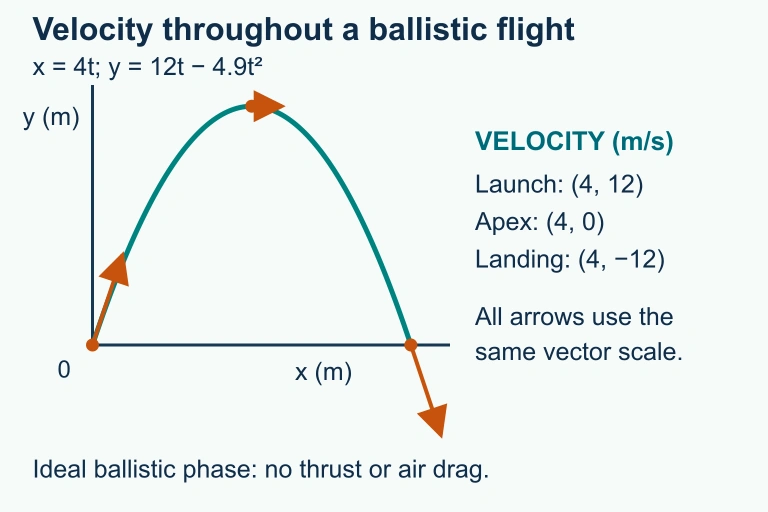 In the idealized unpowered ballistic phase, horizontal velocity stays constant while vertical velocity reaches zero at the apex.
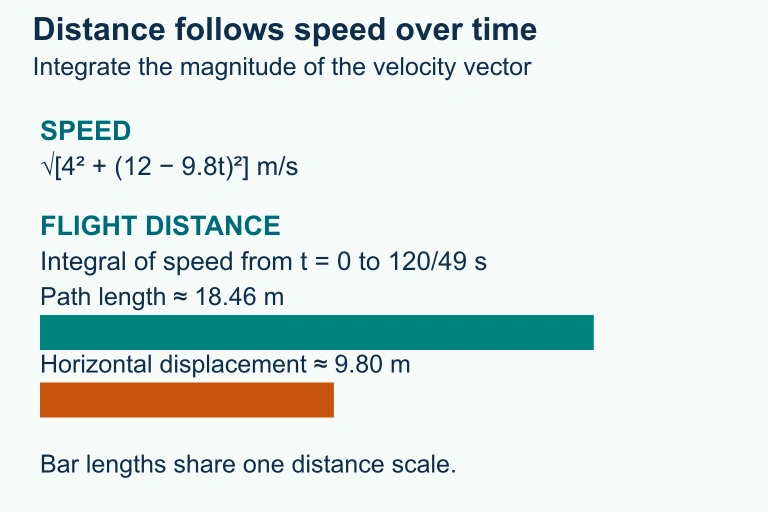 Ballistic motion over 0≤t≤120/49. The speed integral gives path length about 18.46 m; endpoint displacement has magnitude about 9.80 m.
Question 5: CRITICAL THINKING
4 ptsShow answer
SUMMARY
Lesson Summary
Summary
Parametric motion analysis begins with a position vector r(t) = ⟨x(t), y(t)⟩ that encodes both the path and the timing of a particle's journey. Differentiating component-wise yields the velocity vector v(t) = ⟨x′(t), y′(t)⟩, which is tangent to the curve and whose magnitude gives the speed |v(t)| = √[(x′)² + (y′)²]. A second differentiation produces the acceleration vector a(t) = ⟨x″(t), y″(t)⟩. The slope of the curve in Cartesian terms is dy/dx = y′(t)/x′(t), giving horizontal tangents where y′ = 0 (with x′ ≠ 0) and vertical tangents where x′ = 0 (with y′ ≠ 0). The particle is at rest only when both components of velocity are simultaneously zero.
To find the total distance traveled, integrate the speed: L = ∫ₐᵇ |v(t)| dt. This arc length is always at least as large as the magnitude of the displacement vector r(b) − r(a). To determine whether the particle is speeding up or slowing down, compute the dot product v(t) · a(t): positive means speeding up, negative means slowing down. These techniques—differentiation for instantaneous behavior, integration for cumulative quantities, and sign analysis for qualitative interpretation—form the complete toolkit for parametric and vector-valued motion on the AP Calculus BC exam.