

SECTION 1
Historical Context & Motivation
The problem of computing volumes of curved solids predates calculus by two millennia. Ancient mathematicians sought exact formulas for objects like spheres, cones, and paraboloids, but they lacked a general technique to handle arbitrary curves. The disc method — which slices a solid of revolution into infinitesimally thin circular cross-sections — emerged from the same intellectual lineage that produced Riemann sums and the definite integral. Understanding this history reveals why integration is so naturally suited to volume problems: both rest on the principle of summing infinitely many infinitesimal contributions.
~250 BCE • Archimedes' Method of Exhaustion
1635 • Cavalieri's Principle
1665–1676 • Newton & Leibniz Develop Calculus
1748 • Euler's Introductio in Analysin Infinitorum
The central question the disc method addresses is deceptively simple: given a region in the plane bounded by a curve, what is the exact volume of the solid formed when that region is revolved around an axis? While special cases (cylinders, cones, spheres) have known formulas, the disc method provides a universal technique that works for any integrable function — and it is a staple of every AP Calculus exam.
SECTION 2
Core Principles & Definitions
Before diving into formulas, it is essential to anchor the disc method in a few foundational ideas. Each principle below connects the geometric act of revolving a region to the algebraic machinery of definite integration. Master these, and setting up any disc-method integral becomes almost mechanical.
Solid of Revolution
Disc as Cross-Section
Radius Function
Summing Infinitesimal Volumes
SECTION 3
Visual Explanation: Revolving Around the x-Axis
In the diagram above, notice that each disc is perpendicular to the x-axis. The radius of the disc at position x equals the function value f(x), because that is the distance from the x-axis (the axis of rotation) to the curve. The volume of a single disc is the area of the circle, π[f(x)]², multiplied by its infinitesimal thickness dx. Integrating from the left boundary a to the right boundary b accumulates these contributions into the exact volume of the solid.
 Rotating the region from y = 0 to y = x², for 0 ≤ x ≤ 2, about the x-axis gives disks with radius x². The volume is π∫₀²x⁴ dx = 32π/5.
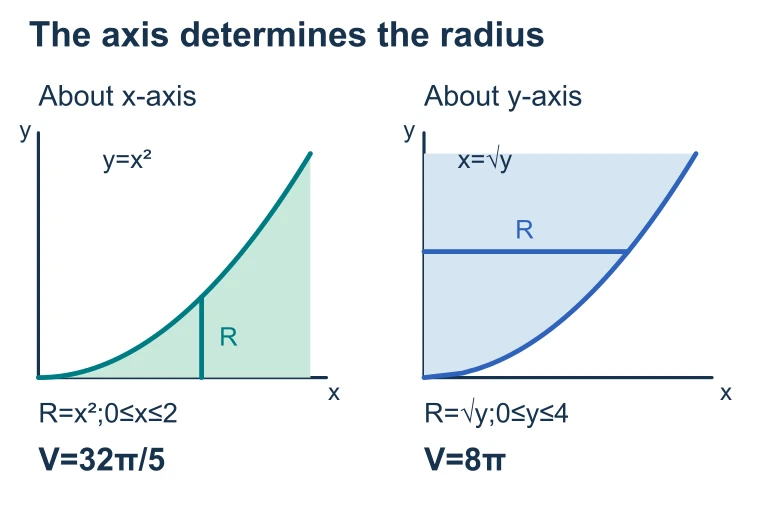 Rotating the region from y = 0 to y = x², for 0 ≤ x ≤ 2, about the x-axis gives disks with radius x². The volume is π∫₀²x⁴ dx = 32π/5.
SECTION 4
Mathematical Framework
Revolution About the x-Axis
When a region bounded by y = f(x), the x-axis, and the vertical lines x = a and x = b is revolved about the x-axis, each cross-section at position x is a disc of radius f(x). The area of that disc is A(x) = π[f(x)]². Because the generic volume element is dV = A(x) dx, the total volume is given by the following integral.
DISC METHOD — x-AXIS
V = volume of the solid; f(x) = radius of each disc; a, b = bounds on the x-axis; dx = infinitesimal thickness of each disc.
Revolution About the y-Axis
When the same style of rotation occurs about the y-axis, the roles of x and y swap. You must express the curve as x = g(y), and integrate with respect to y over the interval from y = c to y = d. Each disc now has radius g(y) and thickness dy.
DISC METHOD — y-AXIS
g(y) = x expressed as a function of y (the radius of each disc); c, d = bounds on the y-axis; dy = infinitesimal thickness.
Derivation from Riemann Sums
Partition [a, b] into n subintervals of width Δx = (b − a)/n and choose a sample point xk in each subinterval. The volume of the k-th disc is approximately π[f(xk)]² Δx. Summing over all n discs yields the Riemann sum:
RIEMANN SUM FORM
As n → ∞ and Δx → 0, the Riemann sum converges to the definite integral, recovering the disc-method formula exactly.
SECTION 5
Revolving About x-Axis vs. y-Axis
The disc method formula is structurally identical regardless of the axis of rotation; the key difference lies in which variable you integrate with respect to and how you express the radius function. A side-by-side visual comparison clarifies the setup for each scenario.
| Feature | Revolve about x-axis | Revolve about y-axis |
|---|---|---|
| Variable of integration | x | y |
| Radius function | r = f(x) | r = g(y) (solve for x) |
| Disc orientation | Perpendicular to x-axis (vertical face) | Perpendicular to y-axis (horizontal face) |
| Thickness element | dx | dy |
| Formula | V = π ∫ₐᵇ [f(x)]² dx | V = π ∫꜀ᵈ [g(y)]² dy |
Summary of disc method setup for each axis of rotation
SECTION 6
Worked Examples
Example 1: Revolution About the x-Axis
Find the volume of the solid obtained by revolving the region bounded by y = x², y = 0, x = 0, and x = 2 about the x-axis.
Worked example
- 1
Step 1 — Identify the radius and bounds
The axis of rotation is the x-axis. At each x ∈ [0, 2], the radius of the disc equals the distance from the x-axis to the curve: r = f(x) = x². The bounds are a = 0 and b = 2. - 2
Step 2 — Write the integral
Apply the disc formula: V = π ∫₀² [x²]² dx = π ∫₀² x⁴ dx. - 3
Step 3 — Evaluate the integral
∫₀² x⁴ dx = [x⁵/5]₀² = 2⁵/5 − 0 = 32/5. - 4
Step 4 — Compute the volume
V = π × 32/5 = 32π/5.V = 32π/5 ≈ 20.106 cubic units
Example 2: Revolution About the y-Axis
Find the volume of the solid obtained by revolving the region bounded by y = x², y = 0, and y = 4 about the y-axis.
Worked example
- 1
Step 1 — Solve for x in terms of y
Since we are revolving about the y-axis, we need x as a function of y. From y = x², we get x = √y (taking the positive root for the first-quadrant region). - 2
Step 2 — Identify the radius and bounds
The radius of each horizontal disc is r = g(y) = √y. The y-bounds are c = 0 and d = 4. - 3
Step 3 — Write and evaluate the integral
V = π ∫₀⁴ [√y]² dy = π ∫₀⁴ y dy = π [y²/2]₀⁴ = π (16/2 − 0) = 8π.V = 8π ≈ 25.133 cubic units
SECTION 7
Strengths, Limitations & When to Use the Disc Method
The disc method is a powerful tool, but it is not always the most efficient choice for computing volumes of revolution. Understanding its strengths and limitations helps you quickly decide whether to use discs, washers, or cylindrical shells on exam day.
| Strengths | Limitations |
|---|---|
| Conceptually straightforward: each slice is a simple circle with area πr². | Only works when the region touches the axis of rotation (no hollow core). For gaps, use the washer method. |
| Integral setup is quick when the curve is easily expressed as a function of the appropriate variable. | Requires rewriting the function if the natural variable does not match the axis (e.g., solving y = x³ for x when revolving about the y-axis). |
| Works seamlessly with known antiderivatives, making many problems evaluable by hand. | For revolution about a line other than the coordinate axes, the radius expression becomes more complex. |
| Directly motivated by Riemann sums, reinforcing foundational integration concepts. | When slicing perpendicular to the axis yields complicated or piecewise radii, the shell method may be easier. |
Disc method: strengths vs. limitations
Key takeaway
SECTION 8
Connection to Advanced Methods
The disc method is the simplest member of a family of volume-by-integration techniques. Mastering it creates a springboard for two natural generalizations that frequently appear on the AP Calculus BC exam: the washer method and the shell method. Understanding how these relate back to the disc method deepens conceptual fluency.
| Feature | Disc Method | Washer Method | Shell Method |
|---|---|---|---|
| Cross-section shape | Filled circle (πR²) | Annulus: π(R² − r²) | Cylindrical shell: 2πrh |
| Region touches axis? | Yes (required) | Not necessarily | Not necessarily |
| Slice direction | ⊥ to axis of rotation | ⊥ to axis of rotation | ∥ to axis of rotation |
| Best when | Single curve, region touches axis | Two curves bounding a region with a hollow core | Algebra is simpler in the variable parallel to the axis |
Comparison of volume-of-revolution methods
Notice that the washer method is a direct extension of the disc method: a washer is simply a disc with a concentric hole removed. If the inner radius shrinks to zero, the washer formula reduces identically to the disc formula. The shell method, by contrast, uses a fundamentally different slicing strategy — thin concentric cylinders instead of flat discs — and it integrates parallel to the axis of rotation. On the AP exam, you will not be told which method to use; you must recognize the geometry and select the approach that yields the simplest integral.
SECTION 9
Practice Problems
Question 1: CONCEPTUAL
- A. Squaring accounts for the two halves (above and below the x-axis) of each disc.
- B. The area of a circular disc of radius r is πr², so with r = f(x) the area becomes π[f(x)]².
- C. The squaring converts the arc length element into a volume element.
- D. It comes from the chain rule applied to the composition of f with the circular parametrization.
- E. Squaring is needed because the volume of a cylinder of height h and radius r is πr²h, and here h = [f(x)]².
Show answer (B)
Question 2: BASIC CALCULATION
- A. 12π
- B. 18π
- C. 24π
- D. 36π
- E. 72π
Show answer (C)
Question 3: INTERMEDIATE
- A. π ∫₀⁴ y dy
- B. π ∫₀² x⁴ dx
- C. π ∫₀⁴ y² dy
- D. 2π ∫₀² x(4 − x²) dx
- E. π ∫₀² (4 − x²)² dx
Show answer (A)
Question 4: APPLIED
Show answer
Question 5: CRITICAL THINKING