

SECTION 1
Historical Context & Motivation
Trigonometric functions were among the earliest tools of mathematical astronomy, but the need to reverse them—finding an angle from a known ratio—drove centuries of mathematical development. When astronomers measured the position of a celestial body and needed to determine the angle of elevation, they were effectively computing what we now call inverse trigonometric functions. The calculus of these functions matured alongside the broader development of differential calculus in the seventeenth and eighteenth centuries, as mathematicians sought to differentiate every function they could define. Understanding the derivatives of inverse trigonometric functions is essential for integration techniques, implicit differentiation, and modeling problems where angles change with respect to other variables.
~150 CE • Ptolemy's Chord Tables
1676 • Newton's Inverse Series
1737 • Euler Formalizes Inverse Trig
1797 • Lagrange's Derivative Formalism
The central question this lesson addresses is direct and practical: if y = arcsin(x), arctan(x), or any other inverse trigonometric function, what is dy/dx? More importantly, how do we derive these formulas from first principles using implicit differentiation, and how do we apply them when the argument is itself a composite function? Mastering these derivatives equips you with tools that appear repeatedly in integration by parts, trigonometric substitution, and related-rates problems on the AP Calculus BC exam.
SECTION 2
Core Principles & Definitions
Before differentiating inverse trigonometric functions, you need a firm grasp of what these functions are and why their domains must be restricted. A function must be one-to-one to possess an inverse, so we restrict each trigonometric function to an interval where it is strictly monotonic. These restricted domains become the ranges of the corresponding inverse functions, and the original ranges become the domains. The derivative formulas all emerge from a single technique: write the inverse relationship as an implicit equation, differentiate both sides, and solve for dy/dx using a Pythagorean identity.
Domain Restriction
Implicit Differentiation Strategy
Pythagorean Identity Conversion
Chain Rule Extension
KEY TAKEAWAY
SECTION 3
Visual Explanation: Graphs of Inverse Trig Functions and Their Derivatives
The left panel illustrates a fundamental property: arcsin is steepest near the edges of its domain and most gradual near x = 0, where its slope equals exactly 1. The right panel makes this quantitative—the derivative 1/√(1 − x²) equals 1 at x = 0 and blows up to +∞ as x → ±1. Geometrically, as the sine function flattens at its peaks (±π/2), tiny changes in x demand enormous changes in the angle y = arcsin(x), producing the vertical asymptotes in the derivative. Notice that the derivative is always positive on (−1, 1), confirming that arcsin is strictly increasing throughout its domain. These observations generalize: each inverse trig derivative tells you about the rate at which the corresponding angle changes as its ratio argument changes, and the denominators always arise from Pythagorean-identity conversions.
SECTION 4
Mathematical Framework: Deriving the Formulas
Every inverse trigonometric derivative can be derived through the same three-step process: (1) rewrite the inverse function as an implicit trigonometric equation, (2) differentiate both sides with respect to x using implicit differentiation, and (3) solve for dy/dx and use a Pythagorean identity to express the result purely in terms of x. Let us carry out this derivation in full for arcsin and arctan, then state the remaining four formulas.
Derivation of d/dx[arcsin(x)]
Let y = arcsin(x), so that sin(y) = x with y ∈ [−π/2, π/2]. Differentiating both sides with respect to x gives cos(y) · dy/dx = 1, hence dy/dx = 1/cos(y). Since sin²(y) + cos²(y) = 1, we have cos(y) = √(1 − sin²(y)) = √(1 − x²). The positive square root is justified because y lies in [−π/2, π/2], where cosine is non-negative. Therefore:
DERIVATIVE OF ARCSIN
The domain excludes x = ±1 because cos(y) = 0 at y = ±π/2, making the derivative undefined at those endpoints.
Derivation of d/dx[arctan(x)]
Let y = arctan(x), so tan(y) = x with y ∈ (−π/2, π/2). Differentiating implicitly gives sec²(y) · dy/dx = 1, so dy/dx = 1/sec²(y) = cos²(y). Using the identity 1 + tan²(y) = sec²(y), we obtain sec²(y) = 1 + x², so cos²(y) = 1/(1 + x²). Therefore:
DERIVATIVE OF ARCTAN
Unlike arcsin, arctan has domain all of ℝ, and its derivative is defined everywhere—a smooth, bell-shaped function centered at x = 0.
Complete Table of Six Derivatives
DERIVATIVE OF ARCCOS
Note: arccos(x) = π/2 − arcsin(x), so its derivative is the negative of the arcsin derivative.
DERIVATIVES OF ARCCSC, ARCSEC, ARCCOT
The arcsec and arccsc derivatives require |x| > 1. Arccot's derivative matches −(arctan derivative), paralleling the arccos/arcsin relationship.
Chain Rule Generalization
 For a camera 4 m above the path, tan θ = 4/x. At x = 3 m and walking speed 2 m/s, the angular-speed magnitude is 8/25 rad/s; the sign depends on direction.
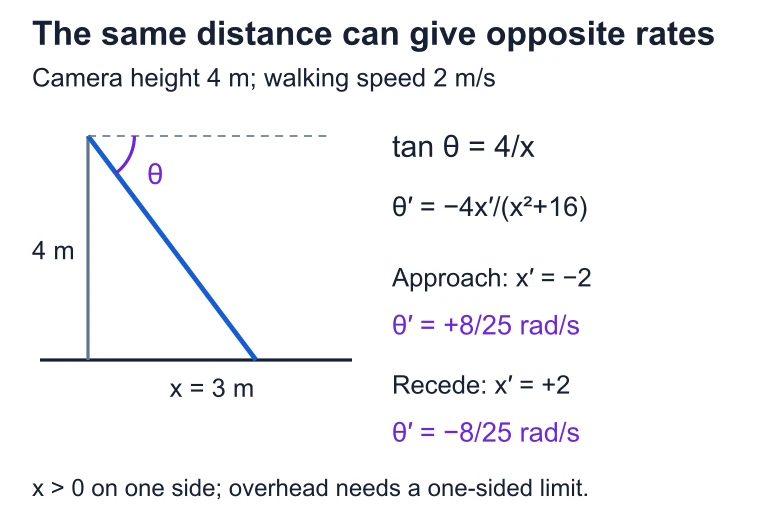 For a camera 4 m above the path, tan θ = 4/x. At x = 3 m and walking speed 2 m/s, the angular-speed magnitude is 8/25 rad/s; the sign depends on direction.
SECTION 5
Detailed Breakdown: Derivative Pairs and Domain Restrictions
The six inverse trigonometric derivatives naturally organize into three pairs based on their algebraic structure and cofunction relationships. Recognizing these pairs dramatically reduces memorization and helps you quickly identify which formula to apply in a given problem. The table below summarizes each function, its restricted domain and range, derivative, and the key identity used in its derivation.
| Function | Domain → Range | Derivative | Cofunction Partner |
|---|---|---|---|
| arcsin(x) | [−1, 1] → [−π/2, π/2] | 1/√(1 − x²) | arccos (negative derivative) |
| arccos(x) | [−1, 1] → [0, π] | −1/√(1 − x²) | arcsin (negative derivative) |
| arctan(x) | ℝ → (−π/2, π/2) | 1/(1 + x²) | arccot (negative derivative) |
| arccot(x) | ℝ → (0, π) | −1/(1 + x²) | arctan (negative derivative) |
| arcsec(x) | |x| ≥ 1 → [0, π], y ≠ π/2 | 1/(|x|√(x² − 1)) | arccsc (negative derivative) |
| arccsc(x) | |x| ≥ 1 → [−π/2, π/2], y ≠ 0 | −1/(|x|√(x² − 1)) | arcsec (negative derivative) |
The six inverse trig derivatives organized by cofunction pairs
The diagram highlights a powerful mnemonic: you really only need to memorize three derivative formulas (arcsin, arctan, arcsec), because each cofunction partner simply negates the result. Furthermore, the AP Calculus BC exam primarily tests arcsin and arctan; arcsec appears less frequently, and arccsc, arccot are rarely tested directly. Focus your memorization accordingly, but understand the pattern so you can reconstruct any formula under pressure.
SECTION 6
Worked Example: Chain Rule with Inverse Trig Functions
Consider the function f(x) = arctan(3x²). We wish to compute f′(x) and evaluate f′(1). This problem combines the arctan derivative formula with the chain rule, a structure that appears frequently on the AP Calculus BC exam.
Differentiate f(x) = arctan(3x²)
- 1
Step 1 — Identify the Outer and Inner Functions
The outer function is arctan(u) and the inner function is u = 3x². By the chain rule, f′(x) = d/du[arctan(u)] · du/dx. - 2
Step 2 — Apply the Arctan Derivative Formula
We know d/du[arctan(u)] = 1/(1 + u²). Substituting u = 3x² gives 1/(1 + (3x²)²) = 1/(1 + 9x⁴).Outer derivative: 1/(1 + 9x⁴) - 3
Step 3 — Differentiate the Inner Function
du/dx = d/dx[3x²] = 6x.Inner derivative: 6x - 4
Step 4 — Multiply by the Chain Rule
f′(x) = [1/(1 + 9x⁴)] · 6x = 6x/(1 + 9x⁴).f′(x) = 6x / (1 + 9x⁴) - 5
Step 5 — Evaluate at x = 1
f′(1) = 6(1)/(1 + 9(1)⁴) = 6/10 = 3/5.f′(1) = 3/5
Common Mistake Alert
SECTION 7
Strengths, Limitations, and Common Pitfalls
Inverse trigonometric derivative formulas are elegant and compact, but they come with constraints that can trip up even strong students. The table below contrasts the advantages of these formulas with the most common sources of error and conceptual confusion.
| Strength | Limitation / Pitfall | Exam Tip |
|---|---|---|
| Only three unique denominator forms to memorize | Confusing √(1 − x²) with √(x² − 1); the former is for arcsin/arccos, the latter for arcsec/arccsc | Check the domain: if |x| ≤ 1, it's the arcsin/arccos family; if |x| ≥ 1, it's arcsec/arccsc |
| Directly applicable to antidifferentiation (recognizing integrands) | Forgetting the chain rule factor du/dx when differentiating composite arguments | Write u = [inner function] explicitly before differentiating; never skip this step |
| Cofunction pairs reduce six formulas to three | Mixing up the sign: arccos derivative is negative, arcsin is positive | Remember that decreasing functions (arccos, arccot, arccsc) have negative derivatives |
| The derivation via implicit differentiation reinforces core calculus skills | The absolute value in the arcsec/arccsc derivatives is easy to overlook | The |x| ensures the derivative is positive for arcsec regardless of whether x > 1 or x < −1 |
Strengths and pitfalls of inverse trig differentiation
KEY TAKEAWAY
SECTION 8
Connection to Integration and Advanced Topics
The derivatives of inverse trigonometric functions serve as the bridge between differentiation and integration in calculus. When you encounter an integrand that matches an inverse trig derivative, you can immediately write down the antiderivative. This is one of the most direct applications of the Fundamental Theorem of Calculus and appears in nearly every integration unit. Beyond basic antidifferentiation, these formulas connect to trigonometric substitution, a technique you will study in the BC curriculum, where integrals involving √(a² − x²), √(a² + x²), or √(x² − a²) are handled by substituting x = a sin θ, x = a tan θ, or x = a sec θ, respectively.
| Current Topic | Advanced Extension |
|---|---|
| d/dx[arcsin(x)] = 1/√(1 − x²) | ∫ 1/√(a² − x²) dx = arcsin(x/a) + C — direct antidifferentiation with a scaling constant |
| d/dx[arctan(x)] = 1/(1 + x²) | ∫ 1/(a² + x²) dx = (1/a)arctan(x/a) + C — fundamental in partial fractions and improper integrals |
| Implicit differentiation of sin(y) = x | The inverse function theorem: (f⁻¹)′(a) = 1/f′(f⁻¹(a)), a general result for any invertible differentiable function |
| Chain rule with inverse trig functions | Differentiating inverse hyperbolic functions (arcsinh, arctanh) uses the same implicit differentiation strategy with hyperbolic identities |
How inverse trig differentiation connects to integration and advanced calculus
As you progress through the BC curriculum, keep in mind that the pattern you learned here—rewrite, implicitly differentiate, apply an identity, solve for dy/dx—is not limited to trigonometric functions. The same approach works for logarithmic, exponential, and hyperbolic inverse functions. Mastering this technique for inverse trig functions gives you a template applicable to any differentiable bijection.
SECTION 9
Practice Problems
Question 1: CONCEPTUAL
- A. arccos(x) and arcsin(x) have the same domain but opposite ranges, so their derivatives must be opposites.
- B. arcsin(x) + arccos(x) = π/2 for all x in [−1, 1], so differentiating both sides gives arcsin′(x) + arccos′(x) = 0.
- C. The implicit differentiation of cos(y) = x introduces an extra factor of −1 from the chain rule, but this is unrelated to the arcsin derivative.
- D. arccos(x) = 1/arcsin(x), so by the reciprocal rule, the derivative picks up a negative sign.
- E. cos(x) = −sin(x + π/2), so the inverse functions inherit this negation directly.
Show answer (B)
Question 2: BASIC CALCULATION
- A. 1 / √(1 − 25x²)
- B. 5 / √(1 − 5x²)
- C. 5 / √(1 − 25x²)
- D. −5 / √(1 − 25x²)
- E. 5 / (1 + 25x²)
Show answer (C)
Question 3: INTERMEDIATE
- A. 1/4
- B. 1/2
- C. 1
- D. e/(1 + e²)
- E. π/4
Show answer (B)
Question 4: APPLIED
5 ptsShow answer
Question 5: CRITICAL THINKING
3 ptsShow answer
SUMMARY
Summary & Review
Summary
The derivatives of inverse trigonometric functions are derived through a systematic process: rewrite the inverse relationship as an implicit equation, differentiate both sides with respect to x, solve for dy/dx, and convert back to the variable x using a Pythagorean identity. The six derivatives organize into three cofunction pairs sharing the same denominator: √(1 − x²) for arcsin/arccos, 1 + x² for arctan/arccot, and |x|√(x² − 1) for arcsec/arccsc. Within each pair, the cofunction's derivative is simply the negative of its partner's.
For the AP Calculus BC exam, focus especially on the derivatives of arcsin and arctan, and always apply the chain rule when the argument is a composite function. These derivative formulas reappear as antidifferentiation formulas in integration, making them among the most frequently tested derivative rules on the exam. The key to success is consistent practice with the implicit differentiation derivation, so you can reconstruct any formula even if memory fails during the test.