

SECTION 1
Historical Context & Motivation
The story of differentiating trigonometric functions is inseparable from the broader development of calculus itself. While sine and cosine were the first trigonometric functions whose derivatives were rigorously established, mathematicians quickly recognized that the tangent, cotangent, secant, and cosecant functions—defined as ratios and reciprocals of sine and cosine—demanded their own derivative formulas. These secondary derivatives became essential tools in navigation, optics, and the study of periodic phenomena, where slope and rate-of-change information about more complex waveforms was needed.
1614 • Napier's Trigonometric Tables
1665–1676 • Newton & Leibniz Develop Calculus
1748 • Euler's Introductio in Analysin Infinitorum
1800s • Standardized Calculus Curricula
With the derivatives of sin x and cos x already in hand, the central question becomes: how can we systematically derive the derivatives of tan x, cot x, sec x, and csc x using only the quotient rule and the known derivatives of sine and cosine? This lesson answers that question and builds fluency with these four formulas so that you can apply them confidently under exam conditions.
SECTION 2
Core Principles & Definitions
Before deriving any formulas, it is essential to recall the definitions of the four functions in terms of sine and cosine, as well as the two prerequisite derivative facts. The quotient rule serves as the single unifying technique: because tan x = sin x / cos x, cot x = cos x / sin x, sec x = 1 / cos x, and csc x = 1 / sin x, every derivative in this lesson reduces to a quotient-rule application followed by a Pythagorean-identity simplification.
Prerequisite: d/dx [sin x] = cos x
Prerequisite: d/dx [cos x] = −sin x
Quotient Rule
Pythagorean Identities
Domain Awareness
KEY TAKEAWAY
SECTION 3
Visual Explanation — Graphs and Their Derivatives
A powerful way to internalize these derivatives is to see the original function alongside its derivative on the same axes. The diagram below plots y = tan x and its derivative y = sec²x over the interval (−π/2, π/2). Notice that wherever tan x has a horizontal tangent (at x = 0), sec²x equals 1—its minimum value. As tan x steepens near its vertical asymptotes, sec²x grows without bound, reflecting the increasingly rapid rate of change.
This visual reinforces a critical observation: the derivative sec²x is always positive on its domain, which is consistent with the fact that tan x is strictly increasing on each interval between consecutive vertical asymptotes. By contrast, the derivative of cot x turns out to be −csc²x, which is always negative, reflecting the strictly decreasing behavior of cotangent on each of its intervals.
SECTION 4
Mathematical Framework — Deriving the Four Formulas
We now carry out the four derivations in full. Each one follows the same three-step pattern: express the function as a quotient of sine and cosine, apply the quotient rule, and simplify using the Pythagorean identity sin²x + cos²x = 1.
Derivative of tan x
Write tan x = sin x / cos x. Let f(x) = sin x and g(x) = cos x. The quotient rule gives d/dx [tan x] = [cos x · cos x − sin x · (−sin x)] / cos²x = [cos²x + sin²x] / cos²x = 1 / cos²x = sec²x.
DERIVATIVE OF TANGENT
Valid for all x where cos x ≠ 0, i.e., x ≠ π/2 + nπ for any integer n.
Derivative of cot x
Write cot x = cos x / sin x. Applying the quotient rule with f(x) = cos x and g(x) = sin x yields d/dx [cot x] = [−sin x · sin x − cos x · cos x] / sin²x = −[sin²x + cos²x] / sin²x = −1 / sin²x = −csc²x.
DERIVATIVE OF COTANGENT
Valid for all x where sin x ≠ 0, i.e., x ≠ nπ for any integer n.
Derivative of sec x
Write sec x = 1 / cos x. Applying the quotient rule with f(x) = 1 and g(x) = cos x gives d/dx [sec x] = [0 · cos x − 1 · (−sin x)] / cos²x = sin x / cos²x. Rewriting this as (1/cos x)(sin x/cos x) yields sec x tan x.
DERIVATIVE OF SECANT
Valid for all x where cos x ≠ 0. The product form sec x tan x is the standard representation.
Derivative of csc x
Write csc x = 1 / sin x. The quotient rule with f(x) = 1 and g(x) = sin x gives d/dx [csc x] = [0 · sin x − 1 · cos x] / sin²x = −cos x / sin²x. Factoring as −(1/sin x)(cos x/sin x) produces −csc x cot x.
DERIVATIVE OF COSECANT
Valid for all x where sin x ≠ 0. Note the negative sign—csc x mirrors sec x but with an extra factor of −1.
 For a light 20 m from a wall rotating at 0.5 rad/s, y = 20 tan θ gives dy/dt = 10 sec²θ. At θ = π/3, the spot moves at 40 m/s.
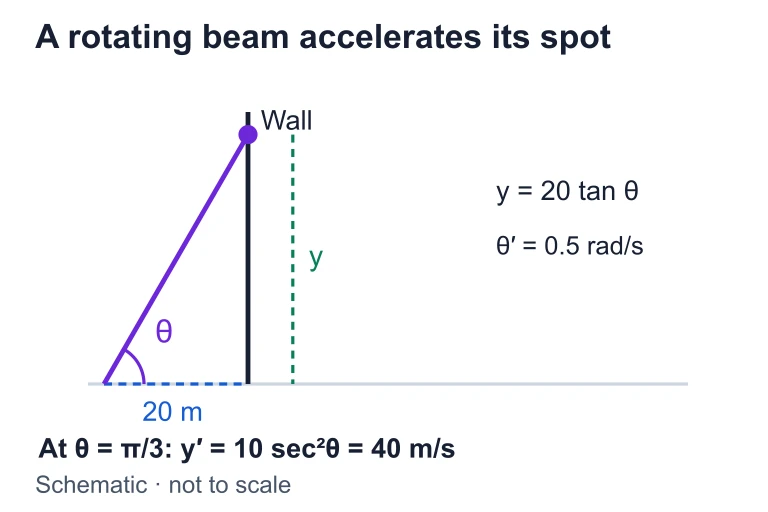 For a light 20 m from a wall rotating at 0.5 rad/s, y = 20 tan θ gives dy/dt = 10 sec²θ. At θ = π/3, the spot moves at 40 m/s.
SECTION 5
Patterns & Memory Aids
Memorizing four separate formulas becomes far easier when you recognize the structural symmetry between the "co" pairs. The derivative of each co-function (cotangent, cosecant) mirrors the derivative of its companion function (tangent, secant) but carries an extra negative sign. This pattern originates in the fact that d/dx [cos x] = −sin x carries a negative sign while d/dx [sin x] = cos x does not.
| Function | Derivative | Co-function | Derivative of Co-function |
|---|---|---|---|
| tan x | sec²x | cot x | −csc²x |
| sec x | sec x tan x | csc x | −csc x cot x |
Co-function derivative pairs — the co-version always picks up a negative sign.
Memory Tip
SECTION 6
Worked Example — Differentiating a Composite Expression
Let us work through a representative problem that combines the chain rule with the derivative formulas developed in Section 4. Problems of this type appear routinely on the AP Calculus BC exam.
Find dy/dx for y = 3 sec(2x) + tan²(x)
- 1
Step 1 — Identify the component functions
The expression has two additive terms. The first term, 3 sec(2x), is a constant multiple of the secant of a linear inner function u = 2x. The second term, tan²(x), is [tan x]² — a power of a trigonometric function. - 2
Step 2 — Differentiate the first term using the chain rule
d/dx [3 sec(2x)] = 3 · sec(2x) tan(2x) · d/dx [2x] = 3 · sec(2x) tan(2x) · 2 = 6 sec(2x) tan(2x). We applied d/du [sec u] = sec u tan u and multiplied by the inner derivative du/dx = 2.6 sec(2x) tan(2x) - 3
Step 3 — Differentiate the second term using the chain rule
Write tan²(x) = [tan x]². Applying the general power rule: d/dx [tan x]² = 2 tan x · d/dx [tan x] = 2 tan x · sec²x.2 tan x sec²x - 4
Step 4 — Combine the results
Adding the derivatives of both terms gives the final answer.dy/dx = 6 sec(2x) tan(2x) + 2 tan x sec²x
Common Pitfall
SECTION 7
Strengths, Limitations & Common Errors
Understanding where each formula excels and where students commonly stumble is just as important as knowing the formulas themselves. The table below contrasts the properties of each derivative formula, highlighting domain restrictions and typical error patterns.
| Formula | Always Positive/Negative? | Common Student Errors |
|---|---|---|
| d/dx [tan x] = sec²x | Always positive (sec²x ≥ 1) | Writing sec x instead of sec²x; forgetting the square |
| d/dx [cot x] = −csc²x | Always negative (−csc²x ≤ −1) | Dropping the negative sign; confusing with sec²x |
| d/dx [sec x] = sec x tan x | Sign matches sign of tan x | Writing sec²x tan x instead of sec x tan x |
| d/dx [csc x] = −csc x cot x | Sign opposite to cot x | Omitting the negative sign; mixing up csc and sec |
Derivative properties and frequent mistakes
KEY TAKEAWAY
SECTION 8
Connection to Advanced Topics
The four derivative formulas derived in this lesson serve as essential building blocks for several advanced calculus topics that appear later on the AP Calculus BC exam. Integration of trigonometric functions, in particular, frequently relies on recognizing these derivatives in reverse. For example, knowing that d/dx [tan x] = sec²x immediately tells you that ∫ sec²x dx = tan x + C. Similarly, the integral ∫ sec x tan x dx = sec x + C follows directly from the derivative of sec x.
| This Lesson's Result | Advanced Application (BC Exam) |
|---|---|
| d/dx [tan x] = sec²x | Antiderivative: ∫ sec²x dx = tan x + C; integral of tan x via substitution |
| d/dx [sec x] = sec x tan x | Trigonometric substitution in integrals (e.g., x = a sec θ); integration of sec x |
| d/dx [cot x] = −csc²x | Antiderivative: ∫ csc²x dx = −cot x + C; appears in partial fraction integrals |
| d/dx [csc x] = −csc x cot x | Reduction formulas for ∫ cscⁿx dx; arc-length computations involving csc x |
| Chain rule + trig derivatives | Implicit differentiation, related rates, parametric and polar derivatives |
How today's derivatives feed into advanced BC topics
Beyond the AP exam, these derivatives play central roles in Fourier analysis, where trigonometric functions form the basis for representing periodic signals, and in differential equations, where solutions often involve combinations of all six trigonometric functions and their derivatives. Mastering these formulas now establishes a foundation that extends well beyond a single exam.
SECTION 9
Practice Problems
Question 1: CONCEPTUAL
- A. Because cot x = cos x / sin x, the quotient rule produces cos²x + sin²x = 1 in the numerator, which is positive, so the derivative is positive—it does not carry a negative sign.
- B. The negative sign arises because cot x is the reciprocal of tan x, and taking the reciprocal always introduces a negative sign in the derivative.
- C. When the quotient rule is applied to cos x / sin x, the numerator becomes −sin²x − cos²x = −(sin²x + cos²x) = −1, producing the overall negative sign.
- D. The negative sign is a convention chosen so that the co-function derivatives all carry negative signs; the derivation itself yields a positive result.
- E. The derivative of cot x is −sec²x, and the negative comes from the chain rule applied to cos(x).
Show answer (C)
Question 2: BASIC CALCULATION
- A. −5 csc x cot x − 2 sec²x
- B. 5 csc x cot x − 2 sec²x
- C. −5 csc x cot x + 2 sec²x
- D. −5 csc²x − 2 sec x tan x
- E. 5 sec x tan x − 2 csc²x
Show answer (A)
Question 3: INTERMEDIATE
- A. sec(3x²) tan(3x²)
- B. 6x sec(3x²) tan(3x²)
- C. 3x² sec(3x²) tan(3x²)
- D. 6x sec²(3x²)
- E. 6x sec(3x²) sec²(3x²)
Show answer (B)
Question 4: APPLIED
5 ptsShow answer
Question 5: CRITICAL THINKING
3 ptsShow answer
SUMMARY
Lesson Summary
Summary
This lesson established the derivatives of the four remaining trigonometric functions by applying the quotient rule to ratios and reciprocals of sine and cosine. The central results are: d/dx [tan x] = sec²x, d/dx [cot x] = −csc²x, d/dx [sec x] = sec x tan x, and d/dx [csc x] = −csc x cot x. Each derivation relied on the Pythagorean identity sin²x + cos²x = 1 for simplification.
A powerful mnemonic connects all six trigonometric derivatives: co-function derivatives always carry a negative sign. When combined with the chain rule, these four formulas enable differentiation of composite, product, and quotient expressions involving any trigonometric function—skills that are tested extensively in both the multiple-choice and free-response sections of the AP Calculus BC exam.