

SECTION 1
Historical Context & Motivation
The idea of summing infinitely many quantities troubled mathematicians for millennia. The ancient Greek philosopher Zeno of Elea posed paradoxes suggesting that motion itself was impossible: to walk across a room, one must first cover half the distance, then half the remainder, then half of that, and so on through infinitely many steps. The resolution of such paradoxes required a rigorous way to talk about adding infinitely many terms and determining when such a sum is finite. Over the centuries, mathematicians from Archimedes to Euler grappled with infinite sums, sometimes arriving at startling results—Euler famously assigned the value −1/12 to the divergent series 1 + 2 + 3 + ⋯ using methods that were ahead of his time's rigor.
The modern framework for infinite series crystallized in the nineteenth century when Augustin-Louis Cauchy and Karl Weierstrass formalized the concept of a limit. By defining convergence through the sequence of partial sums, they placed infinite series on solid logical footing and eliminated the contradictions that had plagued earlier work. This framework is precisely what the AP Calculus BC curriculum expects you to master.
~450 BCE • Zeno's Paradoxes
~250 BCE • Archimedes & Geometric Series
1668 • Mercator & the Harmonic Series
1821 • Cauchy's Cours d'Analyse
1870s • Weierstrass Rigorizes Analysis
The central question this lesson addresses is deceptively simple: given a sequence of numbers a₁, a₂, a₃, …, does the expression a₁ + a₂ + a₃ + ⋯ represent a well-defined finite number? Answering this question requires the precise language of partial sums and limits, which we develop in the sections that follow.
SECTION 2
Core Principles & Definitions
An infinite series is the formal expression ∑ aₖ from k = 1 to ∞, where {aₖ} is a sequence of real numbers. We cannot literally add infinitely many numbers in one operation, so we instead study the behavior of finite approximations called partial sums. The n-th partial sum is Sₙ = a₁ + a₂ + ⋯ + aₙ. If the sequence {Sₙ} has a finite limit S as n → ∞, we say the series converges to S; otherwise, the series diverges.
Partial Sum Sₙ
Convergent Series
Divergent Series
Divergence Test (nth-Term Test)
SECTION 3
Visual Explanation
The following diagram contrasts a convergent and a divergent series by plotting their partial sums. On the left, the geometric series ∑(1/2)ᵏ has partial sums that approach the horizontal asymptote S = 1. On the right, the harmonic series ∑(1/k) has partial sums that grow without bound, even though the individual terms shrink to zero.
Notice that in both graphs the individual terms aₖ approach zero as k increases. The critical difference is the rate at which they do so. The geometric terms (1/2)ᵏ decay exponentially, making the partial sums level off quickly. The harmonic terms 1/k decay only like 1/k, which is too slow—each block of consecutive terms contributes at least 1/2 to the total, so Sₙ eventually surpasses any finite bound. This visual contrast underscores why convergence is about the behavior of Sₙ, not merely the behavior of aₙ.
SECTION 4
Mathematical Framework
Formal Definitions
N-TH PARTIAL SUM
Sₙ is a finite sum for each fixed n. The sequence {S₁, S₂, S₃, …} is the sequence of partial sums.
CONVERGENCE DEFINITION
If the limit exists and is a real number S, the series converges to S. Otherwise, the series diverges.
DIVERGENCE TEST (NTH-TERM TEST)
Contrapositive: If ∑ aₙ converges, then lim aₙ = 0. The converse is false—lim aₙ = 0 does not imply convergence (the harmonic series is the classic counterexample).
Geometric Series — A Foundational Example
GEOMETRIC SERIES
Here a is the first term and r is the common ratio. The partial sum is Sₙ = a(1 − rⁿ)/(1 − r). As n → ∞ with |r| < 1, rⁿ → 0, yielding the closed form. When |r| ≥ 1, the series diverges.
The geometric series is the workhorse of infinite series theory because it admits a closed-form partial sum, making the limit computation straightforward. Many convergence tests you will encounter later—the ratio test, the root test—compare a general series to a geometric benchmark. For the AP exam, you should be able to identify a geometric series by inspection, state its sum when convergent, and recognize that divergence occurs when |r| ≥ 1.
 A ball falls 10 m and rebounds to 60% of its preceding height. Count the initial fall once and each rebound twice: the geometric series gives 40 m of total travel.
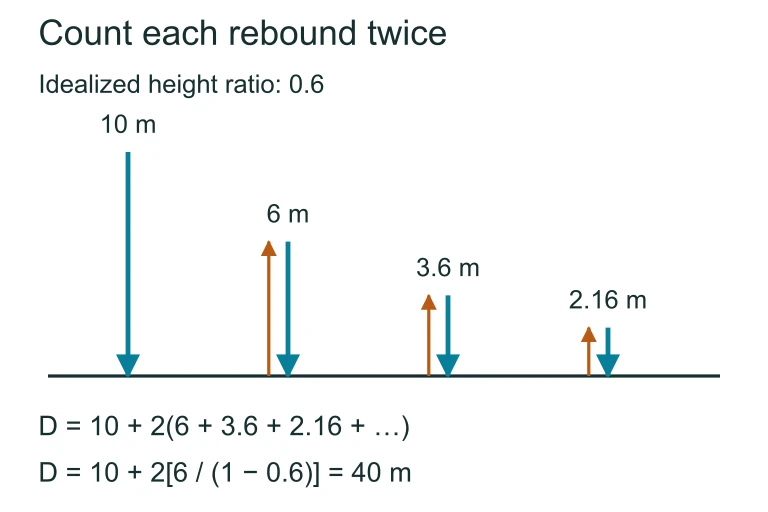 A ball falls 10 m and rebounds to 60% of its preceding height. Count the initial fall once and each rebound twice: the geometric series gives 40 m of total travel.
SECTION 5
Classifying Series Behavior
Infinite series can exhibit several distinct behaviors, which the diagram below organizes into a decision-tree style classification. A series either converges or diverges, and divergent series can diverge to +∞, to −∞, or by oscillation. Among convergent series, we further distinguish between absolute and conditional convergence—a topic explored in depth in later lessons, but the essential vocabulary is introduced here.
| Series | Terms aₖ | lim aₖ | Behavior |
|---|---|---|---|
| ∑ (1/2)ᵏ | (1/2)ᵏ | 0 | Converges to 1 |
| ∑ 1/k | 1/k | 0 | Diverges to +∞ |
| ∑ (−1)ⁿ | (−1)ⁿ | DNE | Diverges (oscillates) |
| ∑ 1/k² | 1/k² | 0 | Converges to π²/6 |
| ∑ (−1)ⁿ⁺¹/n | (−1)ⁿ⁺¹/n | 0 | Converges to ln 2 |
Examples illustrating that lim aₖ = 0 is necessary but not sufficient for convergence.
SECTION 6
Worked Example
Let us determine whether the series ∑ₖ₌₁∞ 3/(4ᵏ) converges or diverges, and if it converges, find its sum.
Worked example
- 1
Step 1 — Identify the Form
Rewrite the general term: 3/4ᵏ = 3 × (1/4)ᵏ. This is a geometric series with first term a₁ = 3/4 (when k = 1) and common ratio r = 1/4.Geometric series: a₁ = 3/4, r = 1/4 - 2
Step 2 — Check the Convergence Condition
A geometric series ∑ arᵏ converges if and only if |r| < 1. Here |r| = |1/4| = 0.25 < 1, so the series converges.|r| = 1/4 < 1 → series converges - 3
Step 3 — Compute the Partial Sum Formula
Write Sₙ = ∑ₖ₌₁ⁿ 3(1/4)ᵏ. Factor out the first term: Sₙ = (3/4) × [1 − (1/4)ⁿ] / [1 − 1/4] = (3/4) × [1 − (1/4)ⁿ] / (3/4) = 1 − (1/4)ⁿ.Sₙ = 1 − (1/4)ⁿ - 4
Step 4 — Take the Limit
As n → ∞, (1/4)ⁿ → 0. Therefore lim(n→∞) Sₙ = 1 − 0 = 1.∑ₖ₌₁∞ 3/4ᵏ = 1 - 5
Step 5 — Verify with the General Formula
Alternatively, use the standard geometric series sum starting at k = 1: a₁/(1 − r) = (3/4)/(1 − 1/4) = (3/4)/(3/4) = 1. This confirms our result.Confirmed: Sum = 1 ✓
SECTION 7
Key Comparisons & Common Misconceptions
| Property | Convergent Series | Divergent Series |
|---|---|---|
| lim Sₙ | Finite real number S | ±∞, or does not exist |
| lim aₙ | Must equal 0 (necessary) | May or may not be 0 |
| Adding finitely many terms | Does not affect convergence (changes sum) | Does not affect divergence |
| Scalar multiplication c∑aₖ | Converges to cS | Still diverges (if c ≠ 0) |
| Sum of two such series | Convergent + convergent = convergent | Divergent + divergent may converge or diverge |
Algebraic properties of convergent vs. divergent series
The table above highlights a subtle but important point: while the sum of two convergent series is always convergent, the sum of two divergent series is not necessarily divergent. For instance, ∑1/k and ∑(−1/k) are both divergent individually (the first diverges to +∞, the second to −∞), but their sum ∑(1/k − 1/k) = ∑0 = 0, which converges. This reinforces the principle that convergence properties do not combine symmetrically for divergent series.
SECTION 8
Connection to Advanced Theory
The definitions of convergence and divergence established here form the foundation for every subsequent topic in the AP Calculus BC series unit. The next natural steps include convergence tests (integral test, comparison tests, ratio test, root test, alternating series test) and power series, which generalize the concept by allowing each term to depend on a variable x, creating functions represented as infinite sums.
| This Lesson | Future Topics |
|---|---|
| Define convergence via lim Sₙ | Integral test: compare Sₙ to ∫f(x)dx |
| Geometric series (|r| < 1) | Ratio/root tests compare general aₙ₊₁/aₙ to a geometric benchmark |
| Divergence test (necessary condition) | Alternating series test adds sufficient conditions for oscillating series |
| Numerical series ∑aₖ | Power series ∑aₖxᵏ, Taylor/Maclaurin series |
How today's definitions connect to upcoming AP Calculus BC topics
In advanced mathematics beyond the AP syllabus, the concept of convergence generalizes further. In real analysis, Cauchy's criterion provides a characterization of convergence without requiring you to know the limit in advance: a series converges if and only if for every ε > 0 there exists N such that |Sₘ − Sₙ| < ε for all m > n > N. In functional analysis, notions like pointwise versus uniform convergence become critical when dealing with series of functions. The careful definitions you learn now—partial sums, limits, divergence—serve as the scaffolding for all of these extensions.
SECTION 9
Practice Problems
Question 1: CONCEPTUAL
- A. If lim(n→∞) aₙ = 0, then the series converges.
- B. If the series converges, then lim(n→∞) aₙ = 0.
- C. If Sₙ is bounded, then the series converges.
- D. If the series diverges, then lim(n→∞) aₙ ≠ 0.
- E. If lim(n→∞) aₙ exists, then the series converges.
Show answer (B)
Question 2: BASIC CALCULATION
- A. 15/4
- B. 5/4
- C. 15/2
- D. 10/3
- E. 3/5
Show answer (A)
Question 3: INTERMEDIATE
- A. Diverges
- B. Converges to 5/2
- C. Converges to 17/14
- D. Converges to 31/14
- E. Converges to 1
Show answer (C)
Question 4: APPLIED
Show answer
Question 5: CRITICAL THINKING