

SECTION 1
Historical Context & Motivation
The mathematical study of motion along a line — rectilinear kinematics — is one of the oldest and most consequential problems in the history of science. Ancient Greek philosophers, including Aristotle, attempted qualitative descriptions of motion but lacked the algebraic and analytic tools necessary to express speed or acceleration as precise quantities. It was not until the late medieval period that scholars at Oxford's Merton College formulated the mean speed theorem, which related uniformly accelerated motion to a constant average velocity — a conceptual precursor to the integral. Galileo's systematic experiments with inclined planes in the early seventeenth century provided the empirical grounding, but the full mathematical framework only crystallized when Newton and Leibniz independently invented calculus. The derivative gave scientists an instantaneous rate of change, and the integral gave them the ability to reconstruct total displacement from a velocity function — together forming the backbone of modern kinematics.
c. 1350 • Merton College Mean Speed Theorem
1638 • Galileo's Two New Sciences
1687 • Newton's Principia Mathematica
1684–1686 • Leibniz Publishes His Calculus
The central question this lesson addresses is deceptively simple: given one description of an object's straight-line motion — say, its position as a function of time — how do we systematically extract every other kinematic quantity? Calculus transforms this question into a routine application of differentiation and antidifferentiation, and the AP Calculus BC exam tests your ability to move fluently among position, velocity, and acceleration in both analytic and graphical settings.
SECTION 2
Core Principles & Definitions
When a particle moves along a straight line, its state at any instant is captured by three interrelated functions of time. Understanding how these functions connect through differentiation and integration is the conceptual nucleus of this topic. The following four principles form the foundation you will use to analyze every rectilinear motion problem on the AP exam.
Position s(t)
Velocity v(t) = s′(t)
Acceleration a(t) = v′(t) = s″(t)
Speed = |v(t)|
KEY TAKEAWAY
SECTION 3
Visual Explanation — The Derivative Chain
The diagram below illustrates the core relationship among the three kinematic functions for a representative position function s(t) = t³ − 6t² + 9t over the interval [0, 5]. Observe how the zeros of v(t) correspond to the local extrema of s(t), and how the zero of a(t) corresponds to the inflection point of s(t). These graphical connections are heavily tested on the AP exam.
Several graphical connections visible in the diagram are tested repeatedly on the AP exam. When the velocity function crosses the time axis from positive to negative (at t = 1), the position function has a local maximum; when it crosses from negative to positive (at t = 3), the position has a local minimum. Meanwhile, the sign of acceleration tells you the concavity of the position graph: when a(t) < 0 (for t < 2), the position graph is concave down, and when a(t) > 0 (for t > 2), the position graph is concave up. The moment a(t) = 0 at t = 2 corresponds to the inflection point of s(t). Training yourself to read across these three panels simultaneously will dramatically speed up your work on free-response questions.
SECTION 4
Mathematical Framework
The mathematical relationships in rectilinear motion flow from the fundamental theorem of calculus. Below are the four essential equations you must internalize. Each one is a direct consequence of the derivative–antiderivative relationship, and together they allow you to move freely among position, velocity, and acceleration.
VELOCITY FROM POSITION
The instantaneous velocity at time t is the derivative of the position function. A positive value means the particle moves in the positive direction; a negative value means it moves in the negative direction.
ACCELERATION FROM VELOCITY
The instantaneous acceleration is the derivative of velocity (equivalently the second derivative of position). When v and a share the same sign, speed is increasing; when they differ in sign, speed is decreasing.
DISPLACEMENT VIA INTEGRATION
The net displacement (change in position) over [a, b] is the definite integral of velocity. This is the signed area between v(t) and the t-axis: area above the axis is positive displacement, area below is negative displacement.
TOTAL DISTANCE VIA INTEGRATION
The total distance traveled (always non-negative) is the integral of the speed |v(t)|. In practice, you split the interval at the zeros of v(t), integrate each subinterval separately, and take absolute values before summing.
AP Exam Tip: Displacement ≠ Distance
SECTION 5
Speeding Up vs. Slowing Down — A Detailed Breakdown
Determining whether a particle is speeding up or slowing down at a given instant requires analyzing the signs of both v(t) and a(t) simultaneously. This is a subtle but critical distinction: a particle moving in the negative direction can still be speeding up if it is accelerating in the negative direction. The rule is elegant — speed increases when velocity and acceleration point the same way, and decreases when they oppose each other.
To apply this analysis systematically on the AP exam, follow three steps. First, find the zeros of v(t) to determine where the particle changes direction. Second, find the zeros of a(t) to identify where the concavity of s(t) changes. Third, construct a sign chart for both v and a over the relevant intervals, then examine the product v(t) × a(t) on each subinterval. Where the product is positive, the particle is speeding up; where it is negative, the particle is slowing down. At instants where either v or a is zero, the behavior is transitional and the particle is momentarily neither speeding up nor slowing down in the usual sense.
SECTION 6
Worked Example
A particle moves along a straight line with velocity v(t) = 3t² − 12t + 9 for t ≥ 0. At time t = 0 the particle is at position s(0) = 2. Find (a) the position function s(t), (b) the total distance traveled from t = 0 to t = 4, and (c) the intervals on which the particle is speeding up.
Full Solution: Position, Distance, and Speed Analysis
- 1
Step 1 — Find s(t) by Antidifferentiating v(t)
Since v(t) = ds/dt = 3t² − 12t + 9, integrate term by term: s(t) = ∫(3t² − 12t + 9) dt = t³ − 6t² + 9t + C. Use the initial condition s(0) = 2 to solve for C: 0 − 0 + 0 + C = 2, so C = 2.s(t) = t³ − 6t² + 9t + 2 - 2
Step 2 — Find When the Particle Changes Direction
Set v(t) = 0: 3t² − 12t + 9 = 0 → 3(t² − 4t + 3) = 0 → 3(t − 1)(t − 3) = 0. The velocity is zero at t = 1 and t = 3. Since v(t) factors as 3(t − 1)(t − 3), a sign analysis reveals v > 0 on (0, 1), v < 0 on (1, 3), and v > 0 on (3, 4). The particle reverses direction at t = 1 and again at t = 3.Direction changes at t = 1 and t = 3 - 3
Step 3 — Compute Total Distance on [0, 4]
Evaluate s at the critical times and endpoints: s(0) = 2, s(1) = 1 − 6 + 9 + 2 = 6, s(3) = 27 − 54 + 27 + 2 = 2, s(4) = 64 − 96 + 36 + 2 = 6. The distance on each subinterval is |s(1) − s(0)| + |s(3) − s(1)| + |s(4) − s(3)| = |6 − 2| + |2 − 6| + |6 − 2| = 4 + 4 + 4.Total distance = 12 - 4
Step 4 — Find a(t) and Determine Speeding-Up Intervals
Differentiate velocity: a(t) = v′(t) = 6t − 12. Then a(t) = 0 at t = 2. Sign chart: a < 0 for t ∈ (0, 2) and a > 0 for t ∈ (2, ∞). Now combine with the sign of v: on (0, 1), v > 0 and a < 0 → opposite signs → slowing down. On (1, 2), v < 0 and a < 0 → same sign → speeding up. On (2, 3), v < 0 and a > 0 → opposite signs → slowing down. On (3, 4), v > 0 and a > 0 → same sign → speeding up.Speeding up on (1, 2) ∪ (3, 4)
SECTION 7
Common Pitfalls & Comparisons
Even strong calculus students lose points on motion problems because of a few recurring conceptual traps. The table below catalogs the most frequent errors and contrasts them with the correct reasoning. Committing these distinctions to memory before exam day can be worth several points.
| Common Mistake | Correct Reasoning |
|---|---|
| Saying the particle speeds up whenever a(t) > 0. | Speed increases when v(t) and a(t) share the same sign, regardless of whether that sign is positive or negative. |
| Computing ∫₀ᵇ v(t) dt to find total distance. | That integral gives net displacement (signed area). Total distance requires ∫₀ᵇ |v(t)| dt, splitting at zeros of v. |
| Assuming v(t) = 0 means the particle has stopped permanently. | v(t) = 0 only means the particle is at rest at that instant. If a(t) ≠ 0 there, the particle immediately resumes motion. |
| Forgetting the constant of integration when recovering s(t) from v(t). | An initial condition (e.g., s(0) = 5) is needed to pin down the unique position function. The AP scoring guide requires it. |
| Confusing 'moving to the left' with 'slowing down.' | Moving left means v < 0. Slowing down means |v| is decreasing. A particle can move left and speed up simultaneously. |
Common mistakes on AP rectilinear motion problems
KEY TAKEAWAY
 The distinction between net change and total movement also appears in flowing water. Suppose a tank receives and releases 4 gal/min for 5 minutes. Its 200 gal inventory stays constant while 20 gal enters and 20 gal leaves: net change is zero and total throughput is 40 gal.
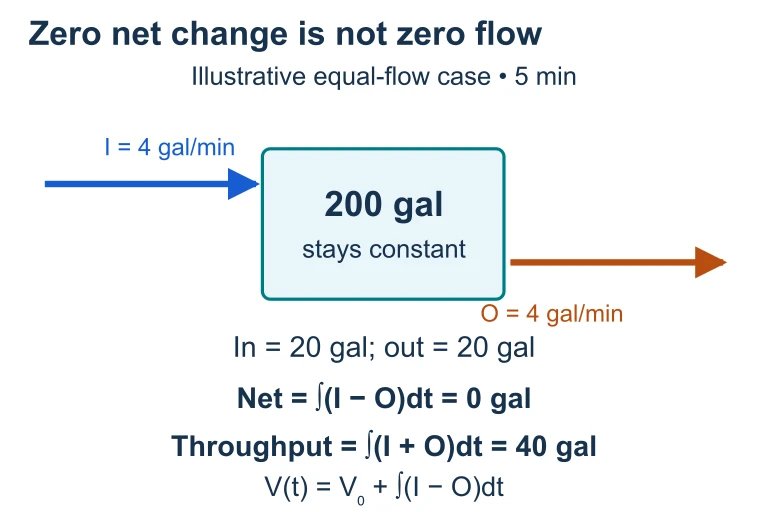 The distinction between net change and total movement also appears in flowing water. Suppose a tank receives and releases 4 gal/min for 5 minutes. Its 200 gal inventory stays constant while 20 gal enters and 20 gal leaves: net change is zero and total throughput is 40 gal.
SECTION 8
Connection to Advanced Theory — Motion in Higher Dimensions
Straight-line motion is the one-dimensional specialization of a much richer framework: vector-valued functions and parametric motion, which appear later in the AP Calculus BC curriculum. The table below summarizes how the key ideas generalize as you move from one-dimensional kinematics to the planar and three-dimensional settings you will encounter in Unit 9 (Parametric Equations, Polar Coordinates, and Vector-Valued Functions).
| Concept | Rectilinear (1-D) | Parametric / Vector (2-D or 3-D) |
|---|---|---|
| Position | s(t), a scalar function | r⃗(t) = ⟨x(t), y(t)⟩, a vector function |
| Velocity | v(t) = s′(t), a scalar | v⃗(t) = ⟨x′(t), y′(t)⟩, a vector tangent to the path |
| Speed | |v(t)| | ‖v⃗(t)‖ = √(x′² + y′²) |
| Total distance | ∫ₐᵇ |v(t)| dt | ∫ₐᵇ ‖v⃗(t)‖ dt (arc length) |
| Acceleration | a(t) = v′(t), a scalar | a⃗(t) = ⟨x″(t), y″(t)⟩, a vector |
Generalizing rectilinear motion to higher dimensions
Notice that every formula you learn for straight-line motion has a direct vector analogue. The scalar absolute value |v(t)| becomes the magnitude of the velocity vector ‖v⃗(t)‖, and the signed integral becomes a scalar integral of that magnitude. If you build deep fluency with the one-dimensional case now, the transition to parametric and vector-valued motion will feel like a natural extension rather than a new topic. Many free-response questions on the BC exam blend both settings, so practicing the 1-D framework thoroughly is an investment that pays dividends across the entire second half of the course.
SECTION 9
Practice Problems
Question 1: CONCEPTUAL
- A. The particle is moving to the right and speeding up.
- B. The particle is moving to the left and slowing down.
- C. The particle is moving to the left and speeding up.
- D. The particle is moving to the right and slowing down.
- E. The particle is at rest and about to change direction.
Show answer (C)
Question 2: BASIC CALCULATION
- A. t = 1 only
- B. t = 2 only
- C. t = 1 and t = 2
- D. t = 3 only
- E. t = 0, t = 1, and t = 2
Show answer (C)
Question 3: INTERMEDIATE
- A. 3 − 2/π
- B. 3
- C. 3 + 2/π
- D. 6/π
- E. 3 + 4/π
Show answer (A)
Question 4: APPLIED
5 ptsShow answer
Question 5: CRITICAL THINKING
3 ptsShow answer
Correction Note — Problem 3
SUMMARY
Lesson Summary
Summary
Straight-line motion connects three fundamental functions through the machinery of calculus. The position function s(t) tells you where the particle is. Its first derivative yields the velocity v(t) = s′(t), which encodes both speed and direction: positive for rightward motion, negative for leftward. The second derivative produces the acceleration a(t) = v′(t). A particle speeds up when v and a share the same sign and slows down when they differ in sign.
To reverse direction — from velocity back to position — you integrate. The net displacement on [a, b] equals ∫ₐᵇ v(t) dt (signed area), while the total distance traveled equals ∫ₐᵇ |v(t)| dt (unsigned area). Remember that recovering s(t) from v(t) requires an initial condition to resolve the constant of integration. Master these relationships and the sign-chart technique for speed analysis, and you will be well prepared for both the multiple-choice and free-response sections of the AP Calculus BC exam.