

SECTION 1
Historical Context & Motivation
The problem of measuring the length of a curve — as opposed to a straight line segment — is one of the oldest challenges in mathematics, stretching back to antiquity when Greek geometers attempted to determine the circumference of a circle. The concept of rectification, the process of finding the exact length of a curve, remained elusive for centuries because it required summing infinitely many infinitesimal line segments, a task that awaited the development of calculus. With the invention of parametric equations — which express the x- and y-coordinates of a curve as separate functions of a parameter — mathematicians gained a powerful tool for describing curves that could loop, self-intersect, or trace paths impossible to capture as a single function y = f(x). The arc length formula for parametric curves unites the ideas of differential calculus (local linear approximation) and integral calculus (accumulation) in an elegant and broadly applicable way.
~250 BCE • Archimedes and Curved Lengths
1637 • Descartes & Parametric Thinking
1659 • First Rectification Proofs
1680s • Newton & Leibniz Formalize Calculus
18th C. • Euler and Parametric Curves
The central question this lesson addresses is deceptively simple: given a curve defined parametrically by x = f(t) and y = g(t) for t in some interval [a, b], how do we compute the total distance traveled along the curve? The answer involves constructing an integral that sums up infinitesimal straight-line displacements, each computed from the derivatives dx/dt and dy/dt, across the parameter interval.
SECTION 2
Core Principles & Definitions
Before diving into the formula, it is essential to ground ourselves in the foundational ideas that make the parametric arc length integral work. These principles connect differential geometry to the integral calculus you have already mastered and establish the conditions under which the formula is valid.
Parametric Representation
Smoothness Condition
Infinitesimal Displacement
Accumulation via Integration
Non-Negative Integrand
KEY TAKEAWAY
SECTION 3
Visual Explanation
The diagram above illustrates the fundamental idea behind the arc length integral. We partition the parameter interval [a, b] into n subintervals, each of width Δt = (b − a)/n. At each partition point tk, we plot the point (f(tk), g(tk)) and connect consecutive points with straight line segments (the amber dashed lines). The length of the k-th segment is √((Δxk)² + (Δyk)²), and the total approximate arc length is the sum of all such segments. As n → ∞, this Riemann-style sum converges to the definite integral that gives the exact arc length — a beautiful synthesis of local linear approximation and global accumulation.
SECTION 4
Mathematical Framework
We now derive the parametric arc length formula rigorously. Consider a curve C given by x = f(t) and y = g(t) for t ∈ [a, b], where f′ and g′ are continuous on [a, b]. Partition the interval into n equal subintervals with endpoints t0 = a < t1 < ⋯ < tn = b. On the k-th subinterval, the Mean Value Theorem guarantees the existence of intermediate points ck and dk such that Δxk = f′(ck)Δt and Δyk = g′(dk)Δt. Substituting into the Pythagorean expression and factoring out Δt yields an integrable expression as n → ∞.
INFINITESIMAL ARC LENGTH ELEMENT
ds represents the infinitesimal arc length, dx/dt = f′(t) is the rate of change of x, and dy/dt = g′(t) is the rate of change of y.
PARAMETRIC ARC LENGTH FORMULA
L is the total arc length of the curve from t = a to t = b. The integrand √((f′(t))² + (g′(t))²) equals the speed of the parametric particle at time t.
SPEED INTERPRETATION
If t represents time, the integrand is the instantaneous speed of a particle tracing the curve. Thus, arc length equals the integral of speed — consistent with the physics formula distance = ∫ speed dt.
Smoothness Requirement
It is worth noting that the parametric arc length formula reduces to the familiar Cartesian arc length formula when the parameter is x itself. Setting x = t and y = f(t), we have dx/dt = 1, so the integrand becomes √(1 + (f′(x))²), recovering L = ∫ₐᵇ √(1 + (dy/dx)²) dx. This confirms that the parametric formula is a generalization of the single-variable result you encountered earlier in the course.
SECTION 5
Setting Up Arc Length Integrals
The most challenging aspect of parametric arc length problems on the AP exam is not the formula itself — it is correctly computing the derivatives, simplifying the expression under the radical, and identifying the proper bounds of integration. In this section we examine a systematic approach to setting up these integrals, along with a detailed visual reference for a common parametric curve.
Step-by-Step Setup Strategy
- Identify the parametric equations and the interval [a, b] for the parameter t.
- Compute dx/dt and dy/dt separately using standard differentiation rules (chain rule, product rule, etc.).
- Square each derivative and add: (dx/dt)² + (dy/dt)².
- Simplify the expression under the radical — look for perfect squares, trigonometric identities (especially Pythagorean and half-angle), or common factors.
- Integrate √((dx/dt)² + (dy/dt)²) from a to b. If no closed form exists, leave the integral or evaluate with a calculator.
AP Exam Tip
 A radius-one wheel rolling without slipping traces x = t − sin t and y = 1 − cos t. Over 0 ≤ t ≤ 2π, the wheel advances 2π units while its rim point travels an arch of length 8.
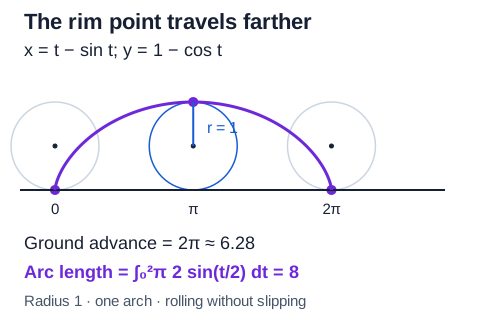 A radius-one wheel rolling without slipping traces x = t − sin t and y = 1 − cos t. Over 0 ≤ t ≤ 2π, the wheel advances 2π units while its rim point travels an arch of length 8.Open full diagram
SECTION 6
Worked Example
Let us find the arc length of one arch of the cycloid defined by x = t − sin t, y = 1 − cos t for t ∈ [0, 2π]. This classic example showcases useful trigonometric simplification techniques.
Arc Length of One Arch of a Cycloid
- 1
Step 1 — Compute the Derivatives
Differentiate each coordinate function with respect to t. We have dx/dt = 1 − cos t and dy/dt = sin t. - 2
Step 2 — Form the Integrand
Square each derivative and add: (dx/dt)² + (dy/dt)² = (1 − cos t)² + sin²t = 1 − 2cos t + cos²t + sin²t = 1 − 2cos t + 1 = 2 − 2cos t.(dx/dt)² + (dy/dt)² = 2 − 2cos t - 3
Step 3 — Simplify Using a Trigonometric Identity
Apply the half-angle identity: 1 − cos t = 2sin²(t/2). Therefore 2 − 2cos t = 4sin²(t/2), and √(2 − 2cos t) = 2|sin(t/2)|. On [0, 2π], sin(t/2) ≥ 0, so the absolute value is unnecessary.√(2 − 2cos t) = 2sin(t/2) - 4
Step 4 — Set Up and Evaluate the Integral
L = ∫₀²π 2sin(t/2) dt. Let u = t/2, so du = dt/2, meaning dt = 2 du. When t = 0, u = 0; when t = 2π, u = π. Then L = ∫₀π 2sin(u) × 2 du = 4∫₀π sin(u) du = 4[−cos(u)]₀π = 4(−cos π + cos 0) = 4(1 + 1) = 8.L = 8
The arc length of one arch of a cycloid generated by a circle of radius r is 8r. In our example, r = 1, so L = 8. This elegant result — the arc length is exactly four times the diameter of the generating circle — was first established by Christopher Wren in 1658, making the cycloid one of the first curves to be successfully rectified.
SECTION 7
Strengths, Limitations & Common Pitfalls
| Aspect | Strength | Limitation / Pitfall |
|---|---|---|
| Generality | Works for any smooth curve, including those that cannot be written as y = f(x). | Requires the curve to be smooth (C¹); cusps and corners need piecewise treatment. |
| Closed-Form Evaluation | Trig identities and algebraic simplification often yield elegant exact answers. | Many arc length integrals have no elementary antiderivative and require numerical methods. |
| Bounds of Integration | Integration bounds come directly from the parameter interval, making setup straightforward. | If the curve retraces itself, you must restrict the parameter to an interval where the curve is traversed once to avoid double-counting. |
| Speed Interpretation | The integrand has a clear physical meaning as speed, aiding intuition. | Students sometimes confuse speed √((dx/dt)² + (dy/dt)²) with velocity components or with |dy/dx|. |
| Simplification | Squaring and adding derivatives often leads to useful cancellations (e.g., a²cos²t + a²sin²t = a²). | Forgetting to simplify before integrating can lead to unnecessarily complicated integrands. |
Strengths and limitations of the parametric arc length formula
KEY TAKEAWAY
SECTION 8
Connections to Advanced Topics
The parametric arc length formula is not an isolated result; it serves as a gateway to several important ideas in multivariable calculus, differential geometry, and physics. Understanding how this formula extends and connects to broader mathematical structures will deepen your appreciation for its elegance and prepare you for college-level coursework.
| This Course (AP Calculus BC) | Extension / Advanced Topic |
|---|---|
| L = ∫ₐᵇ √((dx/dt)² + (dy/dt)²) dt (2D parametric) | L = ∫ₐᵇ √((dx/dt)² + (dy/dt)² + (dz/dt)²) dt — 3D space curves in Calculus III |
| Arc length as accumulated distance along a curve | Arc length parameterization s(t), where the parameter itself is distance — fundamental in differential geometry for defining curvature |
| Polar arc length: L = ∫ₐᵇ √(r² + (dr/dθ)²) dθ | The polar formula is derived from the parametric formula by setting x = r(θ)cos θ, y = r(θ)sin θ |
| Integrand √((dx/dt)² + (dy/dt)²) = speed | In physics, this connects to the magnitude of the velocity vector |v(t)| = ||r′(t)||, central to kinematics |
How parametric arc length connects to advanced topics
On the AP Calculus BC exam, parametric arc length is directly tested both as a standalone skill and as part of broader problems involving parametric and vector-valued functions. The related topic of polar arc length uses identical underlying logic: the differential arc length element ds is always the magnitude of the displacement vector, regardless of the coordinate system used to describe the curve.
SECTION 9
Practice Problems
Question 1: CONCEPTUAL
- A. Because arc length is always computed as the absolute value of dx/dt plus the absolute value of dy/dt
- B. Because each infinitesimal arc segment is approximated by a straight line whose length follows from the Pythagorean theorem applied to horizontal and vertical displacements
- C. Because the formula is derived from the dot product of the velocity vector with the position vector
- D. Because the derivatives dx/dt and dy/dt must be positive for the curve to have a well-defined length
- E. Because the chain rule requires squaring derivatives when changing the variable of integration
Show answer (B)
Question 2: BASIC CALCULATION
- A. 3
- B. 3π
- C. 6π
- D. 9π
- E. π/3
Show answer (B)
Question 3: INTERMEDIATE
- A. ∫₀¹ √(4t² + 9t⁴) dt
- B. ∫₀¹ √(2t + 3t²) dt
- C. ∫₀¹ √(t⁴ + t⁶) dt
- D. ∫₀¹ (4t² + 9t⁴) dt
- E. ∫₀¹ √(4 + 9t²) dt
Show answer (A)
Question 4: APPLIED
5 ptsShow answer
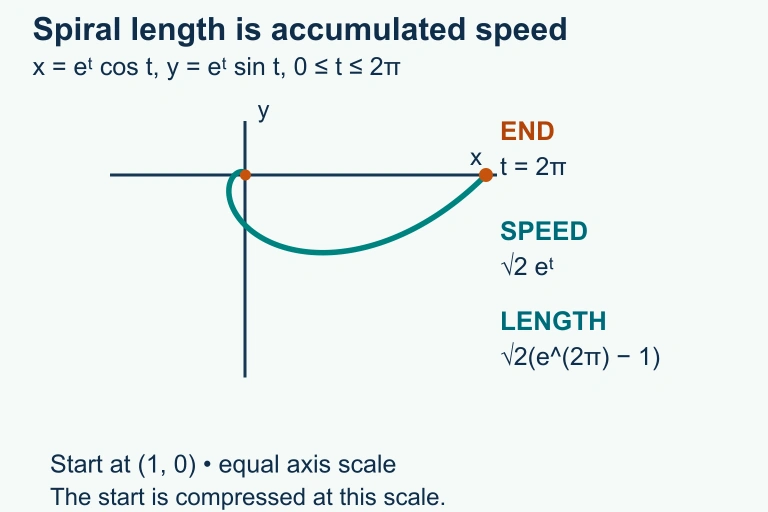 The full spiral and enlarged start are a single package. Local chord triangles explain accumulated path length. Endpoint displacement has magnitude e^(2π)−1, whereas path length is √2(e^(2π)−1).
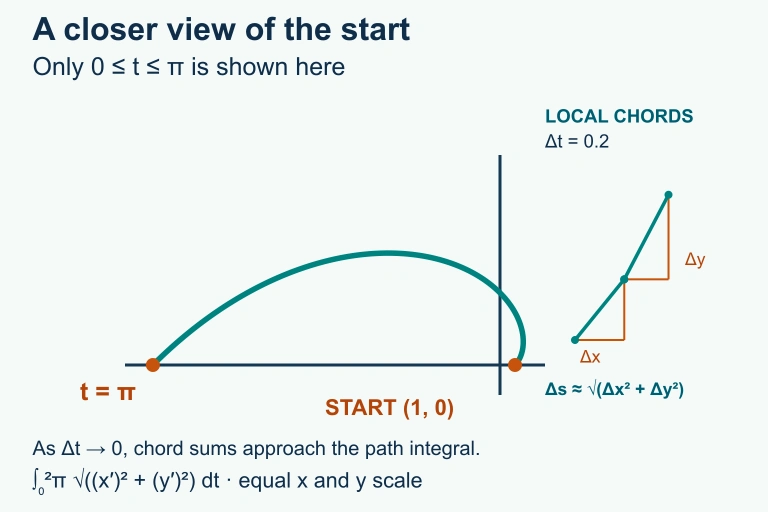 Local chord triangles approximate arc length; equal Δt=0.2 steps lie on x=e^t cos t, y=e^t sin t. Deliver with the full-spiral view.
Question 5: CRITICAL THINKING
4 ptsShow answer
SUMMARY
Lesson Summary
Summary
The parametric arc length formula L = ∫ₐᵇ √((dx/dt)² + (dy/dt)²) dt computes the total distance along a smooth curve defined by x = f(t) and y = g(t) over the parameter interval [a, b]. The derivation rests on approximating infinitesimal arc segments via the Pythagorean theorem and then accumulating those segments through integration. The integrand √((dx/dt)² + (dy/dt)²) has a direct physical interpretation as the instantaneous speed of a particle tracing the curve, so arc length equals the integral of speed over time.
Key problem-solving strategies include: computing dx/dt and dy/dt carefully, simplifying the expression under the radical using trigonometric identities or algebraic factoring, verifying that the smoothness condition is met on the interval, and recognizing when the integral must be evaluated numerically versus exactly. This formula generalizes naturally to polar arc length and to three-dimensional space curves, making it one of the most broadly applicable tools in calculus.