

SECTION 1
Historical Context & Motivation
Long before the formal notation of calculus existed, scholars grappled with the fundamental question of how to determine total quantities from rates of change. Ancient Greek mathematicians, most notably Archimedes, used the method of exhaustion to compute areas bounded by curves—an early precursor to what we now call definite integration. The conceptual leap from summing infinitesimally thin slices to evaluating a closed-form antiderivative took nearly two millennia to formalize, but the practical impulse was always the same: given how quickly something changes, how much of it accumulates over an interval? This question sits at the heart of every applied accumulation problem you will encounter on the AP Calculus BC exam.
~250 BCE • Archimedes' Method of Exhaustion
1668 • Barrow's Geometric Lectures
1687 • Newton's Principia Mathematica
1823 • Cauchy Formalizes the Definite Integral
The recurring question that unites these historical milestones is deceptively simple: If we know the rate at which a quantity changes, how do we recover the total amount that has accumulated over a specific time interval? In the AP Calculus BC curriculum, this question is answered by the accumulation function and the definite integral, tools that translate continuous rate information into net or total change in applied settings ranging from physics to economics.
SECTION 2
Core Principles & Definitions
Before diving into applications, it is essential to anchor the discussion in four foundational ideas. The accumulation function F(x) = ∫ from a to x of f(t) dt represents the net accumulation of the quantity whose rate of change is f(t), starting from a baseline at t = a. This is not merely a formula—it is the conceptual bridge between a rate graph and the total quantity that results from that rate over time. A firm grasp of the following principles will allow you to decode any applied integration problem the AP exam presents.
Net Change Theorem
Accumulation Function as Output
FTC Part I Connection
Units Interpretation
KEY TAKEAWAY
SECTION 3
Visual Explanation — Accumulation as Area
The most powerful way to internalize accumulation is geometrically. When a rate function f(t) is graphed, the signed area between the curve and the t-axis over an interval [a, b] equals the net change in the accumulated quantity. Area above the axis contributes positively (the quantity increases), while area below the axis contributes negatively (the quantity decreases). The diagram below illustrates this for a velocity function v(t), where the accumulated area represents displacement.
This geometric interpretation generalizes to any rate-quantity pair. If f(t) represents the rate of water flowing into a tank (in gallons per minute), then ∫ from a to b of f(t) dt gives the net change in the volume of water over [a, b]. Regions where f(t) < 0 correspond to water flowing out. The interplay between net change (signed integral) and total change (integral of the absolute value) is a distinction the AP exam tests frequently and explicitly.
SECTION 4
Mathematical Framework
The mathematical backbone of accumulation problems rests on the Net Change Theorem and its formalization through the Fundamental Theorem of Calculus. These equations provide the toolkit for transforming rate data—whether given algebraically, graphically, or in a table—into meaningful accumulated quantities.
NET CHANGE THEOREM
Where f is continuous on [a, b] and F is any antiderivative of f. The left side represents the accumulation of the rate f over [a, b]; the right side gives the net change in the quantity F.
ACCUMULATION FUNCTION
F(a) is the initial value of the quantity at t = a. The integral represents all subsequent accumulation. This form is especially useful when a problem provides an initial condition.
TOTAL ACCUMULATED QUANTITY (UNSIGNED)
When the problem asks for total distance (not displacement), total amount gained or lost (not net), or total production regardless of direction, integrate the absolute value of the rate.
FTC PART I — RATE OF ACCUMULATION
The instantaneous rate of change of the accumulation function at x equals the integrand evaluated at x. If the upper limit is a composite function g(x), apply the chain rule: d/dx [∫ₐ^{g(x)} f(t) dt] = f(g(x)) · g′(x).
AP Exam Tip
 Suppose a tank receives and releases 4 gal/min for 5 minutes. Its 200 gal inventory stays constant while 20 gal enters and 20 gal leaves: net change is zero and total throughput is 40 gal.
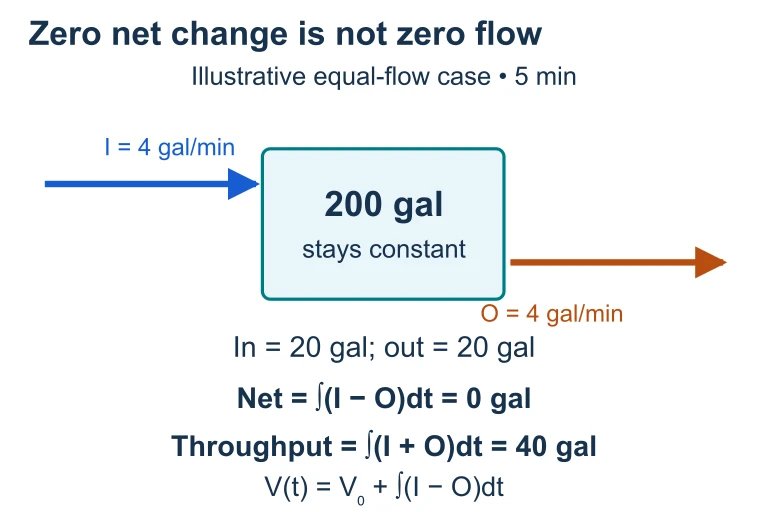 Suppose a tank receives and releases 4 gal/min for 5 minutes. Its 200 gal inventory stays constant while 20 gal enters and 20 gal leaves: net change is zero and total throughput is 40 gal.
SECTION 5
Detailed Breakdown — Common Applied Contexts
The AP Calculus BC exam embeds accumulation problems in diverse physical and economic scenarios. While the underlying mathematics is always the same—integrating a rate to obtain net or total change—success depends on recognizing the rate-quantity pair specific to each context. The table below catalogs the most frequently tested applied contexts, together with the appropriate units interpretation and the distinction between net and total accumulation for each.
| Context | Rate Function f(t) | ∫ f(t) dt Represents | Units Example |
|---|---|---|---|
| Motion | Velocity v(t) | Net displacement (signed) or total distance (unsigned) | m/s × s = meters |
| Population | Growth rate P′(t) | Net change in population over [a, b] | people/yr × yr = people |
| Fluid Flow | Flow rate R(t) | Net volume gained/lost in a tank | gal/min × min = gallons |
| Economics | Marginal cost C′(x) | Total cost of producing from unit a to unit b | $/unit × units = dollars |
| Energy | Power P(t) (watts) | Total energy consumed over [a, b] | J/s × s = joules |
Common rate-quantity pairs on the AP Calculus BC exam
Observe how the left panel (rate graph) and right panel (quantity graph) are related. At any time t, the slope of V(t) on the right equals the height of R(t) on the left—this is the Fundamental Theorem of Calculus in action. When R(t) is large and positive, V(t) rises steeply; when R(t) is small, V(t) flattens. If R(t) were to become negative (outflow exceeding inflow), V(t) would decrease. Recognizing this graphical correspondence is vital for the AP exam, where you may be asked to sketch one graph given the other, or to determine when a maximum or minimum of V(t) occurs by locating the zeros of R(t).
SECTION 6
Worked Example — Water Tank Problem
Water flows into a tank at a rate of R(t) = 6t − t² gallons per minute, for 0 ≤ t ≤ 6. At time t = 0, the tank contains 20 gallons of water. Find the amount of water in the tank at t = 6 minutes, and determine at what time the tank has the most water.
Water Tank Accumulation Problem
- 1
Step 1 — Identify the Accumulation Equation
We use the accumulation framework: V(t) = V(0) + ∫₀ᵗ R(s) ds. Here V(0) = 20 gallons and R(t) = 6t − t². The variable of integration is renamed to s to avoid confusion with the upper limit t. - 2
Step 2 — Compute the Definite Integral
∫₀⁶ (6t − t²) dt = [3t² − t³/3] evaluated from 0 to 6 = (3·36 − 216/3) − 0 = 108 − 72 = 36. The net accumulation over 6 minutes is 36 gallons.∫₀⁶ R(t) dt = 36 gallons - 3
Step 3 — Apply the Initial Condition
V(6) = V(0) + 36 = 20 + 36 = 56. At t = 6 minutes, the tank contains 56 gallons.V(6) = 56 gallons - 4
Step 4 — Find the Maximum Volume
By FTC Part I, V′(t) = R(t) = 6t − t² = t(6 − t). Setting V′(t) = 0 gives t = 0 or t = 6. Since R(t) = t(6 − t) > 0 for all t in (0, 6), R(t) never becomes negative on this interval, meaning V is strictly increasing. The maximum volume on [0, 6] therefore occurs at the right endpoint, t = 6.Maximum volume of 56 gallons at t = 6 - 5
Step 5 — Interpret and Verify Units
Units check: R(t) is in gallons/minute, dt is in minutes, so ∫ R(t) dt is in gallons. Adding this to the initial volume (also in gallons) confirms that V(6) = 56 gallons is dimensionally consistent. On the AP exam, always state the units of your final answer.
SECTION 7
Net Change vs. Total Accumulation — Key Distinctions
One of the most common sources of error on the AP exam is confusing net change with total accumulation. The definite integral ∫ₐᵇ f(t) dt automatically computes net change because the integrand can assume negative values, which cancel positive contributions. When a problem asks for the total quantity regardless of sign—such as total distance traveled, total gallons pumped (in and out combined), or total production—you must integrate the absolute value |f(t)|. The following table distills the distinction across several applied contexts.
| Question Phrasing | Integral Setup | Key Word Cues |
|---|---|---|
| What is the displacement? | ∫ₐᵇ v(t) dt | displacement, net change, position change |
| What is the total distance traveled? | ∫ₐᵇ |v(t)| dt | total distance, distance traveled |
| What is the net change in volume? | ∫ₐᵇ (inflow − outflow) dt | net change, overall change |
| What is the total volume that flows through? | ∫ₐᵇ |inflow − outflow| dt or separate integrals | total amount flowing |
| What is the position at time b? | x(a) + ∫ₐᵇ v(t) dt | position at, value at, how much is there at |
Net change vs. total accumulation: language cues and integral setups
EXAM STRATEGY
SECTION 8
Connection to Advanced Theory
Accumulation functions and definite integrals in applied contexts form the bridge to several advanced topics on the AP Calculus BC exam and in higher mathematics. Understanding how this foundational idea extends will help you see the bigger picture and prepare for cross-topic exam questions.
| This Lesson's Concept | Advanced Extension | Where It Appears |
|---|---|---|
| ∫ₐᵇ f(t) dt as net change | Improper integrals: ∫ₐ^∞ f(t) dt as total long-run accumulation when one bound is infinite | BC Topic 6.13; convergence tests |
| Accumulation function F(x) = ∫ₐˣ f(t) dt | Differential equations: the integral as the general solution to dy/dx = f(x) with initial condition y(a) = y₀ | BC Topics 7.1–7.9 |
| Units of ∫ f(t) dt | Average value of a function: (1/(b−a)) ∫ₐᵇ f(t) dt gives the mean rate or mean value over [a, b] | BC Topic 8.1 |
| Signed area and rate-quantity interpretation | Parametric and polar area: accumulation of area swept in polar or traced by parametric curves | BC Topics 9.8–9.9 |
How accumulation concepts extend to advanced BC topics
In multivariable calculus and beyond, the accumulation idea extends to line integrals, surface integrals, and even probability—where the CDF F(x) = ∫₋∞ˣ f(t) dt accumulates probability density. The interpretive skill you build here—reading a rate, setting up the integral, and interpreting the output with correct units—is the same skill required for every one of these extensions. Mastering it now provides compounding returns throughout your mathematical career.
SECTION 9
Practice Problems
Question 1: CONCEPTUAL
- A. The particle is at position x = −3 at t = 10.
- B. The particle traveled a total distance of 3 units.
- C. At t = 10, the particle is 3 units to the left of its starting position.
- D. The particle's velocity was negative for the entire interval.
- E. The particle's acceleration was negative for the entire interval.
Show answer (C)
Question 2: BASIC CALCULATION
- A. 10 + 32/3
- B. 32/3
- C. 10 + 16
- D. 10 + 8
- E. 42/3
Show answer (A)
Question 3: INTERMEDIATE
- A. 0 meters
- B. 6/π meters
- C. 12/π meters
- D. 18/π meters
- E. 6 meters
Show answer (C)
Question 4: APPLIED
5 ptsShow answer
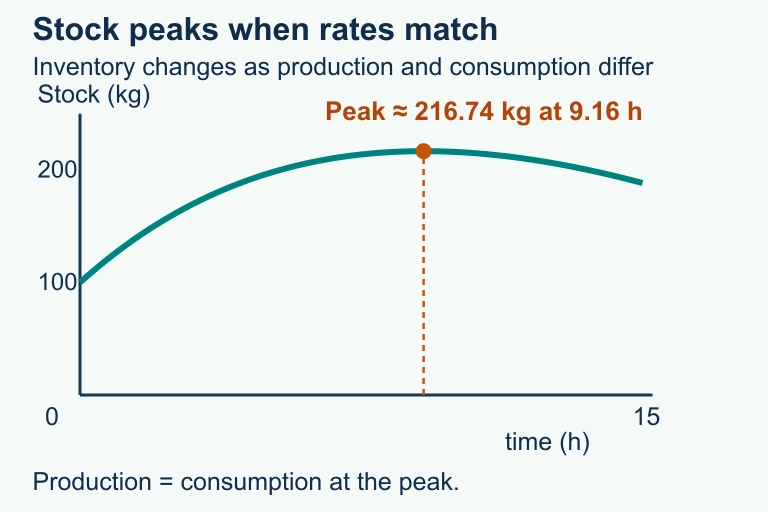 Inventory peaks when declining production first equals constant consumption; gross inlet and outlet totals remain distinct from net change. The vessel cutaway illustrates flow connections; its contents and stock level are unspecified.
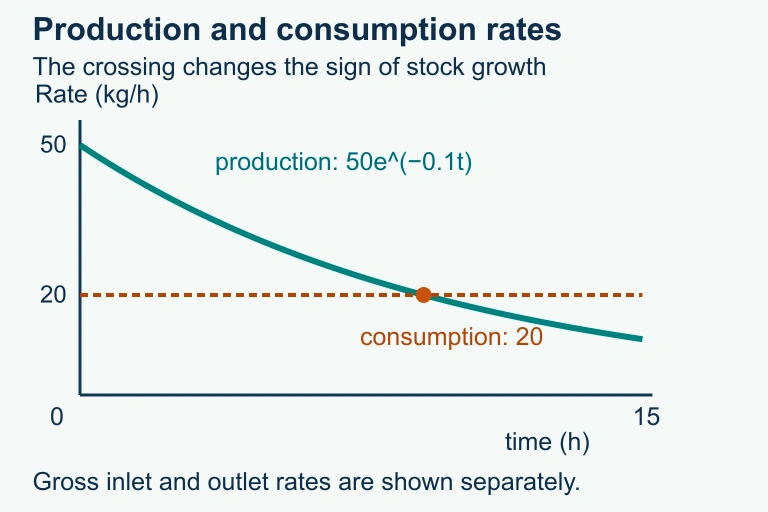 Production rate 50e^(−0.1t) and constant consumption rate 20 kg/h intersect at about 9.16 hours.
Question 5: CRITICAL THINKING
3 ptsShow answer
SUMMARY
Lesson Summary
Summary
The accumulation function F(x) = F(a) + ∫ₐˣ f(t) dt translates a rate of change into the total quantity accumulated from a baseline. The Net Change Theorem tells us ∫ₐᵇ f(t) dt = F(b) − F(a), and the Fundamental Theorem of Calculus Part I ensures that differentiation undoes integration: d/dx [∫ₐˣ f(t) dt] = f(x). In applied contexts—motion, fluid flow, population growth, economics—units analysis (rate units × integration variable units = quantity units) provides both a check on your setup and a pathway to interpreting results.
The critical distinction between net change (∫ f dt, which can be positive, negative, or zero) and total accumulation (∫ |f| dt, always non-negative) appears frequently on the AP exam. Always read the problem's exact phrasing to determine which quantity is requested. Remember to incorporate the initial condition when the problem asks for the value of a quantity at a specific time, not merely the change in that quantity.