Intermediate Value
Theorem
Master the IVT: understand when a continuous function is guaranteed to hit every value between two outputs.
What Is the Intermediate Value Theorem?
The Intermediate Value Theorem says that if a function \( f \) is continuous on a closed interval \( [a, b] \), and \( N \) is any number between \( f(a) \) and \( f(b) \), then there exists at least one value \( c \) in \( (a, b) \) such that \( f(c) = N \).
A continuous route through hills: elevation, grade, and intermediate height
 A continuous function takes every value between its endpoint values. Identify a target height between them before applying the Intermediate Value Theorem.
Intermediate Value Theorem: a height
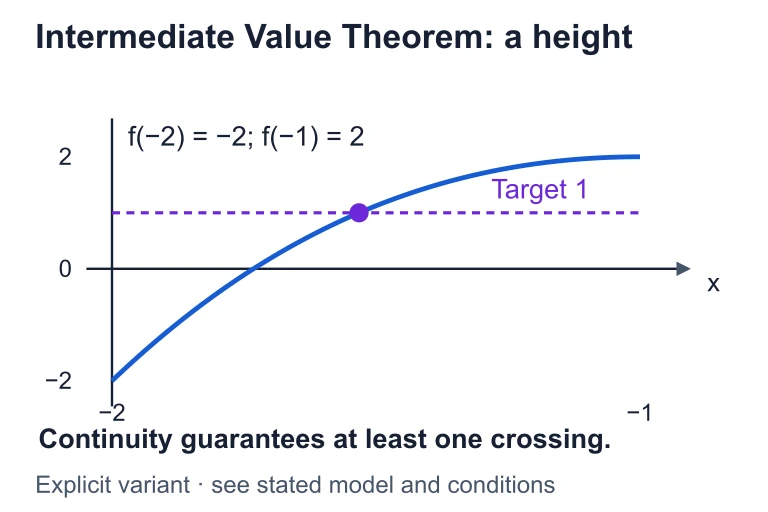 A continuous function takes every value between its endpoint values. Identify a target height between them before applying the Intermediate Value Theorem.
The Continuity Requirement
The IVT only applies when \( f \) is continuous on the entire closed interval \( [a, b] \). A single discontinuity—a jump, a hole, or an asymptote—can invalidate the conclusion.
Visual Intuition
The Formal Statement
Existence, Not Location
A critical detail: the IVT guarantees that a value \( c \) exists, but it does not tell you what \( c \) is. You know the function hits \( N \) somewhere in \( (a, b) \), but the theorem alone cannot pinpoint where.
IVT vs EVT vs MVT
| IVT | EVT | MVT | |
|---|---|---|---|
| Requires | Continuous on \( [a,b] \) | Continuous on \( [a,b] \) | Continuous on \( [a,b] \), differentiable on \( (a,b) \) |
| Guarantees | \( f(c) = N \) for some \( c \) | Absolute max and min exist | \( f'(c) = \frac{f(b)-f(a)}{b-a} \) |
| About | Output values | Extreme values | Slope / rate of change |
How to Apply the IVT
Example 1: Finding a Root
Show that \( f(x) = x^3 - 4x + 1 \) has a root on the interval \( [1, 2] \).
Example 1: Visualized
Example 2: A Specific Value
Let \( g(x) = e^x - 3 \). Show there exists a \( c \in (0, 2) \) such that \( g(c) = 2 \).
Example 3: Using a Table
The table below gives values of a continuous function \( h(x) \). Must there be a value \( c \) in \( [2, 5] \) with \( h(c) = 0 \)?
| \( x \) | 2 | 3 | 4 | 5 |
|---|---|---|---|---|
| \( h(x) \) | \( -3 \) | \( -1 \) | \( 4 \) | \( 7 \) |
When the IVT Does Not Apply
IVT and Sign Changes
The most common AP application: showing an equation \( f(x) = 0 \) has a solution. If \( f \) is continuous and \( f(a) \) and \( f(b) \) have opposite signs, the IVT guarantees a root in \( (a, b) \).
Common Mistakes
Quick Reference
| Element | Details |
|---|---|
| Hypothesis | \( f \) continuous on \( [a, b] \); \( N \) between \( f(a) \) and \( f(b) \) |
| Conclusion | There exists \( c \in (a, b) \) with \( f(c) = N \) |
| Guarantees | Existence (at least one), not uniqueness or location |
| Most common use | Proving a root exists via a sign change |
| AP tip | Always state continuity and show \( N \) is between endpoints |
Question 1 of 5
If \( f \) is continuous on \( [1, 5] \), \( f(1) = -3 \), and \( f(5) = 7 \), which value is the IVT guaranteed to be attained by \( f \) on \( (1, 5) \)?
Question 2 of 5
A student writes: "Since \( f(2) = -1 \) and \( f(6) = 5 \), by IVT there exists \( c \in (2, 6) \) with \( f(c) = 0 \)." What critical piece is missing from this argument?
Question 3 of 5
Let \( p(x) = x^4 - 6x^2 + 2 \). Which interval is guaranteed by the IVT to contain a root of \( p \)?
Question 4 of 5
The IVT tells us that if \( f \) is continuous on \( [a,b] \) and \( N \) is between \( f(a) \) and \( f(b) \), then \( f(c) = N \) for some \( c \). Which of the following is true about \( c \)?
Question 5 of 5
A function \( f \) is defined on \( [0, 4] \) with \( f(0) = 1 \) and \( f(4) = 1 \). A student claims: "By the IVT, \( f \) must equal \( 3 \) somewhere on \( (0, 4) \)." Is the student correct?