Washer Method
Revolving Around \(x/y\) Axes
Master the technique of finding volumes of solids of revolution when a region between two curves is rotated around the \(x\)-axis or \(y\)-axis.
What Is a Solid of Revolution?
When you take a 2D region in the coordinate plane and spin it around an axis, the resulting 3D shape is called a solid of revolution. Think of a potter's wheel: the clay profile sweeps around to form a vase.
From Discs to Washers
A ceramic vessel reveals wall material and water capacity
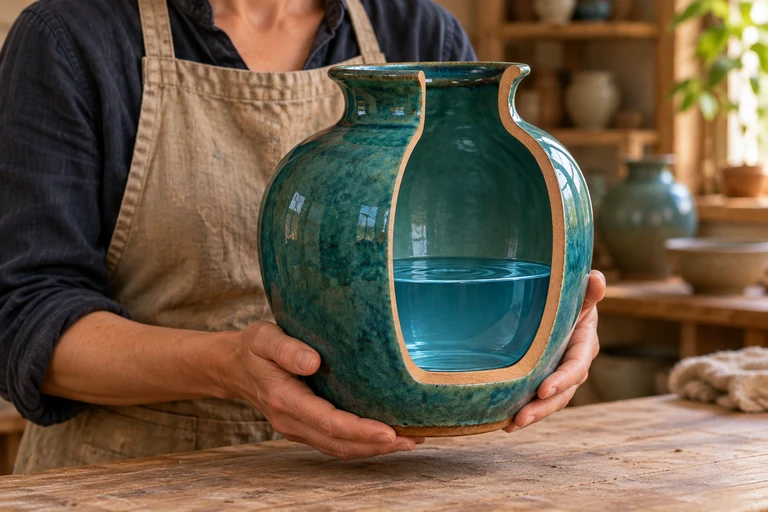 A washer separates wall material from the cavity: its area is π(R² − r²). Integrating the cavity area instead measures the volume available to hold water.
A ceramic vessel reveals wall material and water capacity
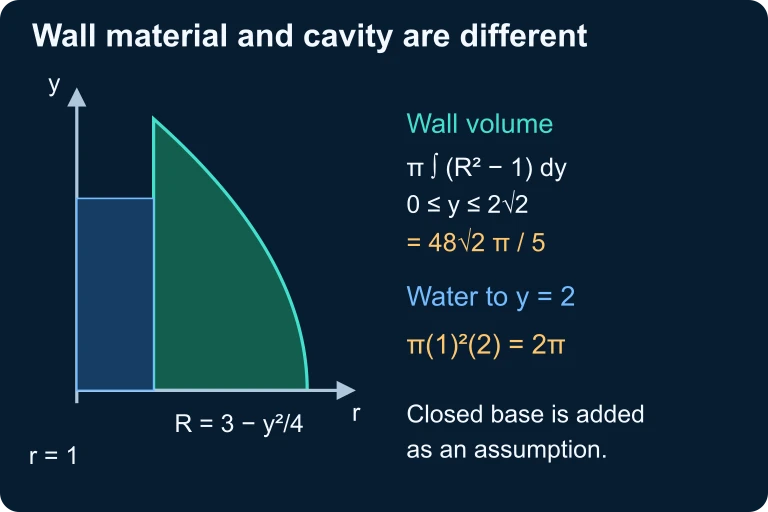 A washer separates wall material from the cavity: its area is π(R² − r²). Integrating the cavity area instead measures the volume available to hold water.
Why Does the Washer Method Matter?
Most real-world solids of revolution are not solid all the way through: pipes, bowls, doughnuts, turbine housings. When the region being rotated is bounded by two curves rather than just one curve and the axis, the disc method alone is not enough.
The Washer Formula: Revolving Around \(x\)-Axis
Revolving Around the \(y\)-Axis
Disc vs Washer vs Shell
| Disc | Washer | Shell | |
|---|---|---|---|
| Curves | 1 curve + axis | 2 curves | 1 or 2 curves |
| Cross-section | Solid circle | Ring (annulus) | Thin cylinder |
| Slices | Perpendicular to axis | Perpendicular to axis | Parallel to axis |
| Formula | \(\pi\!\int R^2\,dx\) | \(\pi\!\int(R^2\!-\!r^2)\,dx\) | \(2\pi\!\int r\cdot h\,dx\) |
How to Apply the Washer Method
Example 1: Revolving Around \(x\)-Axis
Find the volume when the region between \(y = x\) and \(y = x^2\) on \([0,1]\) is revolved around the \(x\)-axis.
Example 1: Solution
Example 2: Revolving Around \(y\)-Axis
Find the volume when the region between \(x = y^2\) and \(x = y\) (for \(0 \leq y \leq 1\)) is revolved around the \(y\)-axis.
Example 2: Solution
Example 3: Harder Setup
Revolve the region between \(y = \sqrt{x}\) and \(y = x^2\) about the \(x\)-axis. Find the volume.
Example 3: Solution
Common Mistakes to Avoid
Summary: Washer Method Quick Reference
| Around \(x\)-axis | Around \(y\)-axis | |
|---|---|---|
| Variable | Integrate with respect to \(x\) | Integrate with respect to \(y\) |
| Radii | Vertical distances: \(R(x)\), \(r(x)\) | Horizontal distances: \(R(y)\), \(r(y)\) |
| Formula | \(\pi\!\int_a^b\!(R^2 - r^2)\,dx\) | \(\pi\!\int_c^d\!(R^2 - r^2)\,dy\) |
| Limits | \(x\)-values of intersections | \(y\)-values of intersections |
| Solve for | \(y = f(x)\) | \(x = f(y)\) |
Question 1 of 5
The region between \(y = x\) and \(y = x^3\) on \([0,1]\) is revolved about the \(x\)-axis. Which integral gives the volume?
Question 2 of 5
When revolving around the \(y\)-axis, the radii \(R(y)\) and \(r(y)\) represent:
Question 3 of 5
The region between \(y = \sqrt{x}\) and \(y = x^2\) is revolved about the \(x\)-axis. What is the volume?
Question 4 of 5
A student writes \(\displaystyle V = \pi\!\int_0^1\!(\sqrt{x} - x^2)^2\,dx\) for the previous problem. What error did they make?
Question 5 of 5
The region between \(x = 4 - y^2\) and \(x = 0\) (the \(y\)-axis) for \(0 \leq y \leq 2\) is revolved about the \(y\)-axis. Which integral gives the volume?