01 / 21

Volumes with
Cross Sections

Learn to compute volumes of solids whose cross sections are triangles and semicircles using definite integrals.

AP Calculus AB

What Is a Cross Section?

Imagine slicing a loaf of bread. Each slice is a cross section: a 2D shape revealed when you cut perpendicular to an axis. In calculus, we stack infinitely many thin slices to compute the volume of a 3D solid.

Base region on the \(xy\)-plane
slice
\(a\)
\(b\)

The Volume Integral

If we know the cross-sectional area \(A(x)\) at every point \(x\) from \(a\) to \(b\), the volume of the solid is:

The key challenge: express \(A(x)\) in terms of \(x\). The shape of the cross section (triangle, semicircle, square, etc.) determines the area formula, and the base of each cross section comes from the region's boundary curves.

The Base Region Sets the Size

The base of each cross section is typically the vertical (or horizontal) distance between two curves. If the region is bounded above by \(f(x)\) and below by \(g(x)\), the base length at position \(x\) is:

\(s(x)\)
\(f(x)\)
\(g(x)\)
\(y\)
\(x\)

This \(s(x)\) becomes the side, base, or diameter of each cross section, depending on the shape.

Triangular Cross Sections

Equilateral Triangle
Side length = \(s(x)\). Area: $$A(x) = \frac{\sqrt{3}}{4}\,[s(x)]^2$$
Isosceles Right Triangle
Leg = \(s(x)\). Area: $$A(x) = \frac{1}{2}\,[s(x)]^2$$
Right Triangle (hyp)
Hypotenuse = \(s(x)\). Area: $$A(x) = \frac{1}{4}\,[s(x)]^2$$

Inside an Equilateral Cross Section

\(s(x)\)
\(h\)
\(s(x)\)
\(\text{height} = \frac{\sqrt{3}}{2} s(x)\)
\(\text{Area} = \frac{\sqrt{3}}{4}[s(x)]^2\)

Semicircular Cross Sections

When each cross section is a semicircle, the diameter equals \(s(x)\), so the radius is \(r = \frac{s(x)}{2}\).

\(s(x)\) = diameter
\(r\)
\(r = \frac{s(x)}{2}\)
\(A = \frac{\pi}{8}[s(x)]^2\)

Triangle vs. Semicircle: Key Differences

Property Equilateral \(\triangle\) Semicircle
Shape Triangle Half-circle
\(s(x)\) represents Side length Diameter
Area formula \(\frac{\sqrt{3}}{4}s^2\) \(\frac{\pi}{8}s^2\)
Constant factor \(\approx 0.433\) \(\approx 0.393\)
Both use \(V = \int_a^b A(x)\,dx\)

Step-by-Step Method

1
Sketch the base region. Identify the bounding curves \(f(x)\) and \(g(x)\) and find where they intersect.
2
Write \(s(x)\). The base/diameter of each cross section: \(s(x) = f(x) - g(x)\).
3
Choose the area formula. Equilateral triangle: \(\frac{\sqrt{3}}{4}s^2\). Semicircle: \(\frac{\pi}{8}s^2\). Isosceles right triangle (leg): \(\frac{1}{2}s^2\).
4
Set up the integral. \(V = \int_a^b A(x)\,dx\) with the correct limits of integration.
5
Evaluate. Expand, integrate, and simplify. Factor out constants early.

Example 1: Equilateral Triangle Slices

The base of a solid is the region bounded by \(y = \sqrt{x}\) and \(y = 0\) from \(x = 0\) to \(x = 4\). Cross sections perpendicular to the \(x\)-axis are equilateral triangles. Find the volume.

\(s = \sqrt{x}\)
\(y = \sqrt{x}\)
\(y\)
\(x\)
0 4

Example 2: Semicircular Slices

The base of a solid is the region bounded by \(y = 1 - x^2\) and \(y = 0\). Cross sections perpendicular to the \(x\)-axis are semicircles. Find the volume.

\(s = 1 - x^2\)
\(y = 1 - x^2\)
\(y\)
\(x\)
-1 1

Example 2: Evaluating the Integral

1
Integrate term by term: \(\int_{-1}^{1}(1 - 2x^2 + x^4)\,dx\)
2
Use symmetry (even function): \(= 2\int_0^1(1 - 2x^2 + x^4)\,dx\)
3
Evaluate: \(= 2\left[x - \frac{2x^3}{3} + \frac{x^5}{5}\right]_0^1 = 2\left(1 - \frac{2}{3} + \frac{1}{5}\right) = 2\cdot\frac{8}{15} = \frac{16}{15}\)
4
Final answer: \(V = \frac{\pi}{8}\cdot\frac{16}{15} = \frac{2\pi}{15}\)

Example 3: Isosceles Right Triangle Slices

Base region: between \(y = x\) and \(y = x^2\) from \(x = 0\) to \(x = 1\). Cross sections perpendicular to the \(x\)-axis are isosceles right triangles with a leg along the base.

Why the Constant Matters

Every cross-section volume problem reduces to the same pattern: \(V = k\int_a^b [s(x)]^2\,dx\). The only thing that changes between shapes is the constant \(k\):

Square
\(k = 1\)
Equilateral \(\triangle\)
\(k = \frac{\sqrt{3}}{4}\)
Isosceles Rt \(\triangle\) (leg)
\(k = \frac{1}{2}\)
Semicircle
\(k = \frac{\pi}{8}\)

Common Mistakes

Wrong area formula
Using \(\frac{\sqrt{3}}{4}s^2\) for a semicircle, or \(\frac{\pi}{8}s^2\) for a triangle. Always match the shape to its formula.
Diameter vs. radius
For semicircles, \(s(x)\) is the diameter, not the radius. Forgetting to halve it gives an answer 4 times too large.
Wrong limits
Using the wrong intersection points as limits of integration, or forgetting that the region might be symmetric about an axis.

Summary of Formulas

Cross Section \(s(x)\) is... \(A(x)\)
Square Side \(s^2\)
Equilateral \(\triangle\) Side \(\frac{\sqrt{3}}{4}s^2\)
Isosceles Rt \(\triangle\) (leg) Leg \(\frac{1}{2}s^2\)
Isosceles Rt \(\triangle\) (hyp) Hypotenuse \(\frac{1}{4}s^2\)
Semicircle Diameter \(\frac{\pi}{8}s^2\)

Worked practice: Section 9, Practice Problem 4 — Applied

Work through this original lesson problem, then reveal the solution and illustrations.

Let R be the region bounded by y = 4 − x² and y = 0. (a) Set up, but do not evaluate, an integral expression for the volume of the solid whose base is R and whose cross sections perpendicular to the x-axis are equilateral triangles with one side lying on R. (b) Set up, but do not evaluate, an integral expression for the volume of the solid whose base is R and whose cross sections perpendicular to the x-axis are semicircles with diameter on R. (c) Evaluate the integral in part (b) and find the exact volume.

Show answer and explanation

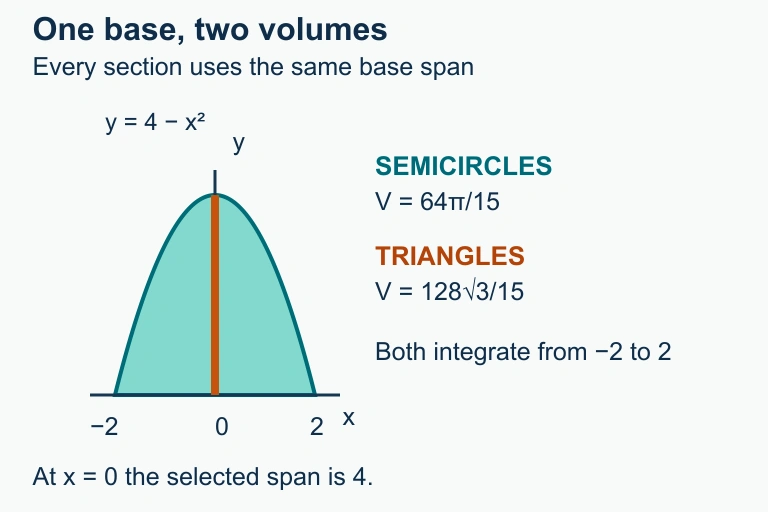
Rubric (5 points): Point 1 (Part a – Limits and s(x)): The parabola y = 4 − x² meets y = 0 when x = −2 and x = 2. The distance across the base is s(x) = (4 − x²) − 0 = 4 − x². Limits of integration are −2 to 2. Point 2 (Part a – Integral): The area of an equilateral triangle with side s is (√3/4)s². Volume = ∫₋₂² (√3/4)(4 − x²)² dx. Point 3 (Part b – Integral): For semicircles with diameter s(x) = 4 − x², the area is (π/8)s² = (π/8)(4 − x²)². Volume = ∫₋₂² (π/8)(4 − x²)² dx. Point 4 (Part c – Expansion and antiderivative): (4 − x²)² = 16 − 8x² + x⁴. So V = (π/8) ∫₋₂² (16 − 8x² + x⁴) dx. Using symmetry: V = (π/8) · 2 ∫₀² (16 − 8x² + x⁴) dx = (π/4)[16x − (8x³/3) + (x⁵/5)]₀². Point 5 (Part c – Final answer): Evaluating: 16(2) − 8(8)/3 + 32/5 = 32 − 64/3 + 32/5 = (480 − 320 + 96)/15 = 256/15. Thus V = (π/4)(256/15) = 64π/15.
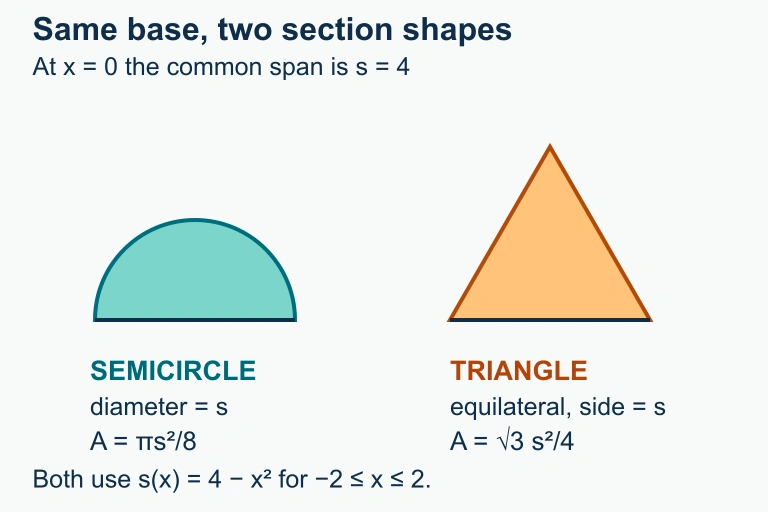
Semicircular and equilateral-triangular cross sections on the same span 4, with their respective area formulas.
The same base span becomes an equilateral-triangle side or a semicircle diameter, changing area while preserving the footprint.
Shared base between y=4−x² and y=0, with endpoints x=±2. Semicircular and equilateral cross sections give volumes 64π/15 and 128√3/15.

Question 1 of 5

The base of a solid is the region bounded by \(y = \sin x\) and \(y = 0\) from \(x = 0\) to \(x = \pi\). Cross sections perpendicular to the \(x\)-axis are equilateral triangles. Which integral gives the volume?

Question 2 of 5

For semicircular cross sections, if the base length at position \(x\) is \(s(x)\), the cross-sectional area is:

Question 3 of 5

A solid has base region bounded by \(y = 4 - x^2\) and \(y = 0\). Cross sections perpendicular to the \(x\)-axis are semicircles. What are the correct limits of integration?

Question 4 of 5

Base region: \(y = x\) and \(y = x^2\). Cross sections are equilateral triangles. What is \(A(x)\)?

Question 5 of 5

Evaluate: \(\displaystyle V = \frac{\pi}{8}\int_{-1}^{1}(1 - x^2)^2\,dx\)