Volumes with
Cross Sections
Learn to compute volumes of solids whose cross sections are squares and rectangles, using definite integrals.
What Is a Solid with Known Cross Sections?
Imagine a loaf of bread: each slice has a recognizable shape. A solid with known cross sections is a 3D object where every slice perpendicular to a chosen axis has a shape you can describe: a square, rectangle, semicircle, or triangle.
Visualizing the 3D Solid
Each green slice is a cross section. Its area depends on where you cut along the \(x\)-axis. We sum up infinitely many thin slices of width \(dx\) to find the total volume.
Why Cross Sections Matter
The Volume Formula
The key challenge is expressing \(A(x)\) in terms of \(x\). For square and rectangle cross sections, the area formula depends on the side length, which is determined by the base region.
Square Cross Sections
The side length \(s(x)\) is typically the vertical distance between two curves: \(s(x) = f(x) - g(x)\).
Rectangle Cross Sections
Often the problem states height as a multiple of width, e.g. "height is twice the base": \(h(x) = 2\,w(x)\).
Squares vs. Rectangles
| Square Cross Section | Rectangle Cross Section | |
|---|---|---|
| Shape | All four sides equal | \(w \neq h\) (usually) |
| Side from base | \(s(x) = f(x) - g(x)\) | \(w(x) = f(x) - g(x)\) |
| Area formula | \(A(x) = [s(x)]^2\) | \(A(x) = w(x) \cdot h(x)\) |
| Extra info needed? | No: side = base width | Yes: height relation given |
How to Solve These Problems
Example 1: Square Slices
The base of a solid is the region bounded by \(y = \sqrt{x}\) and \(y = 0\) from \(x = 0\) to \(x = 4\). Cross sections perpendicular to the \(x\)-axis are squares. Find the volume.
Example 1: Solution
Example 2: Rectangle Slices
The base is bounded by \(y = x^2\) and \(y = 1\). Cross sections perpendicular to the \(y\)-axis are rectangles whose height is 3 times the base width. Find the volume.
Example 2: Solution
Example 3: Two-Curve Base
The base is bounded by \(y = x\) and \(y = x^2\). Cross sections perpendicular to the \(x\)-axis are squares. Find the volume.
Common Mistakes
Summary Cheat Sheet
| Step | Square | Rectangle |
|---|---|---|
| Side / Width | \(s = f(x) - g(x)\) | \(w = f(x) - g(x)\) |
| Height | \(h = s\) (same as side) | \(h\) given by problem |
| Area \(A(x)\) | \(s^2\) | \(w \cdot h\) |
| Volume | \(\displaystyle\int_a^b s^2\,dx\) | \(\displaystyle\int_a^b w \cdot h\,dx\) |
| Key check | Did you square the side? | Did you substitute for \(h\)? |
Worked practice: Section 9, Practice Problem 4 — Applied
Work through this original lesson problem, then reveal the solution and illustrations.
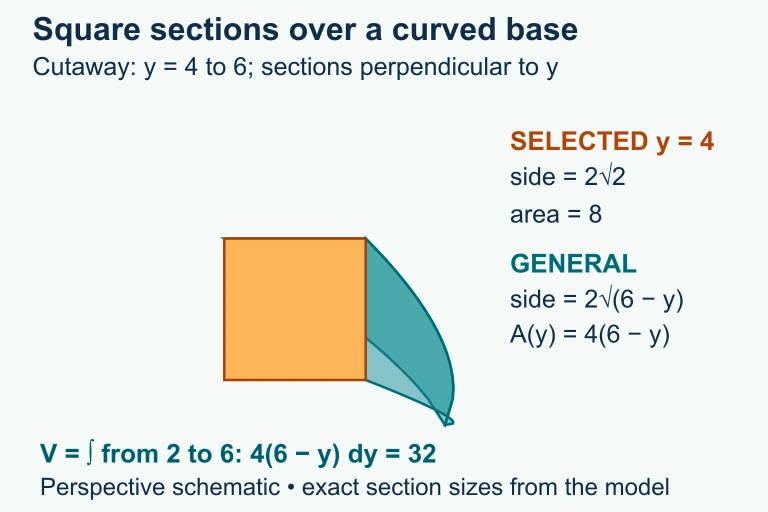
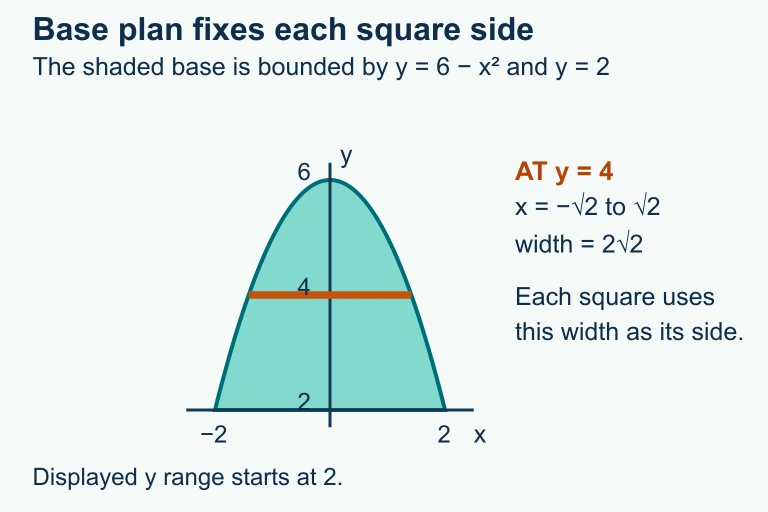
A landscape architect designs a decorative garden bed whose footprint in the xy-plane is the region R bounded by y = 6 − x² and y = 2. The bed is filled with soil so that cross sections perpendicular to the y-axis are squares. (a) Sketch the region R and identify the limits of integration in terms of y. (1 point) (b) Express the side length of a square cross section as a function of y. (1 point) (c) Write and evaluate the integral that gives the volume of soil needed. (2 points)
Show answer and explanation
Rubric (4 points): Point 1 (Part a): The region R is bounded above by the parabola y = 6 − x² and below by the horizontal line y = 2. Setting 6 − x² = 2 gives x = ±2. When slicing perpendicular to the y-axis, y ranges from 2 to 6. Award 1 point for correct limits y = 2 to y = 6 and correct identification of the bounding curves. Point 2 (Part b): From y = 6 − x², solve for x: x = ±√(6 − y). At height y, the horizontal extent of the region is from x = −√(6 − y) to x = √(6 − y), so the side length of the square is s(y) = 2√(6 − y). Award 1 point. Point 3 (Part c — integral setup): A(y) = [2√(6 − y)]² = 4(6 − y). So V = ∫₂⁶ 4(6 − y) dy. Award 1 point for correct area function and integral. Point 4 (Part c — evaluation): V = 4∫₂⁶ (6 − y) dy = 4[6y − y²/2]₂⁶ = 4[(36 − 18) − (12 − 2)] = 4[18 − 10] = 4(8) = 32 cubic units. Award 1 point for correct numerical answer.
Question 1 of 5
The base of a solid is the region bounded by \(y = 4 - x^2\) and \(y = 0\). Cross sections perpendicular to the \(x\)-axis are squares. Which integral gives the volume?
Question 2 of 5
A solid has base bounded by \(y = \sqrt{x}\) and \(y = 0\) for \(0 \le x \le 9\). Cross sections perpendicular to the \(x\)-axis are rectangles with height twice the base. What is the volume?
Question 3 of 5
For the region bounded by \(y = x\) and \(y = x^2\) with square cross sections perpendicular to the \(x\)-axis, \(A(x) =\)
Question 4 of 5
Cross sections perpendicular to the \(y\)-axis are squares. The base is bounded by \(x = y^2\) and \(x = 4\). What are the correct limits of integration?
Question 5 of 5
A student sets up \(\displaystyle V = \int_0^1 (e^x)^2\,dx\) for a solid with square cross sections and base under \(y = e^x\) from \(x = 0\) to \(x = 1\). What is the volume?