Verifying Solutions for
Differential Equations
Learn how to substitute a proposed function into a differential equation and confirm it satisfies the equation: the essential first skill in differential equations.
What Is a Differential Equation?
A differential equation is an equation that involves an unknown function and one or more of its derivatives. Instead of solving for a number, you solve for an entire function.
What Does "Verify" Mean?
To verify a solution means to show that when you substitute the proposed function (and its derivatives) into the differential equation, both sides become identically equal.
Why Verification Matters
Many differential equations have families of solutions. Verification is the tool that lets you confirm a particular candidate belongs to that family: or reject it if it does not.
The Verification Principle
This must hold for all \(x\) in the domain, not just specific points. A single counterexample means the function is not a solution.
General vs. Particular Solutions
Solving vs. Verifying: Key Distinction
| Solving | Verifying | |
|---|---|---|
| Starting point | Only the DE is given | DE and a proposed \(y\) are given |
| Goal | Find the unknown function \(y\) | Show the given \(y\) satisfies the DE |
| Techniques | Separation, integrating factors, etc. | Differentiation + substitution |
| AP Calc AB focus | Separation of variables only | Frequently tested on FRQs |
How to Verify: Step by Step
Example 1: Basic Verification
Example 2: Exponential Function
A cell culture where more cells create more growth events
 In the model y = 100e^(0.4t), the relative growth rate stays at 0.4 while total growth y′ = 0.4y increases with the population.
A cell culture where more cells create more growth events
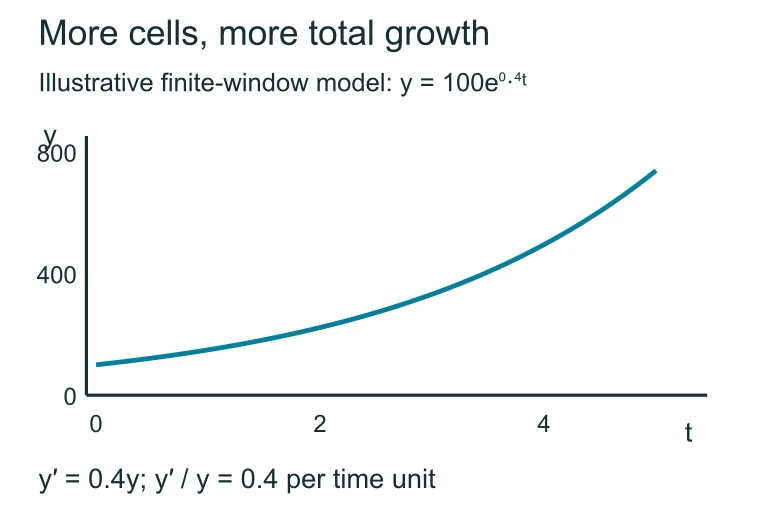 In the model y = 100e^(0.4t), the relative growth rate stays at 0.4 while total growth y′ = 0.4y increases with the population.
Relative rate versus total rate
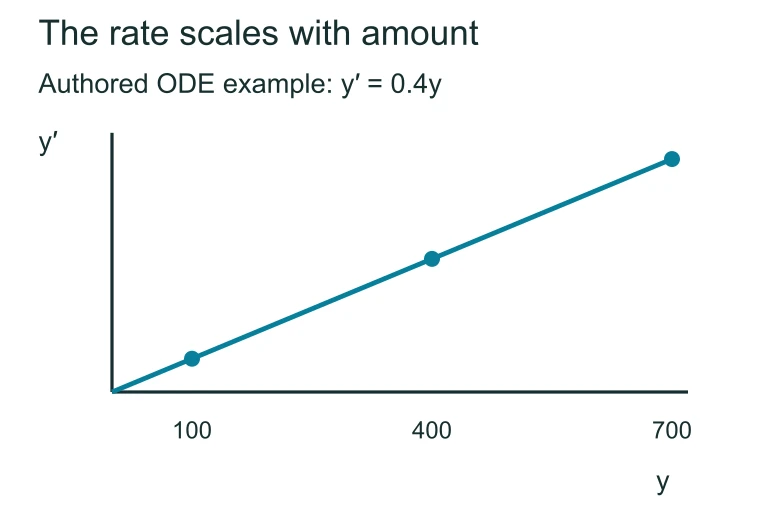 In the model y = 100e^(0.4t), the relative growth rate stays at 0.4 while total growth y′ = 0.4y increases with the population.
Example 3: Second-Order DE
Visualizing Solution Curves
Consider the DE \(\dfrac{dy}{dx} = y\). Its general solution is \(y = Ce^x\). Below, each curve corresponds to a different value of \(C\).
When Verification Fails
Verifying with Initial Conditions
Sometimes you must verify both that the function satisfies the DE and that it passes through a given point \((x_0, y_0)\).
Common Mistakes to Avoid
Summary: Verification Checklist
| Step | Action | Watch For |
|---|---|---|
| 1 | Write down DE and proposed \(y\) | Note the order of the DE |
| 2 | Differentiate \(y\) | Chain rule, product rule |
| 3 | Substitute into DE | Replace every \(y, y', y''\) |
| 4 | Simplify both sides | Factor, combine like terms |
| 5 | Confirm LHS = RHS | Must hold for all \(x\) |
| 6 | Check IC (if given) | Plug in \(x_0\), verify \(y_0\) |
Question 1 of 5
Which of the following is a solution to the differential equation \(\dfrac{dy}{dx} = 2y\)?
Question 2 of 5
To verify that \(y = \cos(x)\) is a solution of \(y'' + y = 0\), what is the first step?
Question 3 of 5
A student claims that \(y = x^3\) satisfies \(\dfrac{dy}{dx} = 3x\). Is this correct?
Question 4 of 5
Given the IVP: \(\dfrac{dy}{dx} = -y\), \(y(0) = 4\), which function is the particular solution?
Question 5 of 5
When verifying a general solution \(y = Ce^{kx}\) in a first-order DE, what should happen to the constant \(C\)?