The Quotient Rule
Master the technique for differentiating ratios of functions: when \(\frac{f(x)}{g(x)}\) needs a derivative, the quotient rule delivers.
Why Quotients Need Their Own Rule
You already know the product rule handles \(f(x) \cdot g(x)\). But what about \(\frac{f(x)}{g(x)}\)? You cannot simply differentiate the top and bottom separately:
Because the numerator and denominator both change simultaneously, their rates of change interact. The quotient rule captures that interaction precisely.
A Ratio of Changing Quantities
Imagine revenue \(R(t)\) divided by customers \(C(t)\) giving revenue per customer. Both change over time, so the rate of change of the ratio depends on:
Where You'll Use This Rule
The quotient rule appears whenever you differentiate a fraction whose top and bottom both contain the variable. Common AP Calculus scenarios:
The Quotient Rule: Formal Statement
If \(f\) and \(g\) are differentiable and \(g(x) \neq 0\), then:
Anatomy of the Formula
Quotient Rule vs Product Rule
| Quotient Rule | Product Rule | |
|---|---|---|
| Applies to | \(\dfrac{f(x)}{g(x)}\) | \(f(x) \cdot g(x)\) |
| Formula | \(\dfrac{g\,f' - f\,g'}{g^2}\) | \(f\,g' + g\,f'\) |
| Sign | Subtraction (order matters) | Addition (order doesn't) |
| Denominator | \([g(x)]^2\) | None |
| Mnemonic | Low d-High minus High d-Low | First d-Second plus Second d-First |
How to Apply the Quotient Rule
Example 1: Basic Rational Function
Find \(\dfrac{d}{dx}\!\left[\dfrac{x^2}{x+1}\right]\).
Example 1: Visualized
The derivative, \(\frac{x(x+2)}{(x+1)^2}\), tells us the slope of the original function, \(\frac{x^2}{x+1}\), at any point \(x\). For example, the original function has horizontal tangents (slope = 0) when the derivative is zero, which occurs at \(x=0\) and \(x=-2\).
Example 2: Deriving \(\dfrac{d}{dx}[\tan x]\) via the Quotient Rule
Since \(\tan x = \dfrac{\sin x}{\cos x}\), apply the quotient rule.
Example 3: A Trickier Rational Function
Differentiate \(h(x) = \dfrac{3x^2 - 1}{x^3 + 2}\).
Bonus: Other Trig Derivatives via the Quotient Rule
Every reciprocal or ratio trig function can be derived with the quotient rule. Here are the results:
| Function | Written as | Derivative |
|---|---|---|
| \(\tan x\) | \(\frac{\sin x}{\cos x}\) | \(\sec^2 x\) |
| \(\cot x\) | \(\frac{\cos x}{\sin x}\) | \(-\csc^2 x\) |
| \(\sec x\) | \(\frac{1}{\cos x}\) | \(\sec x \tan x\) |
| \(\csc x\) | \(\frac{1}{\sin x}\) | \(-\csc x \cot x\) |
Common Mistakes to Avoid
Summary: Differentiation Toolkit
| Rule | When to Use | Formula |
|---|---|---|
| Power Rule | \(x^n\) | \(nx^{n-1}\) |
| Product Rule | \(f \cdot g\) | \(fg' + gf'\) |
| Quotient Rule | \(\frac{f}{g}\) | \(\frac{gf' - fg'}{g^2}\) |
| Chain Rule | \(f(g(x))\) | \(f'(g(x)) \cdot g'(x)\) |
Worked practice: Section 9, Practice Problem 4 — Applied
Work through this original lesson problem, then reveal the solution and illustrations.
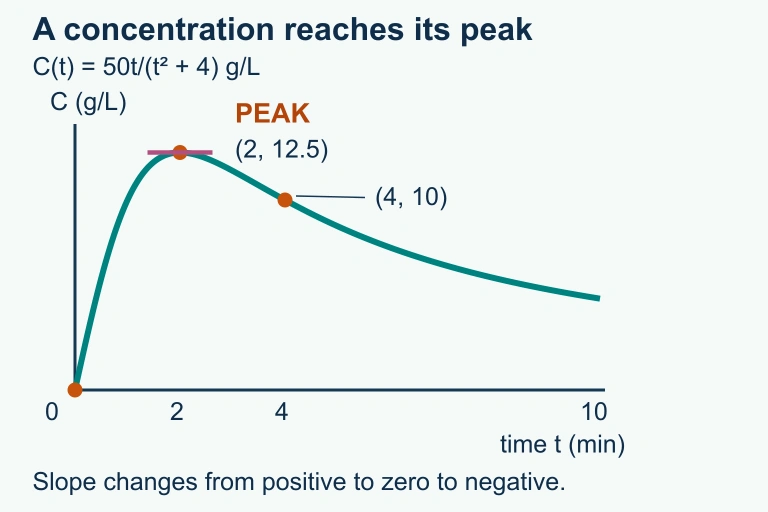
A chemical reaction has a concentration function C(t) = 50t / (t² + 4) grams per liter, where t is measured in minutes. (a) Find C′(t) using the quotient rule. (b) Determine the time t at which the concentration is at its maximum. (c) Find the maximum concentration. (d) Explain the physical meaning of C′(t) = 0 and describe the behavior of C(t) for large values of t.
Show answer and explanation
Rubric (4 points): Point 1 — (a) Correct derivative: Let f(t) = 50t so f′(t) = 50, and g(t) = t² + 4 so g′(t) = 2t. Applying the quotient rule: C′(t) = [(t² + 4)(50) − (50t)(2t)] / (t² + 4)² = [50t² + 200 − 100t²] / (t² + 4)² = (200 − 50t²) / (t² + 4)² = 50(4 − t²) / (t² + 4)². Point 2 — (b) Time of maximum concentration: Set C′(t) = 0, so 50(4 − t²) = 0, giving t² = 4, thus t = 2 minutes (rejecting t = −2 since time must be non-negative). A sign analysis confirms C′(t) > 0 for 0 < t < 2 and C′(t) < 0 for t > 2, confirming a maximum. Point 3 — (c) Maximum concentration: C(2) = 50(2) / (4 + 4) = 100/8 = 12.5 grams per liter. Point 4 — (d) Interpretation: C′(t) = 0 means the rate of change of concentration is zero—the concentration is momentarily neither increasing nor decreasing, which occurs at the peak of concentration. For large t, the denominator t² + 4 grows much faster than the numerator 50t, so C(t) → 0 as t → ∞. Physically, the reactant is being consumed or diluted over time, and the concentration decays toward zero after reaching its peak at t = 2.
Question 1 of 5
What is \(\dfrac{d}{dx}\!\left[\dfrac{x}{x^2+1}\right]\)?
Question 2 of 5
In the quotient rule formula \(\dfrac{gf' - fg'}{g^2}\), what does the minus sign tell us?
Question 3 of 5
Using the quotient rule, what is \(\dfrac{d}{dx}[\cot x]\)?
Question 4 of 5
Find \(\dfrac{d}{dx}\!\left[\dfrac{e^x}{x}\right]\).
Question 5 of 5
A student writes \(\dfrac{d}{dx}\!\left[\dfrac{f}{g}\right] = \dfrac{f'g' - fg}{g^2}\). What is wrong?