The Product Rule
Learn how to differentiate the product of two functions using one of calculus's most essential rules: \( \frac{d}{dx}[f(x) \cdot g(x)] \).
Why Can't We Just Multiply Derivatives?
It's tempting to think that the derivative of a product is just the product of the derivatives. But let's test this with a simple example:
We need a special rule for differentiating products: the Product Rule.
What Is a Product of Functions?
A product of functions is any expression where two (or more) functions are multiplied together. You encounter these constantly in calculus:
Geometric Intuition
Think of \( f(x) \cdot g(x) \) as the area of a rectangle with width \( f \) and height \( g \). When \( x \) changes by a tiny amount \( dx \), both sides change:
An expanding patio reveals the product rule's two strips
 Increasing both side lengths adds two strips and a corner. Dividing the area change by the input change and taking a limit gives the product rule, (fg)′ = f′g + fg′.
The product rule adds two first-order area contributions.
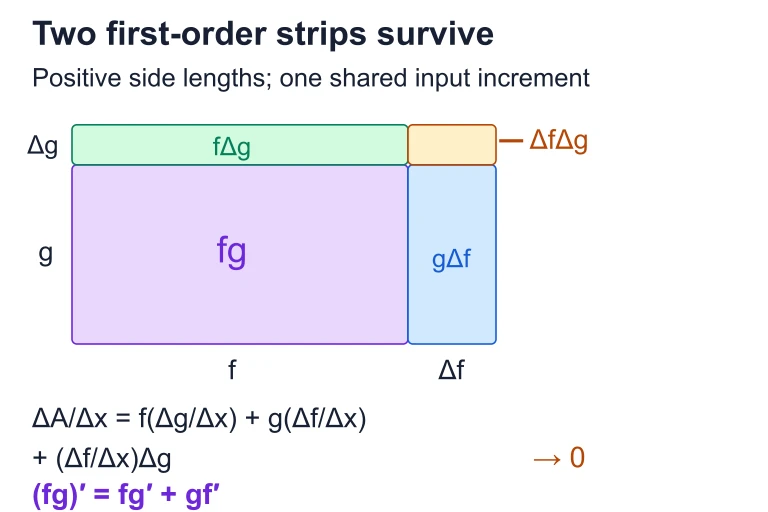 Increasing both side lengths adds two strips and a corner. Dividing the area change by the input change and taking a limit gives the product rule, (fg)′ = f′g + fg′.
The Product Rule: Formal Statement
If \( f(x) \) and \( g(x) \) are both differentiable, then:
In words: "the derivative of the first times the second, plus the first times the derivative of the second."
Equivalent Notations
The Product Rule appears in several equivalent forms. Recognizing each helps you read different textbooks and exams:
Product Rule vs. Other Rules
| Scenario | Rule | Formula |
|---|---|---|
| \( c \cdot f(x) \) | Constant Multiple | \( c \cdot f'(x) \) |
| \( f(x) + g(x) \) | Sum Rule | \( f'(x) + g'(x) \) |
| \( f(x) \cdot g(x) \) | Product Rule | \( f'g + fg' \) |
| \( f(g(x)) \) | Chain Rule | \( f'(g(x)) \cdot g'(x) \) |
How to Apply the Product Rule
Example 1: \( x^2 \sin x \)
Find \( \dfrac{d}{dx}\bigl[x^2 \sin x\bigr] \).
Example 2: \( e^x \ln x \)
Find \( \dfrac{d}{dx}\bigl[e^x \ln x\bigr] \).
Example 3: \( (3x+1)(x^2-4) \)
Find \( \dfrac{d}{dx}\bigl[(3x+1)(x^2-4)\bigr] \). We'll solve it two ways to verify.
\( f' = 3 \), \( g' = 2x \)
\( = 3(x^2-4) + (3x+1)(2x) \)
\( = 3x^2-12 + 6x^2+2x \)
\( = 9x^2 + 2x - 12 \)
\( = 3x^3 + x^2 - 12x - 4 \)
\( \frac{d}{dx} \rightarrow 9x^2 + 2x - 12 \)
✓ Same answer!
Visualizing \( x \cdot e^x \)
Here are the graphs of \( f(x) = x \), \( g(x) = e^x \), and their product \( h(x) = xe^x \). The Product Rule tells us the slope of \( h \) at any point.
Extending to Three Functions
The Product Rule generalizes. For three functions \( f \cdot g \cdot h \):
Each factor "takes a turn" being differentiated while the others stay. For \( n \) functions, there are \( n \) terms.
\( = (1)(\sin x)(e^x) + (x)(\cos x)(e^x) + (x)(\sin x)(e^x) \)
\( = e^x(\sin x + x\cos x + x\sin x) \)
When to Use vs. Expand
| Expression | Best Strategy | Why |
|---|---|---|
| \( (2x+1)(x^3) \) | Expand first | Simple polynomial |
| \( x^2 \cos x \) | Product Rule | Can't expand trig times poly |
| \( e^x \sqrt{x} \) | Product Rule | Can't combine exp and radical |
| \( 5x^4 \) | Power Rule alone | Constant times single power |
Common Mistakes
Question 1 of 5
What is \( \dfrac{d}{dx}\bigl[x^3 \cos x\bigr] \)?
Question 2 of 5
The Product Rule states that \( (fg)' \) equals:
Question 3 of 5
Find \( \dfrac{d}{dx}\bigl[e^x \cdot x^2\bigr] \) evaluated at \( x = 0 \).
Question 4 of 5
Which expression requires the Product Rule to differentiate (cannot be simplified first)?
Question 5 of 5
If \( h(x) = \sin x \cdot \cos x \), what is \( h'(x) \)?