Solving
Related Rates Problems
Learn to connect changing quantities using the chain rule and implicit differentiation to solve real-world rate problems.
What Are Related Rates?
In many real-world scenarios, two or more quantities change simultaneously over time. When these quantities are linked by an equation, their rates of change are also linked. Related rates problems ask you to find how fast one quantity is changing given information about how fast another is changing.
The Chain Rule Connection
Related rates problems rely on implicit differentiation with respect to time \( t \). Every variable that changes over time must be differentiated using the chain rule.
Why Related Rates Matter
The Fundamental Principle
Implicit Differentiation Refresher
In related rates, you differentiate every term with respect to \( t \), treating each variable as a function of \( t \). Here are the key differentiation patterns:
Related Rates vs. Optimization
| Related Rates | Optimization | |
|---|---|---|
| Goal | Find how fast something changes | Find max or min value |
| Key operation | Differentiate with respect to \( t \) | Set \( \frac{dy}{dx} = 0 \) |
| Variables | Multiple, all functions of \( t \) | Usually one independent variable |
| Constraint | Geometric or physical equation | Boundary or domain restriction |
| Answer type | A rate (units/time) | A value (max/min) |
The 5-Step Strategy
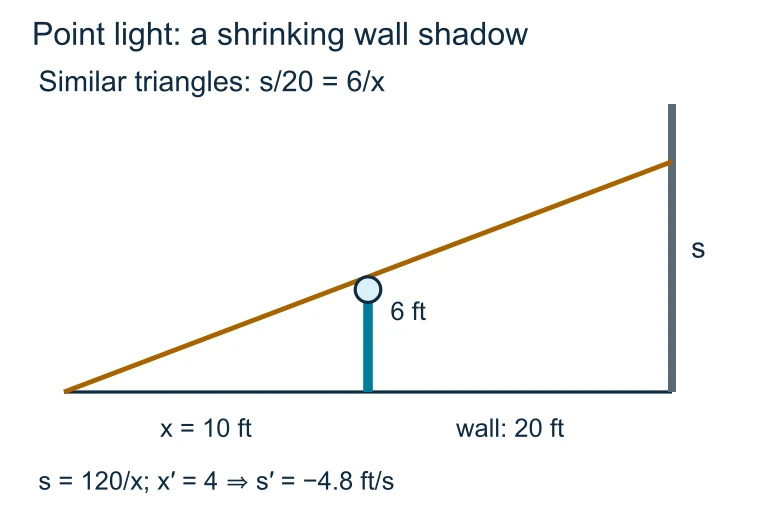
A light-and-camera studio with exact sightlines

Similar triangles connect a 6 ft person, a wall 20 ft from the light, and the shadow height. Differentiate with respect to time to find how the shadow changes as the person moves.Point light: a shrinking wall shadow
Similar triangles connect a 6 ft person, a wall 20 ft from the light, and the shadow height. Differentiate with respect to time to find how the shadow changes as the person moves.Example 1: Expanding Circle
A stone is dropped into a pond, creating a circular ripple. The radius increases at \( \frac{dr}{dt} = 3 \) ft/s. How fast is the area increasing when \( r = 5 \) ft?
Example 2: The Ladder Problem
A 10 ft ladder leans against a wall. The base slides away at \( \frac{dx}{dt} = 1 \) ft/s. How fast is the top sliding down when the base is 6 ft from the wall?
Example 3: Filling a Cone
Water flows into a conical tank (height 10 ft, radius 5 ft) at \( \frac{dV}{dt} = 12 \) ft³/min. How fast is the water level rising when \( h = 6 \) ft?
Why Eliminate Variables First?
In the cone example, the volume formula \( V = \frac{1}{3}\pi r^2 h \) has three variables: \( V \), \( r \), and \( h \). Differentiating directly would give:
General rule: Your equation should contain only one unknown rate plus the rate you are solving for. Use constraints to eliminate extra variables before differentiating.
Geometry connects changing radius and depth

As water rises in a conical tank, its surface radius and depth increase together. Similar triangles express r in terms of h before the volume equation is differentiated.Trigonometric Related Rates
A searchlight rotates at \( \frac{d\theta}{dt} = 2 \) rad/s. The light is 50 m from a straight wall. How fast does the beam move along the wall when \( \theta = \frac{\pi}{6} \)?
Essential Formulas to Know
\( C = 2\pi r \)
\( S = 4\pi r^2 \)
\( \tan\theta = \frac{\text{opp}}{\text{adj}} \)
Common Mistakes to Avoid
Problem Type Summary
| Scenario | Key Equation | After Differentiating |
|---|---|---|
| Expanding circle | \( A = \pi r^2 \) | \( \frac{dA}{dt} = 2\pi r\frac{dr}{dt} \) |
| Ladder/Pythag. | \( x^2 + y^2 = L^2 \) | \( 2x\frac{dx}{dt} + 2y\frac{dy}{dt} = 0 \) |
| Conical tank | \( V = \frac{\pi h^3}{12} \) | \( \frac{dV}{dt} = \frac{\pi h^2}{4}\frac{dh}{dt} \) |
| Rotating light | \( x = d\tan\theta \) | \( \frac{dx}{dt} = d\sec^2\!\theta\cdot\frac{d\theta}{dt} \) |
| Expanding sphere | \( V = \frac{4}{3}\pi r^3 \) | \( \frac{dV}{dt} = 4\pi r^2\frac{dr}{dt} \) |
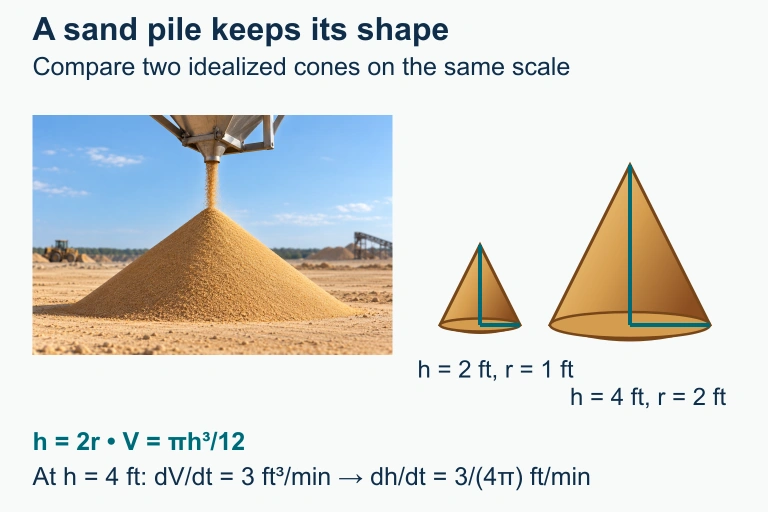
Worked Example — Conical Sand Pile
Sand is poured onto a pile at a rate of 3 ft³/min. The pile maintains the shape of a right circular cone whose height is always equal to twice its base radius. How fast is the height of the pile increasing when the height is 4 ft? Conical Sand Pile Step 1 — Draw and Label Variables We sketch a cone with base radius r and height h. Both r and h are functions of time t. We are given dV/dt = 3 ft³/min and that h = 2r (i.e., r = h/2). We want dh/dt when h = 4. Step 2 — Write the Linking Equation The volume of a cone is V = (1/3)πr²h. Since the cone's proportions are fixed with r = h/2, we eliminate r: V = (1/3)π(h/2)²h = (1/3)π(h²/4)h = πh³/12. V = πh³/12 Step 3 — Differentiate Implicitly with Respect to t Applying the chain rule: dV/dt = (π/12) × 3h² × (dh/dt) = (πh²/4)(dh/dt). dV/dt = (πh²/4)(dh/dt) Step 4 — Substitute Known Values Substitute dV/dt = 3 and h = 4: 3 = (π(4)²/4)(dh/dt) = (16π/4)(dh/dt) = 4π(dh/dt). Step 5 — Solve and Interpret Solving for dh/dt: dh/dt = 3/(4π) ft/min ≈ 0.239 ft/min. Since dh/dt is positive, the height is increasing—consistent with sand being added to the pile. dh/dt = 3/(4π) ft/min ≈ 0.239 ft/min
Question 1 of 5
A balloon is being inflated so that its radius increases at \( \frac{dr}{dt} = 2 \) cm/s. What is \( \frac{dV}{dt} \) when \( r = 3 \) cm?
(Use \( V = \frac{4}{3}\pi r^3 \))
Question 2 of 5
A 13-foot ladder leans against a wall. The foot slides away at 2 ft/s. How fast is the top sliding down when the foot is 5 ft from the wall?
Question 3 of 5
In a related rates problem, when should you substitute known numerical values for the variables?
Question 4 of 5
If \( xy = 12 \) and \( \frac{dx}{dt} = 3 \), what is \( \frac{dy}{dt} \) when \( x = 4 \)?
Question 5 of 5
Water is poured into a cylindrical tank of radius 4 ft at a rate of \( \frac{dV}{dt} = 10 \) ft³/min. How fast is the water level rising?
(Use \( V = \pi r^2 h \) with \( r \) constant.)