Solving
Optimization Problems
Learn to find maximum and minimum values of real-world quantities using derivatives and critical-point analysis.
What Is Optimization?
Optimization is the process of finding the absolute maximum or minimum value of a function subject to given constraints. In calculus, we use derivatives to locate these extreme values efficiently.
Why Optimization Matters
Every real-world design decision involves trade-offs. Optimization lets us quantify the best choice. Here is a classic scenario: you have a fixed amount of fencing and want to enclose the largest area.
Key Vocabulary
The Extreme Value Theorem
This guarantees that optimization problems on closed domains always have a solution. The extreme values occur either at critical points in \( (a, b) \) or at the endpoints \( a \) and \( b \).
The Closed Interval Method
To find the absolute extrema of a continuous function \( f \) on \( [a, b] \):
First vs. Second Derivative Test
| First Derivative Test | Second Derivative Test | |
|---|---|---|
| When to use | Always works at critical points | When \( f''(c) \) is easy to compute |
| Requires | Sign chart of \( f' \) | \( f''(c) \neq 0 \) |
| Local max | \( f' \) changes + to − | \( f''(c) < 0 \) |
| Local min | \( f' \) changes − to + | \( f''(c) > 0 \) |
| Inconclusive | Never (always gives answer) | When \( f''(c) = 0 \) |
The 5-Step Strategy
An open box taking shape on a designer's table
 For a 24 cm square sheet, cutting corners of side x gives V(x) = x(24 − 2x)². The maximum volume is 1,024 cm³ when x = 4 cm.
24 × 24 sheet-cut preset
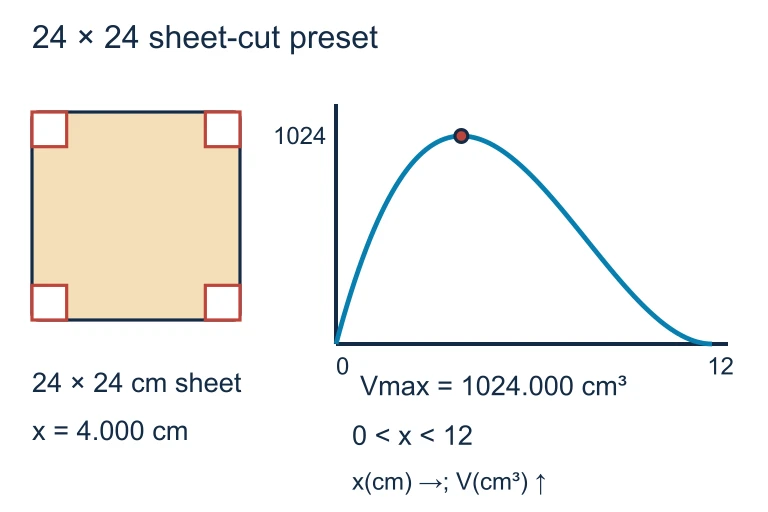 For a 24 cm square sheet, cutting corners of side x gives V(x) = x(24 − 2x)². The maximum volume is 1,024 cm³ when x = 4 cm.
Example 1: Fencing Problem
A farmer has 200 m of fencing and wants to enclose a rectangular area along a river (no fencing needed on the river side). What dimensions maximize the area?
Example 1: Solution
Example 2: Open Box Problem
A box with an open top is made from a 12 in. by 12 in. sheet of metal by cutting equal squares of side \( x \) from each corner and folding up the sides. Find \( x \) to maximize volume.
Example 2: Solution
Example 3: Minimum Distance
Find the point on the parabola \( y = x^2 \) that is closest to the point \( (3, 0) \).
Example 3: Solution
Common Mistakes
Optimization Summary
| Step | Action | Key Check |
|---|---|---|
| 1. Setup | Identify variables, draw diagram | All quantities labeled? |
| 2. Objective | Write \( f(x) \) to optimize | Correct formula? |
| 3. Constraint | Eliminate a variable | One variable left? |
| 4. Domain | Find valid \( x \)-range | Endpoints realistic? |
| 5. Solve | Set \( f'(x) = 0 \), solve | In domain? |
| 6. Verify | Use \( f'' \) or endpoints | Max or min confirmed? |
Question 1 of 5
A farmer uses 120 ft of fencing to enclose a rectangular pen against a barn wall (no fencing on the barn side). Which function represents the area in terms of the width \( w \)?
Question 2 of 5
Given \( f(x) = 2x^3 - 9x^2 + 12x \) on \( [0, 4] \), what is the absolute maximum value?
Question 3 of 5
For the open-box problem, a square sheet has side length \( s \). After cutting corner squares of side \( x \), the volume is \( V(x) = x(s-2x)^2 \). What is the domain of \( x \)?
Question 4 of 5
If \( f'(c) = 0 \) and \( f''(c) > 0 \), what can you conclude about \( f(c) \)?
Question 5 of 5
The sum of two positive numbers is 50. Which value of \( x \) minimizes the expression \( S = x^2 + y^2 \)?