01 / 20

Sketching Graphs of
Functions & Derivatives

Learn to read the story a function tells through its slopes, connect \( f \) to \( f' \), and sketch one from the other with confidence.

AP Calculus AB

What Is a Derivative Graph?

The graph of \( f'(x) \) plots the instantaneous rate of change of \( f(x) \) at every point. Each \( y \)-value on the \( f' \) graph equals the slope of the tangent line to \( f \) at that same \( x \).

Seeing the Connection Visually

\(f(x)\)
\(f\)
peak
\(f'(x)\)
\(f'\)
zero
\(f\) increasing then decreasing
\(f'\) positive then negative
Key insight:
Where \(f\) has a peak or valley, \(f'\) crosses the \(x\)-axis.

Why This Matters on the AP Exam

Free Response
You are given \( f' \) and asked to describe the behavior of \( f \): intervals of increase, decrease, and concavity.
Multiple Choice
Match a graph of \( f \) to the correct graph of \( f' \), or vice versa: a skill tested every year.
Justifications
Earn full credit by connecting sign of \( f' \) to increasing/decreasing and sign of \( f'' \) to concavity.

The Core Translation Rules

1
\( f \) increasing \( \Longleftrightarrow \) \( f'(x) > 0 \): the derivative graph is above the \( x \)-axis.
2
\( f \) decreasing \( \Longleftrightarrow \) \( f'(x) < 0 \): the derivative graph is below the \( x \)-axis.
3
Local max/min of \( f \) \( \Longleftrightarrow \) \( f'(x) = 0 \) and \( f' \) changes sign.
4
\( f \) concave up \( \Longleftrightarrow \) \( f' \) is increasing; \( f \) concave down \( \Longleftrightarrow \) \( f' \) is decreasing.
5
Inflection point of \( f \) \( \Longleftrightarrow \) \( f' \) has a local extremum (peak or valley).

Rules in Action: Diagram

\(f(x)\)
local max local min inflection
\(f\) inc.
\(f\) dec.
\(f\) inc.
\(f'(x)\)
\(f' > 0\)
\(f' < 0\)
\(f' > 0\)
Translation Summary
\(f\) max/min \( \to f' = 0 \)
\(f\) inflection \( \to f' \) extremum
\(f\) increasing \( \to f' > 0 \)
\(f\) decreasing \( \to f' < 0 \)
\(f\) concave up \( \to f' \) rising
\(f\) concave down \( \to f' \) falling
\( f(x) = x^3 - 3x \)
\( f'(x) = 3x^2 - 3 \)

Increasing vs. Concave Up: Key Distinction

Increasing / Decreasing Concave Up / Down
What it describes Direction of \( f \) Curvature (bending) of \( f \)
Determined by Sign of \( f'(x) \) Sign of \( f''(x) \) or slope of \( f' \)
On the \( f' \) graph \( f' \) above/below \( x \)-axis \( f' \) increasing/decreasing
Special point Local max/min where \( f' = 0 \) Inflection where \( f' \) has extremum

How to Sketch \( f' \) from \( f \)

1
Identify all local extrema of \( f \). Mark these \( x \)-values: they become the zeros of \( f' \).
2
Determine increasing/decreasing intervals. Where \( f \) rises, draw \( f' \) above the axis. Where \( f \) falls, draw \( f' \) below.
3
Judge steepness. Steeper slope on \( f \) means \( f' \) is farther from zero. Gentle slope means \( f' \) is near zero.
4
Check concavity. If \( f \) is concave up, \( f' \) should be increasing. If concave down, \( f' \) should be decreasing.
5
Connect smoothly. \( f' \) inherits continuity from \( f \) (if \( f \) is differentiable). Draw a smooth curve through your plotted features.

Example 1: \( f(x) = x^2 - 4x + 3 \)

\(f(x)\)
vertex (2, \(-1\))
1 3
\(f'(x)\)
\(x = 2\)
\(f' < 0\)
\(f' > 0\)
Parabola (quadratic) Straight line (linear)
Degree drops by 1: quadratic \(\to\) linear

Example 2: Sketching \( f' \) from a Cubic

\(f(x)\)
max min inflection
\(f'(x)\)
\(f' < 0\)
\(f' > 0\)
\(f' > 0\)
Cubic \( \to \) Quadratic derivative: inflection of \(f\) maps to extremum of \(f'\)

Example 3: Sketching \( f \) from \( f' \)

Given: \(f'(x)\)
a b
\(f' > 0\)
\(f' < 0\)
\(f' > 0\)
Sketch: \(f(x)\)
local max local min Reverse Steps 1.
\(f' = 0\) at \(a, b \to f\) has extrema at \(a, b\)
2.
\(f' > 0\) before \(a \to f\) rises
3.
\(f' < 0\) between \(a, b \to f\) falls (\(a\) is local max)
4.
\(f' > 0\) after \(b \to f\) rises (\(b\) is local min)
5.
\(f'\) min between \(a, b \to f\) has inflection there

Example 4: When \( f \) Has a Corner

\(f(x)\)
corner
\(f(x) = |x|\)
\(f'(x)\)
\(f' = -1\)
\(f' = 1\)
\(f'(x)\): jump discontinuity
\(f'(0)\) does not exist

Reading \( f \), \( f' \), and \( f'' \) Together

\( f \)
Position: where is the function \(f\)? Above or below the axis? What shape does the curve take?
\( f' \)
Velocity: is \( f \) going up or down? How fast? Zeros of \( f' \) are extrema of \( f \).
\( f'' \)
Acceleration: is \( f \) bending up or down? Zeros of \( f'' \) are inflection points of \( f \).

A continuous route through hills: elevation, grade, and intermediate height

A walking path crosses a ridge and hollow beside a staff-bearing observer.For f(x) = x³ − 3x, height, slope, and change in slope are different quantities. The extrema occur at x = −1 and 1; concavity changes at x = 0.

Height, grade and changing grade
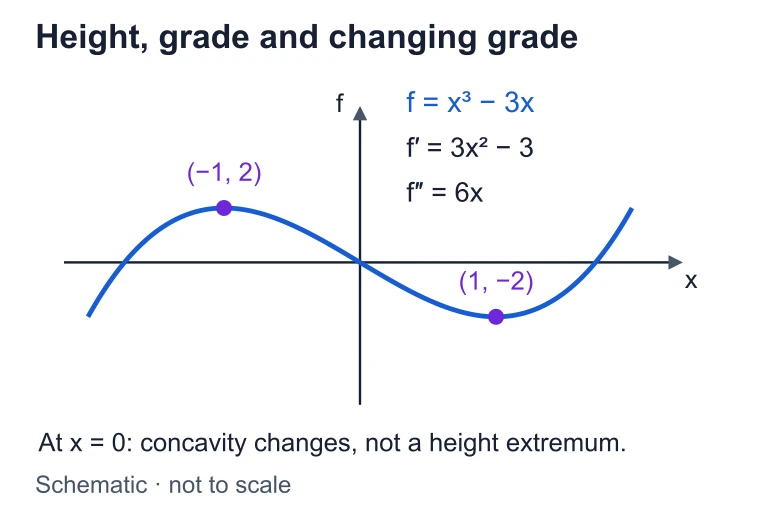
For f(x) = x³ − 3x, height, slope, and change in slope are different quantities. The extrema occur at x = −1 and 1; concavity changes at x = 0.For f(x) = x³ − 3x, height, slope, and change in slope are different quantities. The extrema occur at x = −1 and 1; concavity changes at x = 0.

Common Mistakes to Avoid

Confusing \(f\) and \(f'\)
A peak on \( f \) does not mean a peak on \( f' \). It means \( f' = 0 \) there. The peak of \( f' \) corresponds to an inflection point of \( f \).
Ignoring Concavity
Getting increase/decrease right but drawing wrong curvature. Always check: is \( f' \) rising or falling in each interval?
Forgetting Non-differentiable Points
Corners, cusps, and vertical tangents mean \( f' \) is undefined there. Do not draw \( f' \) through these points.

Summary Cheat Sheet

Feature of \( f \) What \( f' \) does What \( f'' \) does
Increasing \( f' > 0 \) (above axis) Any sign
Decreasing \( f' < 0 \) (below axis) Any sign
Local maximum \( f' = 0 \), sign change \( + \to - \) \( f'' < 0 \)
Local minimum \( f' = 0 \), sign change \( - \to + \) \( f'' > 0 \)
Concave up \( f' \) is increasing \( f'' > 0 \)
Concave down \( f' \) is decreasing \( f'' < 0 \)
Inflection point \( f' \) has local extremum \( f'' = 0 \) (sign change)

Question 1 of 5

If \( f'(x) > 0 \) for all \( x \) in the interval \( (a, b) \), which of the following must be true about \( f \) on \( (a, b) \)?

Question 2 of 5

The graph of \( f' \) crosses the \( x \)-axis from positive to negative at \( x = c \). What can you conclude about \( f \) at \( x = c \)?

Question 3 of 5

If \( f' \) has a local minimum at \( x = d \), what feature does \( f \) have at \( x = d \)?

Question 4 of 5

Suppose \( f(x) = x^4 - 4x^3 \). At which \( x \)-value does \( f \) have a local minimum?

Question 5 of 5

The graph of \( f \) has a corner at \( x = k \). Which statement about \( f'(k) \) is correct?