Second Derivative
Test
Learn how to use concavity and the second derivative to classify critical points as local maxima or minima: faster and more elegant than the First Derivative Test.
What Is a Critical Point?
A critical point of a function \( f \) occurs at \( x = c \) where the first derivative is zero or undefined:
At these points, the tangent line is horizontal (or absent). The function could have a local max, a local min, or neither: the critical point alone does not tell us which.
Concavity and \( f'' \)
Why Use the Second Derivative?
The First Derivative Test requires checking the sign of \( f' \) on both sides of every critical point. The Second Derivative Test gives the answer in one computation: just evaluate \( f''(c) \).
The Second Derivative Test
Let \( f \) be a function where \( f'(c) = 0 \) and \( f'' \) is continuous near \( c \).
Theorem Visualized
First vs Second Derivative Test
| First Derivative Test | Second Derivative Test | |
|---|---|---|
| What you check | Sign of \( f' \) on each side of \( c \) | Value of \( f''(c) \) |
| Number of evaluations | At least 2 (left and right) | Just 1 |
| Always conclusive? | Yes | No: fails when \( f''(c)=0 \) |
| Best for | All cases, including cusps | Polynomial/rational functions |
How to Apply the Test
Example 1: \( f(x) = x^3 - 3x \)
Graph of \( f(x) = x^3 - 3x \)
Example 2: \( g(x) = -2x^2 + 8x - 5 \)
Example 3: Inconclusive Case
Consider \( h(x) = x^4 \). Find and classify its critical point.
Example 4: \( f(x) = x + \frac{4}{x} \)
Common Mistakes
Quick Reference Summary
| Condition at \( x = c \) | Concavity | Conclusion |
|---|---|---|
| \( f'(c) = 0 \), \( f''(c) > 0 \) | Concave Up | Local Minimum |
| \( f'(c) = 0 \), \( f''(c) < 0 \) | Concave Down | Local Maximum |
| \( f'(c) = 0 \), \( f''(c) = 0 \) | Unknown | Inconclusive |
| \( f'(c) \neq 0 \) | N/A | Not a critical point |
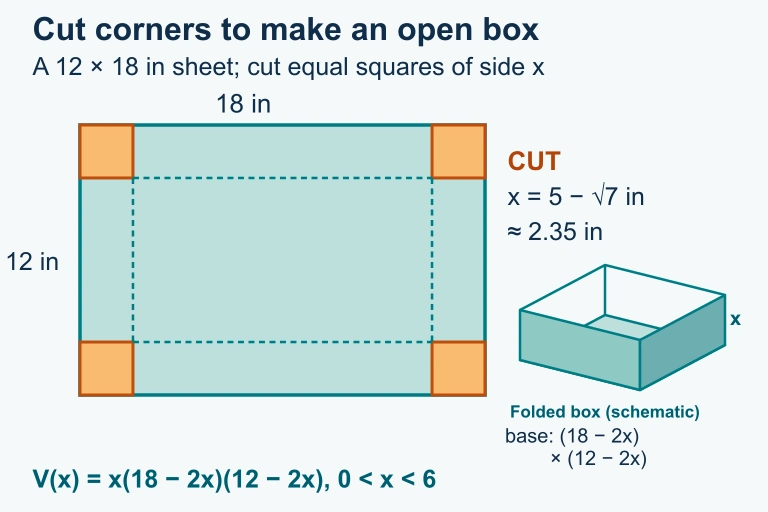
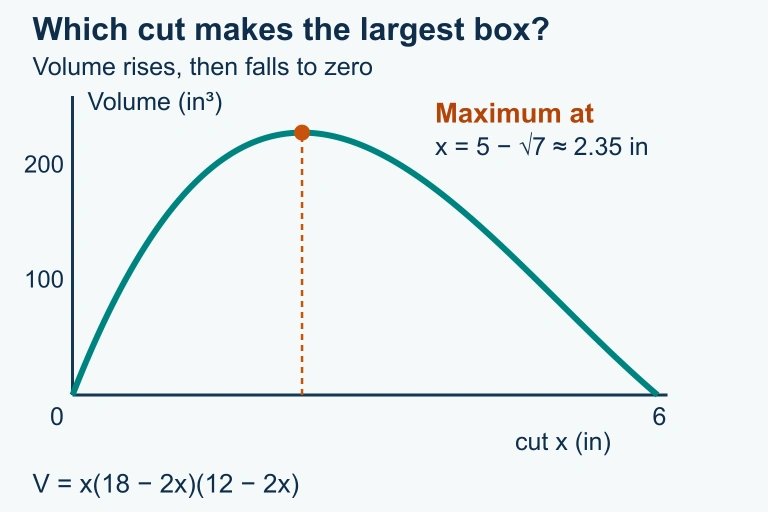
Worked practice: Section 9, Practice Problem 4 — Applied
Work through this original lesson problem, then reveal the solution and illustrations.
A manufacturer designs an open-top box by cutting equal squares of side length x inches from each corner of a 12-inch by 18-inch sheet of metal and folding up the sides. (a) Show that the volume of the box is V(x) = x(12 − 2x)(18 − 2x). (b) Find all critical points of V on the interval (0, 6). (c) Use the Second Derivative Test to classify each critical point. (d) State the dimensions that maximize the volume and give the maximum volume.
Show answer and explanation
Rubric (5 points): Point 1 (Part a): After cutting squares of side x from each corner, the base has dimensions (12 − 2x) by (18 − 2x), and the height is x. Therefore V(x) = x(12 − 2x)(18 − 2x). Expanding: V(x) = x(216 − 24x − 36x + 4x²) = 4x³ − 60x² + 216x. Point 2 (Part b): V′(x) = 12x² − 120x + 216 = 12(x² − 10x + 18). Using the quadratic formula: x = (10 ± √(100 − 72))/2 = (10 ± √28)/2 = 5 ± √7. So x = 5 − √7 ≈ 2.354 and x = 5 + √7 ≈ 7.646. Only x = 5 − √7 lies in (0, 6). Point 3 (Part c — computing f″): V″(x) = 24x − 120. At x = 5 − √7: V″(5 − √7) = 24(5 − √7) − 120 = 120 − 24√7 − 120 = −24√7 ≈ −63.5. Point 4 (Part c — conclusion): Since V′(5 − √7) = 0 and V″(5 − √7) = −24√7 < 0, by the Second Derivative Test, V has a local maximum at x = 5 − √7. Because this is the only critical point on (0, 6) and V(0) = V(6) = 0, this local maximum is also the absolute maximum on [0, 6]. Point 5 (Part d): With x = 5 − √7, the dimensions are: height = 5 − √7 ≈ 2.354 in, width = 12 − 2(5 − √7) = 2 + 2√7 ≈ 7.292 in, length = 18 − 2(5 − √7) = 8 + 2√7 ≈ 13.292 in. Maximum volume: V(5 − √7) = (5 − √7)(2 + 2√7)(8 + 2√7). Computing numerically: V ≈ 2.354 × 7.292 × 13.292 ≈ 228.2 in³.
Question 1 of 5
Let \( f(x) = x^3 - 12x + 1 \). Using the Second Derivative Test, classify the critical point at \( x = 2 \).
Question 2 of 5
If \( f''(c) = 0 \) and \( f'(c) = 0 \), what does the Second Derivative Test tell you?
Question 3 of 5
Let \( g(x) = -x^4 + 4x^2 \). Find \( g''(x) \) and determine the classification at \( x = 0 \).
Question 4 of 5
For \( h(x) = \sin(x) \), the Second Derivative Test at \( x = \frac{\pi}{2} \) yields:
Question 5 of 5
Which of the following is an advantage of the First Derivative Test over the Second Derivative Test?