Rates of Change in
Applied Concepts
Master how derivatives model real-world rates: from volume draining out of a tank to bacteria population growth and beyond motion problems.
What Is a Rate of Change?
A rate of change measures how one quantity changes with respect to another. If \( y = f(x) \), then the derivative \( f'(x) \) tells us the instantaneous rate at which \( y \) changes per unit change in \( x \).
In applied problems, \( x \) is often time \( t \), but it can also be temperature, radius, depth, or any independent variable.
Beyond Motion: Where Rates Appear
Average vs Instantaneous Rate
The Core Principle
The units of the derivative are always: units of \( Q \) per unit of \( x \). Getting the units right is half the battle on the AP exam.
Interpreting \( f'(a) \) in Context
The AP exam rewards precise language. A complete interpretation has three parts:
Cooling coffee with temperature and rate shown separately
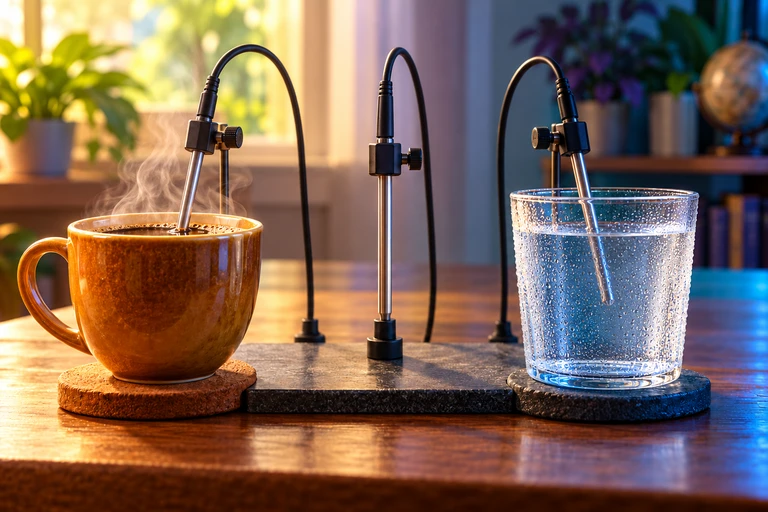 Temperature and its rate of change have different units. At 5 minutes, the coffee is 142 °F and cooling at 4.3 °F per minute.
Temperature and its rate have different units
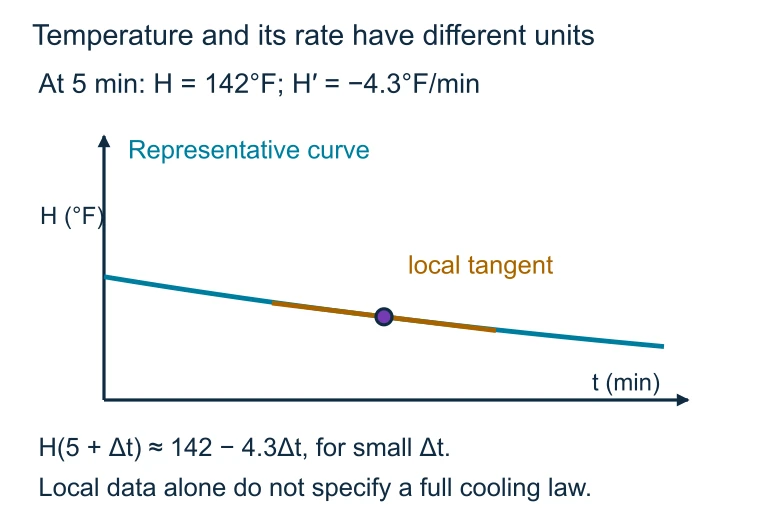 Temperature and its rate of change have different units. At 5 minutes, the coffee is 142 °F and cooling at 4.3 °F per minute.
Rate vs Accumulation
Two related but different questions arise in applied problems. Make sure you know which one is being asked:
| Rate Question | Accumulation Question | |
|---|---|---|
| Asks for | \( f'(a) \) | \( \displaystyle\int_a^b f'(t)\,dt \) |
| Meaning | How fast right now | Total change over \([a,b]\) |
| Units | output / input | output units only |
| Answer type | A single number | Net change (area under curve) |
Step-by-Step Approach
Example 1: Draining Tank
The volume of water in a tank is modeled by \( V(t) = 200 - 3t^2 + 0.1t^3 \) liters, where \( t \) is measured in minutes. Find the rate at which the volume is changing at \( t = 4 \) minutes.
Example 2: Marginal Cost
A company's total cost of producing \( x \) widgets is \( C(x) = 500 + 8x - 0.02x^2 \) dollars. Find the marginal cost when \( x = 100 \) widgets.
Example 3: Bacteria Growth
A bacteria population is modeled by \( P(t) = 1000 \cdot e^{0.15t} \), where \( t \) is in hours. At what rate is the population growing when \( t = 6 \) hours?
Example 4: Table-Based Estimation
The temperature \( T(t) \) of a cooling object (in \(^{\circ}\text{F}\)) is recorded at selected times. Estimate \( T'(5) \).
| \( t \) (min) | 0 | 2 | 5 | 8 | 12 |
|---|---|---|---|---|---|
| \( T(t) \) (\(^{\circ}\text{F}\)) | 180 | 162 | 140 | 124 | 110 |
Why Units Matter
On the AP exam, you must state the units of a derivative in context. The rule is simple:
Sign of \( f'(x) \): Increasing or Decreasing?
Common Mistakes
Summary: Applied Rates Toolkit
| Concept | Formula / Tool | When to Use |
|---|---|---|
| Instantaneous rate | \( f'(a) \) | "At what rate" at a point |
| Average rate | \( \frac{f(b)-f(a)}{b-a} \) | "Average rate over \([a,b]\)" |
| Table estimation | Symmetric difference quotient | No formula given, only data |
| Interpretation | Three-part sentence | Every free-response answer |
| Units | \( \frac{\text{output units}}{\text{input units}} \) | Always required on AP |
Question 1 of 5
The amount of fuel in a tank is given by \( F(t) = 80 - 2t - 0.05t^2 \) gallons, where \( t \) is in hours. What is \( F'(4) \)?
Question 2 of 5
A company's revenue is \( R(x) = 50x - 0.5x^2 \) dollars for \( x \) items sold. What are the units of \( R'(x) \)?
Question 3 of 5
Given the table below, which is the best estimate for \( g'(3) \)?
| \( t \) | 1 | 3 | 5 | 7 |
|---|---|---|---|---|
| \( g(t) \) | 10 | 18 | 22 | 24 |
Question 4 of 5
The number of bacteria in a culture is \( N(t) = 500e^{0.2t} \). At \( t = 5 \), the population is:
Question 5 of 5
If \( h'(2) = -7 \) and \( h(t) \) measures the water level of a lake in feet at time \( t \) hours, which is the best interpretation?