Position, Velocity &
Acceleration Using Integrals
Learn how integration connects the fundamental quantities of motion: recover velocity from acceleration and position from velocity.
What Is Rectilinear Motion?
When an object moves along a straight line, we describe its motion with three related functions of time \( t \):
Derivatives Go Down, Integrals Go Up
Why Do Integrals Matter Here?
In real-world problems, you often measure acceleration (e.g., from sensors) but need to find velocity or position. Integration lets you work backwards:
The Integral Relationships
Each constant \( C \) is determined by an initial condition: a known value of \( v \) or \( s \) at a specific time.
Definite Integral Form
The definite integral gives you the net change over an interval:
Displacement vs. Total Distance
Indefinite vs. Definite Integral
| Indefinite \( \int v\,dt \) | Definite \( \int_a^b v\,dt \) | |
|---|---|---|
| Result | A function \( s(t) + C \) | A number (net change) |
| Needs \(+C\)? | Yes | No |
| Use when... | You want a full formula for \( s(t) \) | You want displacement over \([a,b]\) |
| Initial condition | Needed to find \( C \) | Built into the formula |
Step-by-Step Method
Example 1: Constant Acceleration
A particle has acceleration \( a(t) = 6 \) m/s², with \( v(0) = 2 \) m/s and \( s(0) = 1 \) m. Find \( s(t) \).
Example 2: Variable Acceleration
Given \( a(t) = 4t - 2 \), \( v(1) = 3 \), \( s(1) = 0 \). Find \( s(t) \).
Example 3: Displacement and Distance
A particle has \( v(t) = t^2 - 4 \) on \([0, 3]\). Find displacement and total distance.
One cart, three meanings: position, displacement, and distance
 Suppose v(t) = t² − 4t + 3 on [0,4] with initial position 2. The final position is 10/3, displacement is 4/3 units, and total distance is 4 units.
Signed change and distance differ
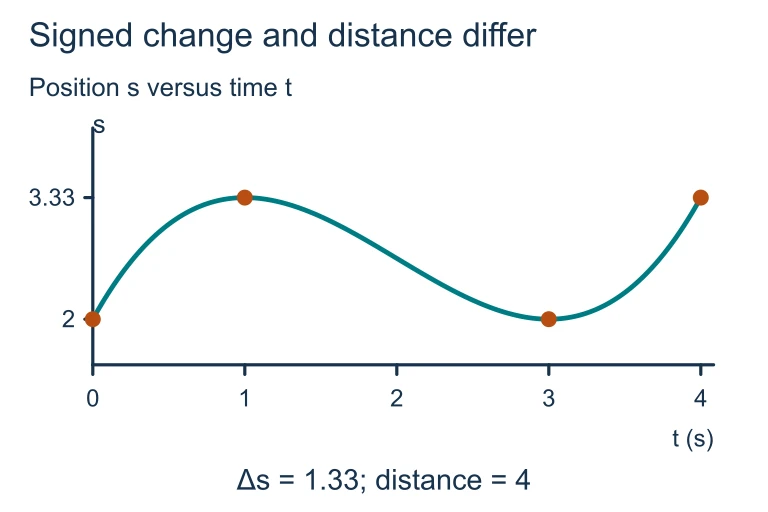 Suppose v(t) = t² − 4t + 3 on [0,4] with initial position 2. The final position is 10/3, displacement is 4/3 units, and total distance is 4 units.
Visualizing \( v(t) = t^2 - 4 \)
When Is the Particle at Rest?
A particle is at rest when \( v(t) = 0 \). This is where the velocity function crosses the \( t \)-axis. These points are critical for total distance problems.
Interpreting Signed Area
Common Mistakes to Avoid
Summary Table
| Given | Operation | Result |
|---|---|---|
| \( a(t) \) | \(\int a(t)\,dt\) | \( v(t) + C \) |
| \( v(t) \) | \(\int v(t)\,dt\) | \( s(t) + C \) |
| \( v(t) \) on \([a,b]\) | \(\int_a^b v(t)\,dt\) | Displacement |
| \( v(t) \) on \([a,b]\) | \(\int_a^b |v(t)|\,dt\) | Total distance |
| \( s(t) \) | \( s'(t) \) | \( v(t) \) |
| \( v(t) \) | \( v'(t) \) | \( a(t) \) |
Question 1 of 5
A particle has velocity \( v(t) = 3t^2 - 6t \). What is the displacement from \( t = 0 \) to \( t = 3 \)?
Question 2 of 5
If \( a(t) = 10 \) and \( v(0) = -3 \), what is \( v(t) \)?
Question 3 of 5
A particle has \( v(t) = t - 2 \) on \([0, 4]\). What is the total distance traveled?
Question 4 of 5
Given \( a(t) = 6t \), \( v(0) = 4 \), and \( s(0) = 1 \), find \( s(2) \).
Question 5 of 5
If \( v(t) = \cos(t) \) and \( s(0) = 2 \), what is \( s(\pi) \)?