01 / 21

Modeling with
Differential Equations

Learn to translate real-world scenarios into differential equations using rates of change: from population growth to cooling coffee.

AP Calculus AB

What Is a Differential Equation?

A differential equation is an equation that relates a function to one or more of its derivatives. It describes how a quantity changes over time or space.

\(\frac{dy}{dt} = 3y\)
Rate of change proportional to the current value
\(\frac{dT}{dt} = -k(T - A)\)
Rate depends on difference from ambient temperature

Why Model with Differential Equations?

Many real-world processes are described by their rate of change rather than an explicit formula. Differential equations let us capture this behavior mathematically.

Population Growth
Birth/death rates drive how populations change over time
Cooling/Heating
Temperature changes based on the gap from surroundings
Compound Interest
Money grows proportionally to its current balance

The Language of Rates

Translating word problems into differential equations starts with recognizing key phrases that signal rates of change.

1
"rate of change" → \(\frac{dy}{dt}\) (derivative of \(y\) with respect to \(t\))
2
"proportional to" → multiply by a constant \(k\): e.g., \(\frac{dy}{dt} = ky\)
3
"difference from" → subtract a value: e.g., \(\frac{dy}{dt} = k(y - A)\)
4
"at a constant rate" → \(\frac{dy}{dt} = C\), where \(C\) is a constant

Core Model: Exponential Growth & Decay

\(t\) \(y\) \(k > 0\) (growth) \(k < 0\) (decay) \(y_0\) \(y_0\)

Core Model: Newton's Law of Cooling

\(t\) \(T\) \(T_{\text{env}}\) \(T_0\) Cooling curve \(T - T_{\text{env}}\)

Proportional vs. Constant Rate

Not every rate of change involves a differential equation of the same form. Recognizing the type of rate determines the structure of your equation.

Proportional Rate Constant Rate
Verbal Cue "proportional to \(y\)" "at a constant rate"
Equation Form \(\frac{dy}{dt} = ky\) \(\frac{dy}{dt} = C\)
Solution Type Exponential: \(y = y_0 e^{kt}\) Linear: \(y = Ct + y_0\)
Example Bacteria doubling Filling a tank at 5 L/min

The Logistic Growth Model

\(t\) \(P\) \(L\) Inflection: \(P = L/2\) \(P_0\)

How to Set Up a Differential Equation

1
Identify the variables. What quantity is changing? Call it \(y\) (or \(P\), \(T\), etc.). What is the independent variable? Usually \(t\) (time).
2
Express the rate. Write \(\frac{dy}{dt}\) on the left side. The problem tells you what this equals.
3
Translate the relationship. "Proportional to \(y\)" means \(ky\). "Difference from \(A\)" means \((y - A)\). Combine as needed.
4
Include initial conditions. State \(y(0) = y_0\) or whatever starting value is given.
5
Check units and signs. Growth → positive rate. Decay/cooling → negative coefficient or structure that yields a negative rate when appropriate.

Example 1: Bacterial Population

Problem: A colony of bacteria grows at a rate proportional to its current population. Initially there are 500 bacteria. Write a differential equation and initial condition for the population \(P(t)\).

1
Variables: \(P\) = population, \(t\) = time
2
"rate proportional to population" → \(\frac{dP}{dt} = kP\)
3
Initial condition: \(P(0) = 500\)

Example 2: Cooling Coffee

Problem: A cup of coffee at 90°C is placed in a room at 22°C. The temperature changes at a rate proportional to the difference between the coffee and room temperatures. Write the DE.

1
Variables: \(T\) = coffee temperature, \(t\) = time
2
"rate proportional to difference" → \(\frac{dT}{dt} = -k(T - 22)\)
3
Initial condition: \(T(0) = 90\)

Example 3: Tank Mixing Problem

Problem: A tank holds 100 L of pure water. A salt solution at 3 g/L flows in at 2 L/min, and the well-mixed solution flows out at 2 L/min. Let \(Q(t)\) be grams of salt at time \(t\). Write the DE.

1
Rate in: \(3 \;\text{g/L} \times 2 \;\text{L/min} = \) 6 g/min
2
Rate out: concentration \(\times\) flow = \(\frac{Q}{100} \times 2 = \) \(\frac{Q}{50}\) g/min
3
Net rate: \(\frac{dQ}{dt} = \text{rate in} - \text{rate out}\)

Follow the salt through a working mixing rig
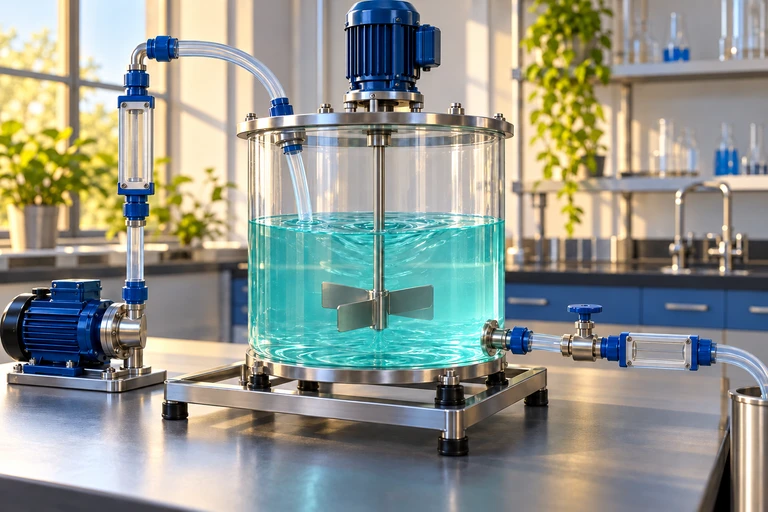
A stirred transparent tank has one upper inlet and one lower outlet with a valve. The exact diagram links its 100 L salt balance to a computed approach to equilibrium.A well-mixed 100 L tank receives and releases 4 L/min. Salt enters at 2 kg/min and leaves at 0.04S kg/min, giving S′ = 2 − 0.04S.

Stirred tank salt balance
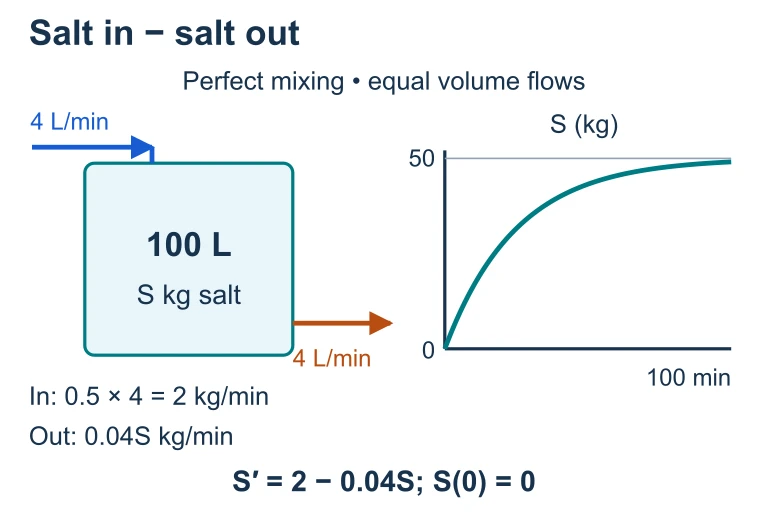
A well-mixed 100 L tank receives and releases 4 L/min. Salt enters at 2 kg/min and leaves at 0.04S kg/min, giving S′ = 2 − 0.04S.A well-mixed 100 L tank receives and releases 4 L/min. Salt enters at 2 kg/min and leaves at 0.04S kg/min, giving S′ = 2 − 0.04S.

Visualizing with Slope Fields

A slope field shows tiny line segments at many points \((t, y)\), each with slope equal to \(\frac{dy}{dt}\). It reveals the behavior of solutions without solving the equation.

\(t\) \(y\) Solution curve Slope field for \(\frac{dy}{dt} = 0.5y\)

Initial Conditions Matter

A differential equation has infinitely many solutions (a family of curves). The initial condition \(y(t_0) = y_0\) picks out the one specific solution that passes through a given point.

\(t\) \(y\) \(y(0) = 3\) Family of solutions to \(\frac{dy}{dt} = 0.5y\)

Common Mistakes to Avoid

✕ Wrong Sign
Using \(\frac{dT}{dt} = k(T - T_{\text{env}})\) for cooling instead of \(-k(T - T_{\text{env}})\). Cooling requires a negative rate when \(T > T_{\text{env}}\).
✕ Forgetting Initial Conditions
Writing only \(\frac{dy}{dt} = ky\) without specifying \(y(0) = y_0\). The DE alone has infinitely many solutions.
✕ Confusing \(y\) with \(\frac{dy}{dt}\)
Writing the function where the derivative should go, or vice versa. Always ask: what is the rate, and what is the quantity?

Summary of Key Models

Scenario Differential Equation Solution Form
Exponential Growth \(\frac{dy}{dt} = ky,\; k > 0\) \(y = y_0 e^{kt}\)
Exponential Decay \(\frac{dy}{dt} = ky,\; k < 0\) \(y = y_0 e^{kt}\)
Newton's Cooling \(\frac{dT}{dt} = -k(T - T_{\text{env}})\) \(T = T_{\text{env}} + (T_0 - T_{\text{env}})e^{-kt}\)
Logistic Growth \(\frac{dP}{dt} = kP(1 - \frac{P}{L})\) S-shaped curve → \(L\)
Constant Rate \(\frac{dy}{dt} = C\) \(y = Ct + y_0\)

Worked practice: Section 9, Practice Problem 4 — Applied

Work through this original lesson problem, then reveal the solution and illustrations.

A rumor spreads through a school of 1,200 students. At time t = 0, 40 students have heard the rumor. The rate at which the rumor spreads is jointly proportional to the number of students who have heard the rumor and the number who have not yet heard it. (a) Write a differential equation that models this situation. Define all variables. (b) Determine the number of students who have heard the rumor at the instant when the rumor is spreading most rapidly. (c) Describe the long-term behavior of the solution and explain why this is consistent with the model. (d) If the proportionality constant is k = 0.0003, compute the rate at which the rumor is spreading at t = 0.

Show answer and explanation

Rubric (5 points): Point 1 (Part a — Setting Up Variables): Let R(t) = number of students who have heard the rumor at time t. Then (1200 − R) is the number who have not. The initial condition is R(0) = 40. Point 2 (Part a — Writing the DE): "Jointly proportional to R and (1200 − R)" gives: dR/dt = kR(1200 − R), where k > 0. This is a logistic differential equation with carrying capacity L = 1200. Point 3 (Part b — Maximum Rate): The rate dR/dt = kR(1200 − R) is a downward-opening parabola in R. It is maximized at R = 1200/2 = 600 students. This is the general logistic result: maximum growth rate occurs at half the carrying capacity. Point 4 (Part c — Long-term Behavior): As t → ∞, R(t) → 1200. Eventually, all students hear the rumor. This is consistent with the model because when R = 1200, dR/dt = k(1200)(0) = 0, meaning the rumor stops spreading since there is no one left who hasn't heard it. The equilibrium R = 1200 is stable. Point 5 (Part d — Computing Initial Rate): At t = 0, R = 40. dR/dt = 0.0003 × 40 × (1200 − 40) = 0.0003 × 40 × 1160 = 0.0003 × 46400 = 13.92 students per unit time. The rumor initially spreads at approximately 13.9 students per unit time.
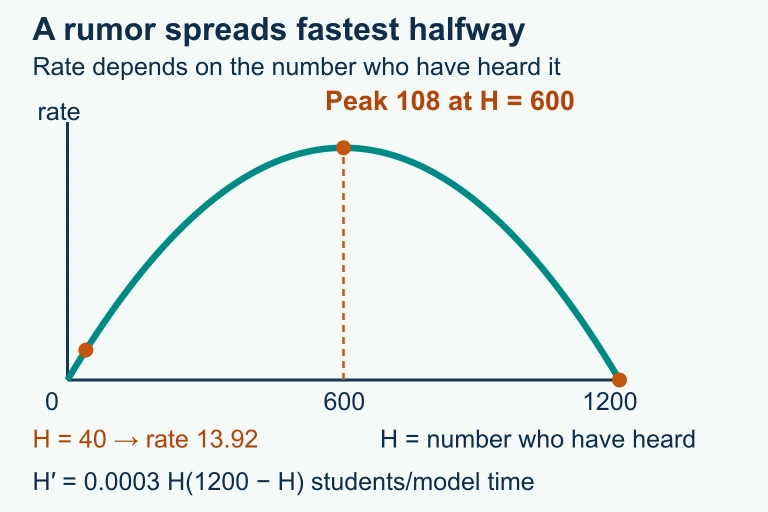
Rate H′=0.0003H(1200−H) versus informed population H. The rate is zero at 0 and 1200, reaches 108 at H=600, and is 13.92 at H=40.
The idealized rumor rate is greatest when half the 1200-person population has heard it; pictured students are qualitative context.

Question 1 of 5

A population of rabbits grows at a rate proportional to the current population. If there are initially 200 rabbits, which differential equation models this situation?

Question 2 of 5

A cup of soup cools in a room at 20°C. Its temperature changes at a rate proportional to the difference between the soup and room temperatures. Which equation models this?

Question 3 of 5

In the logistic model \(\frac{dP}{dt} = kP\!\left(1 - \frac{P}{L}\right)\), what happens to the growth rate as \(P\) approaches \(L\)?

Question 4 of 5

A tank contains 50 L of water. Saltwater at 4 g/L flows in at 3 L/min, and the well-mixed solution drains at 3 L/min. If \(Q(t)\) is grams of salt at time \(t\), which is the correct DE?

Question 5 of 5

A radioactive substance decays at a rate proportional to the amount present. If the half-life is 10 years, which equation correctly models the amount \(A(t)\)?