Meaning of the
Derivative in Context
Learn to interpret what \( f'(a) \) actually tells you in real-world scenarios: rates of change with units, direction, and meaning.
What Is a Derivative, Really?
At its core, the derivative \( f'(a) \) measures the instantaneous rate of change of \( f \) at \( x = a \). It answers: "How fast is the output changing right now?"
But on the AP exam, the question is rarely "compute the limit." Instead, you must explain what the derivative means using the language of the problem.
The Tangent Line Connection
Geometrically, \( f'(a) \) is the slope of the tangent line to the curve at \( x = a \). But in applied problems, slope has a real-world meaning tied to the units of the problem.
Why Context Matters on the AP Exam
The Interpretation Template
Units of \( f'(x) \)
The units of the derivative always follow the pattern: units of output divided by units of input. This comes directly from the difference quotient \( \frac{\Delta f}{\Delta x} \).
| Scenario | \( f(x) \) units | \( x \) units | \( f'(x) \) units |
|---|---|---|---|
| Position | meters | seconds | meters/second |
| Population | people | years | people/year |
| Cost | dollars | items | dollars/item |
| Temperature | degrees F | hours | degrees F/hour |
\( f(a) \) vs. \( f'(a) \)
One of the most common AP errors is confusing the value of the function with the rate of change of the function. They answer completely different questions.
Cooling coffee with temperature and rate shown separately
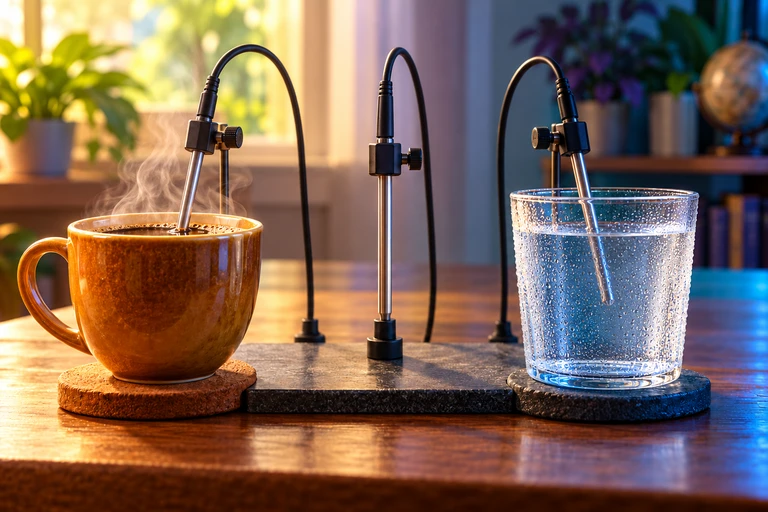 Temperature and its rate of change have different units. At 5 minutes, the coffee is 142 °F and cooling at 4.3 °F per minute.
Temperature and its rate have different units
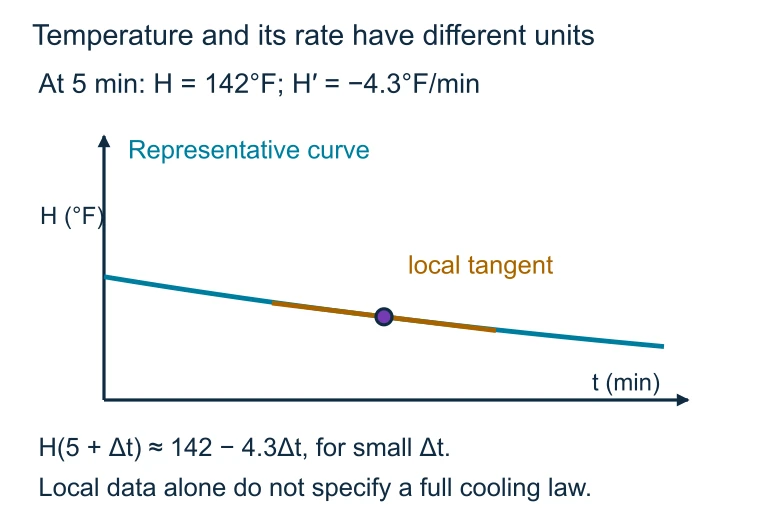 Temperature and its rate of change have different units. At 5 minutes, the coffee is 142 °F and cooling at 4.3 °F per minute.
Sign of \( f'(a) \): Increasing or Decreasing?
How to Write an Interpretation
Example 1: Water in a Tank
Problem: Let \( W(t) \) be the volume of water in a tank, in gallons, at time \( t \) minutes. Given that \( W'(4) = -3 \), interpret this value.
Follow the salt through a working mixing rig
 For net flow R(t) = 4t − t² gal/min and 10 gal initially, V(t) = 10 + 2t² − t³/3. Volume peaks at t = 4 minutes, when the net rate changes from positive to negative.
Signed net flow and inventory
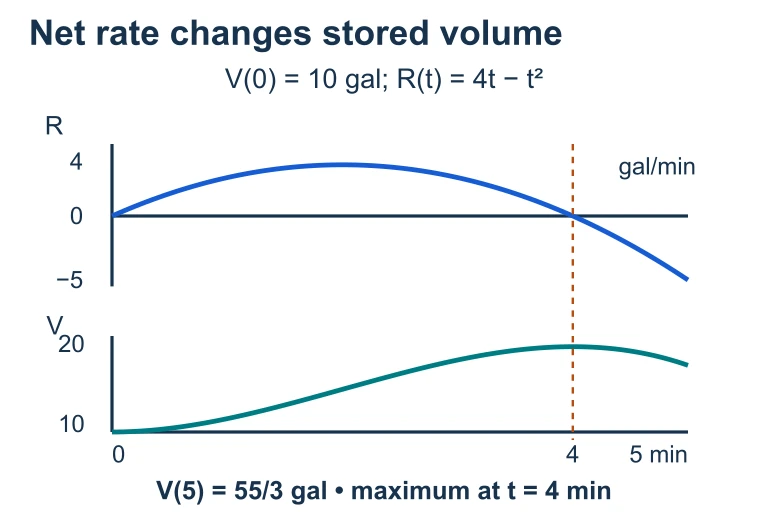 For net flow R(t) = 4t − t² gal/min and 10 gal initially, V(t) = 10 + 2t² − t³/3. Volume peaks at t = 4 minutes, when the net rate changes from positive to negative.
Example 2: Bacterial Growth
Problem: The number of bacteria in a culture is modeled by \( B(t) \), where \( t \) is measured in hours. If \( B'(6) = 450 \), interpret this value.
Example 3: Marginal Cost
Problem: A company's total cost to produce \( x \) widgets is \( C(x) \) dollars. If \( C'(150) = 12.50 \), interpret this value and explain what it means for the company.
The "Approximately" Connection
The derivative gives an instantaneous rate, which can be used to approximate changes over small intervals:
This is why we say "the approximate change in \( f \) for one additional unit of \( x \) is \( f'(a) \)." The approximation is better when the interval is small and \( f \) is roughly linear near \( a \).
Common Mistakes
Summary Checklist
| Element | What to Include | Common Error |
|---|---|---|
| Input value | "At \( t = 4 \) minutes..." | Omitting the specific value |
| Output quantity | "...the volume of water..." | Saying "the function" |
| Direction | "...is decreasing..." | "is changing" (too vague) |
| Rate + Units | "...at 3 gallons per minute." | Missing units entirely |
| Sign handling | Use \( |f'(a)| \) with "decreasing" | "increasing at -3" |
Question 1 of 5
The temperature of a cup of coffee, in degrees Fahrenheit, is modeled by \( T(t) \), where \( t \) is in minutes. If \( T'(5) = -4.2 \), which is the best interpretation?
Question 2 of 5
A car's position along a highway is given by \( s(t) \) miles, where \( t \) is in hours. What are the units of \( s'(t) \)?
Question 3 of 5
The profit from selling \( x \) units is \( P(x) \) dollars. If \( P'(200) = 8 \), which statement is most accurate?
Question 4 of 5
If \( f(3) = 50 \) and \( f'(3) = -2 \), which is the best estimate of \( f(4) \)?
Question 5 of 5
The depth of snow on the ground, \( D(t) \) inches, is measured \( t \) hours after midnight. If \( D'(8) = 0 \), what does this mean?