The Mean Value
Theorem
Discover how the instantaneous rate of change must equal the average rate of change at least once on any smooth curve.
What Is the Average Rate of Change?
Given a function \( f \) on the interval \( [a, b] \), the average rate of change is the slope of the secant line connecting the endpoints:
This tells you how fast \( f \) changes on average across the entire interval: it's the "big picture" slope.
What Is the Instantaneous Rate?
The instantaneous rate of change at a point \( x = c \) is the derivative \( f'(c) \): the slope of the tangent line at that exact point.
Why Does the MVT Matter?
The Mean Value Theorem is one of the most powerful results in calculus. It connects the local behavior (derivative) of a function to its global behavior (net change).
The Formal Statement
In words: somewhere between \( a \) and \( b \), the tangent line is parallel to the secant line connecting \( (a, f(a)) \) and \( (b, f(b)) \).
Visualizing the MVT
A continuous route through hills: elevation, grade, and intermediate height
 Continuity on the closed interval and differentiability in its interior guarantee a tangent parallel to the endpoint secant.
Mean Value Theorem: match a slope
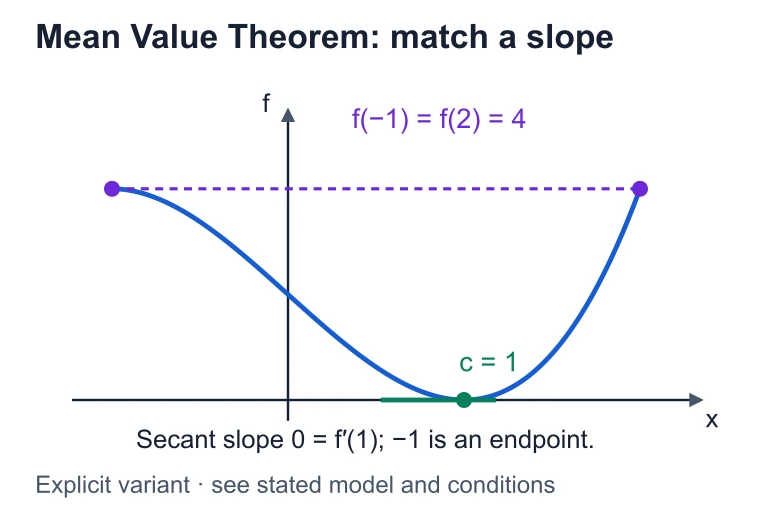 Continuity on the closed interval and differentiability in its interior guarantee a tangent parallel to the endpoint secant.
The Two Hypotheses
Both conditions are essential. If either fails, the MVT conclusion may not hold.
MVT vs Rolle's Theorem
| Mean Value Theorem | Rolle's Theorem | |
|---|---|---|
| Hypotheses | Continuous on \( [a,b] \), differentiable on \( (a,b) \) | Same + \( f(a) = f(b) \) |
| Conclusion | \( f'(c) = \frac{f(b)-f(a)}{b-a} \) | \( f'(c) = 0 \) |
| Secant slope | Any value | Exactly \( 0 \) |
| Relationship | General case | Special case of MVT |
How to Apply the MVT
Example 1: \( f(x) = x^2 \)
Find the value of \( c \) guaranteed by the MVT for \( f(x) = x^2 \) on \( [1, 3] \).
Example 1: Visual
Example 2: \( f(x) = x^3 - 3x \)
Find all values of \( c \) guaranteed by the MVT for \( f(x) = x^3 - 3x \) on \( [-1, 2] \).
Example 3: \( f(x) = \sqrt{x} \)
Find \( c \) for \( f(x) = \sqrt{x} \) on \( [0, 4] \).
Common Mistakes
Summary Table
| MVT | Rolle's | IVT | |
|---|---|---|---|
| About | Derivatives | Derivatives | Function values |
| Requires | Cont. + Diff. | Cont. + Diff. + \( f(a)=f(b) \) | Continuity only |
| Guarantees | \( f'(c) = \frac{f(b)-f(a)}{b-a} \) | \( f'(c) = 0 \) | \( f(c) = k \) |
| Key idea | Tangent ∥ secant | Horizontal tangent | Hits every value |
Question 1 of 5
The MVT guarantees that for \( f(x) = x^2 + 1 \) on \( [0, 2] \), there exists \( c \in (0,2) \) such that \( f'(c) \) equals:
Question 2 of 5
Which condition is not required for the Mean Value Theorem to apply?
Question 3 of 5
For \( f(x) = x^3 \) on \( [0, 3] \), what is the value of \( c \) guaranteed by the MVT?
Question 4 of 5
The MVT cannot be applied to which function on \( [-1, 1] \)?
Question 5 of 5
A car travels 150 miles in 2 hours. By the MVT, which statement is guaranteed?