Introduction to
Related Rates
Learn how to connect rates of change of two or more quantities that vary with time using the chain rule.
What Are Related Rates?
In many real-world situations, two or more quantities change simultaneously over time. When these quantities are connected by an equation, their rates of change are also connected.
Related rates problems ask you to find the rate at which one quantity changes, given the rate at which a related quantity changes. Both rates are derivatives with respect to time \( t \).
A Visual Intuition
Imagine a circular ripple spreading outward when a stone drops into a pond. As the radius \( r \) increases over time, the area \( A \) also increases. How fast is the area growing?
Why Related Rates Matter
Related rates connect calculus to the physical world. Whenever quantities are changing simultaneously, you can use derivatives to answer practical questions.
The Core Rule: Implicit Differentiation
The foundation of every related rates problem is implicit differentiation with respect to time \( t \). If an equation relates variables that all depend on \( t \), differentiate every term using the chain rule.
The Chain Rule Connection
Every time you differentiate a variable with respect to \( t \), the chain rule produces a \( \frac{d(\text{variable})}{dt} \) factor. This is what creates the "related" part.
Related Rates vs. Standard Derivatives
Students often confuse these two types of problems. Here is the critical difference:
| Related Rates | Standard Derivatives | |
|---|---|---|
| Independent variable | Time \( t \) | Usually \( x \) |
| Differentiation type | Implicit: \( \frac{d}{dt} \) | Explicit: \( \frac{d}{dx} \) |
| What you find | Rate at a specific instant | General derivative function |
| Chain rule usage | Every variable gets \( \frac{d(\cdot)}{dt} \) | Only for compositions |
| When to substitute values | After differentiating | Before or after, depends |
The Five-Step Method
Example 1: Expanding Circle
A circle's radius increases at \( \frac{dr}{dt} = 3 \text{ cm/s} \). Find \( \frac{dA}{dt} \) when \( r = 5 \text{ cm} \).
Example 2: The Ladder Problem
A 10 ft ladder leans against a wall. The base slides away at \( \frac{dx}{dt} = 1 \text{ ft/s} \). Find \( \frac{dy}{dt} \) when the base is 6 ft from the wall.
Ladder Problem: Solution
Example 3: Filling a Cone
Water fills a conical tank (height 10 ft, radius 5 ft) at \( \frac{dV}{dt} = 12 \text{ ft}^3\text{/min} \). Find \( \frac{dh}{dt} \) when \( h = 4 \text{ ft} \).
Cone Solution: Eliminate a Variable
A filling cone: connect volume and height
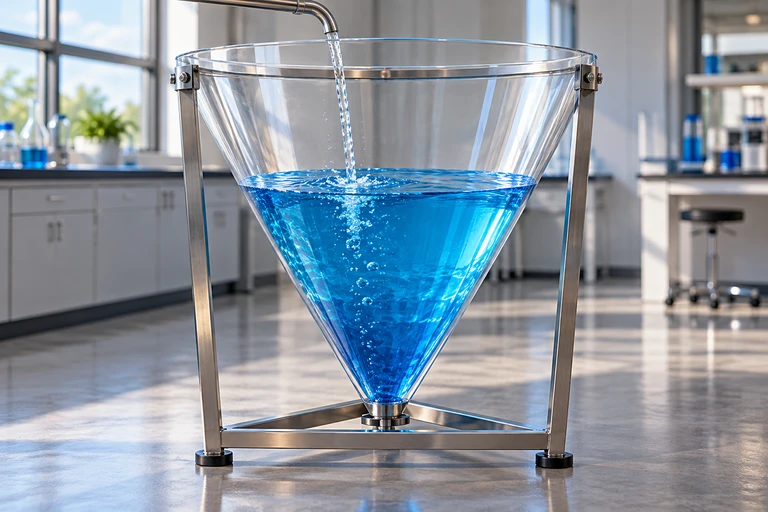 For a tank 12 ft high with top radius 4 ft, r = h/3 and V = πh³/27. An inflow of 8 ft³/min raises the water at 2/π ft/min when h = 6 ft.
A filling cone: connect volume and height
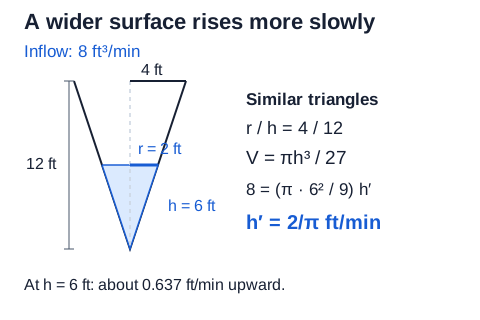 For a tank 12 ft high with top radius 4 ft, r = h/3 and V = πh³/27. An inflow of 8 ft³/min raises the water at 2/π ft/min when h = 6 ft.Open full diagram
Common Formulas in Related Rates
| Shape | Equation | After \( \frac{d}{dt} \) |
|---|---|---|
| Circle area | \( A = \pi r^2 \) | \( \frac{dA}{dt} = 2\pi r\frac{dr}{dt} \) |
| Sphere volume | \( V = \frac{4}{3}\pi r^3 \) | \( \frac{dV}{dt} = 4\pi r^2\frac{dr}{dt} \) |
| Right triangle | \( x^2 + y^2 = L^2 \) | \( 2x\frac{dx}{dt} + 2y\frac{dy}{dt} = 0 \) |
| Cone volume | \( V = \frac{1}{3}\pi r^2 h \) | Product rule (or eliminate \( r \)) |
| Trigonometric | \( \tan\theta = \frac{y}{x} \) | \( \sec^2\theta\frac{d\theta}{dt} = \frac{x\frac{dy}{dt} - y\frac{dx}{dt}}{x^2} \) |
Common Mistakes to Avoid
Question 1 of 5
A circle's radius increases at \( \frac{dr}{dt} = 2 \text{ cm/s} \). What is \( \frac{dA}{dt} \) when \( r = 3 \text{ cm} \)?
Question 2 of 5
Given \( x^2 + y^2 = 25 \), with \( \frac{dx}{dt} = 4 \), what is \( \frac{dy}{dt} \) when \( x = 3 \) and \( y = 4 \)?
Question 3 of 5
A spherical balloon is inflated at \( \frac{dV}{dt} = 100 \text{ cm}^3\text{/s} \). How fast is the radius growing when \( r = 5 \text{ cm} \)?
Question 4 of 5
In a related rates problem, why must you differentiate before substituting known values?
Question 5 of 5
A 13 ft ladder leans against a wall. The base moves away at \( \frac{dx}{dt} = 2 \text{ ft/s} \). When the base is 5 ft from the wall, how fast is the top sliding down?