Introduction to
Optimization Problems
Learn how to use derivatives to find maximum and minimum values of real-world quantities: from maximizing area to minimizing cost.
What is Optimization?
Optimization is the process of finding the absolute maximum or minimum value of a function subject to given constraints. In calculus, we use derivatives to identify these extreme values efficiently.
Why Does Optimization Matter?
Key Vocabulary
The Closed Interval Method
Visualizing Extreme Values
First vs. Second Derivative Test
| First Derivative Test | Second Derivative Test | |
|---|---|---|
| What you check | Sign change of \( f'(x) \) around \( c \) | Sign of \( f''(c) \) |
| Local max | \( f' \) changes + to − | \( f''(c) < 0 \) |
| Local min | \( f' \) changes − to + | \( f''(c) > 0 \) |
| When it fails | Never fails (always conclusive) | Inconclusive if \( f''(c) = 0 \) |
| Best for | General use, any critical point | Quick check when \( f'' \) is easy to compute |
How to Solve an Optimization Problem
An open box taking shape on a designer's table

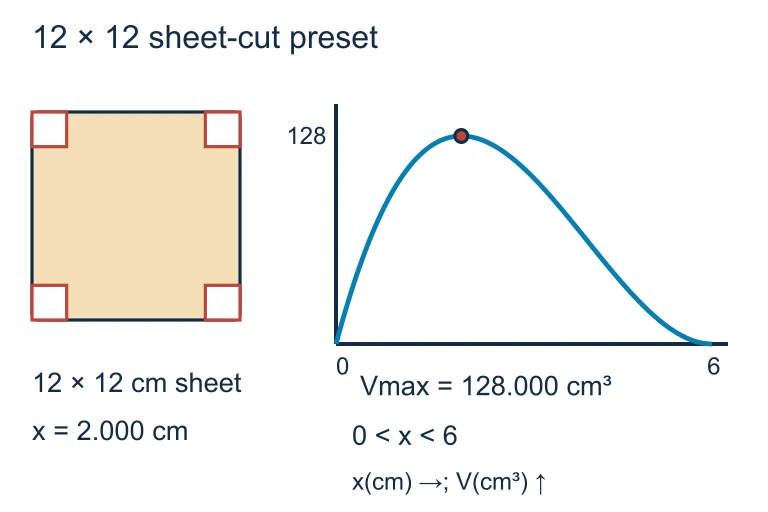
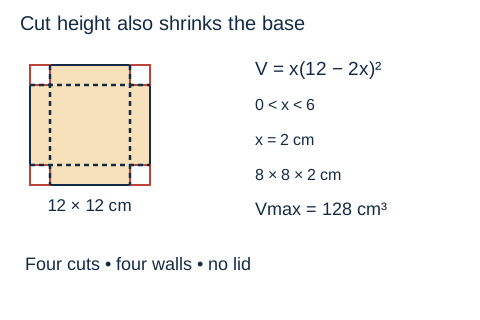
Suppose an open box is made from a 12 cm square sheet. Cutting corners of side x gives V(x) = x(12 − 2x)² for 0 < x < 6; the maximum is 128 cm³ at x = 2 cm.Corner cuts determine the box dimensions
12 × 12 sheet-cut preset
Suppose an open box is made from a 12 cm square sheet. Cutting corners of side x gives V(x) = x(12 − 2x)² for 0 < x < 6; the maximum is 128 cm³ at x = 2 cm.Designing a three-sided enclosure beside a river

With the river side unfenced, 120 m of fencing gives x + 2y = 120. The largest rectangular area is 1,800 m², with x = 60 m and y = 30 m.Designing a three-sided enclosure beside a river
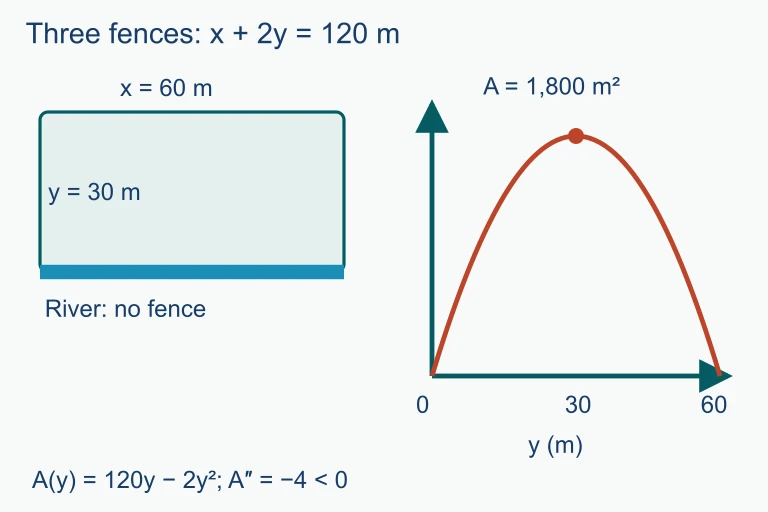
With the river side unfenced, 120 m of fencing gives x + 2y = 120. The largest rectangular area is 1,800 m², with x = 60 m and y = 30 m.Example 1: Maximum Area Fence
A farmer has 200 m of fencing to enclose a rectangular field along a river (no fence needed on the river side). What dimensions maximize the enclosed area?
Example 1: Solution
Example 1: The Area Function
Example 2: Minimum Material Box
An open-top box with a square base must have a volume of \(32 \text{ cm}^3\). Find the dimensions that minimize the amount of material used (surface area).
Example 2: Solution
Example 3: Closest Point on a Curve
Find the point on \( y = \sqrt{x} \) that is closest to the point \( (3, 0) \).
Common Mistakes to Avoid
Summary of Optimization Steps
| Step | Action | Key Question |
|---|---|---|
| 1. Setup | Draw diagram, label variables | What am I optimizing? |
| 2. Model | Write objective and constraint | What equation relates my variables? |
| 3. Reduce | Use constraint to get one variable | Which variable should I eliminate? |
| 4. Domain | Find feasible interval | What values make physical sense? |
| 5. Calculus | Differentiate, set equal to zero | Where is \( f'(x) = 0 \)? |
| 6. Verify | Compare critical points and endpoints | Is this a max or min? |
Worked practice: Section 9, Practice Problem 4 — Applied
Work through this original lesson problem, then reveal the solution and illustrations.
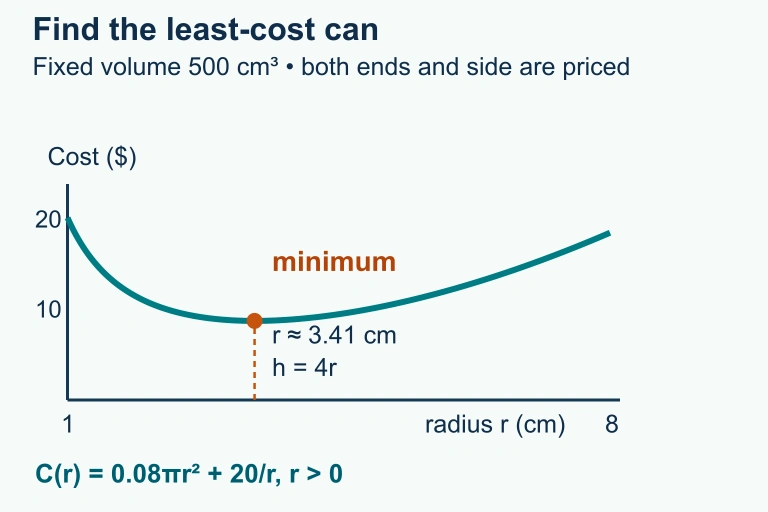
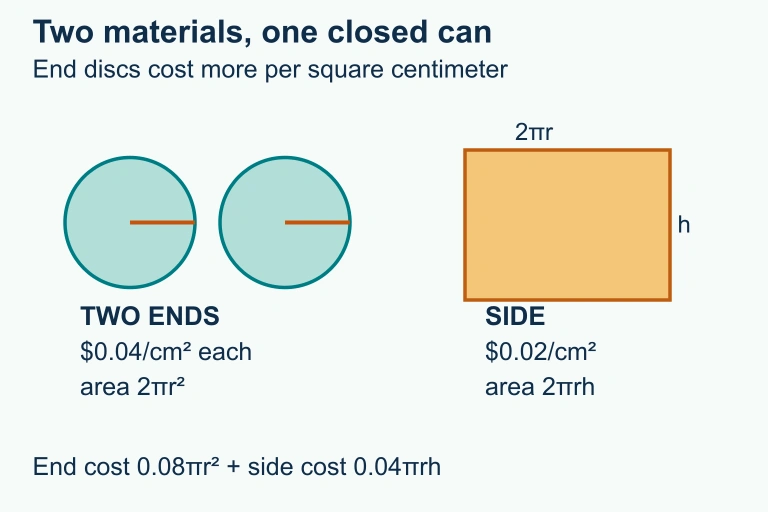
A manufacturer produces cylindrical cans that must hold exactly 500 cm³ of liquid. The material for the top and bottom costs $0.04 per cm², and the material for the curved side costs $0.02 per cm². (a) Express the total cost C as a function of the radius r. (b) Find the radius r that minimizes the total cost. (c) Find the corresponding height h. (d) Justify that your answer gives a minimum.
Show answer and explanation
Rubric (5 points): Point 1 — Setting up the cost function: The top and bottom each have area πr², costing 0.04(2πr²) = 0.08πr². The lateral surface has area 2πrh, costing 0.02(2πrh) = 0.04πrh. Total cost: C = 0.08πr² + 0.04πrh. Point 2 — Eliminating h using the volume constraint: From V = πr²h = 500, we get h = 500/(πr²). Substituting: C(r) = 0.08πr² + 0.04πr · 500/(πr²) = 0.08πr² + 20/r, for r > 0. Point 3 — Finding the critical point: C′(r) = 0.16πr − 20/r². Setting C′(r) = 0: 0.16πr = 20/r², so r³ = 20/(0.16π) = 125/π, giving r = (125/π)^(1/3) ≈ 3.414 cm. Point 4 — Finding the corresponding height: h = 500/(πr²) = 500/(π(125/π)^(2/3)). This simplifies to h ≈ 13.66 cm. Point 5 — Justification that this is a minimum: C″(r) = 0.16π + 40/r³. Since both terms are positive for all r > 0, C″(r) > 0 for all r in the domain. In particular, C″ at the critical point is positive, so the Second Derivative Test confirms a local minimum. Since this is the only critical point on (0, ∞) and C → ∞ as r → 0⁺ and as r → ∞, it is also the absolute minimum.
Question 1 of 5
A farmer encloses a rectangular area with 120 m of fencing on three sides (the fourth side is a wall). If \( x \) is the side parallel to the wall, which expression gives the area as a function of one variable?
Question 2 of 5
If \( f(x) = 3x^2 - 12x + 7 \) on the interval \( [0, 5] \), what is the absolute minimum value of \( f \)?
Question 3 of 5
An open-top cylindrical can must hold \( 500\pi \text{ cm}^3\). Which equation correctly relates the surface area to the radius \( r \)?
Question 4 of 5
Why is it valid to minimize \( D^2 \) instead of \( D \) when finding the closest point on a curve?
Question 5 of 5
A function \( f \) is continuous on \( [1, 6] \) with critical points at \( x = 2 \) and \( x = 4 \). Given \( f(1) = 3 \), \( f(2) = 7 \), \( f(4) = 1 \), \( f(6) = 5 \), what is the absolute maximum?