Introducing Calculus
Can Change Occur at an Instant?
Explore the foundational question of calculus: how we measure instantaneous change using limits, average rates, and the leap from secant to tangent lines.
What Is Change?
Every time you check the speedometer of a car, track the temperature over a day, or watch a stock price move, you are observing change. But a crucial question arises: the speedometer shows your speed right now, at a single frozen moment. How is that possible?
Average Rate of Change
We start with what we can measure: the average rate of change over an interval. For a function \( f(x) \), the average rate of change from \( x = a \) to \( x = b \) is:
Think of driving 120 miles in 2 hours: your average speed is 60 mph. But you weren't going exactly 60 mph every second: you sped up, slowed down, maybe stopped. The average hides the details.
The Secant Line
From Secant to Tangent
Now comes the key idea: what happens if we slide point \( b \) closer and closer to point \( a \)? The secant line rotates and approaches a special line that just touches the curve at a single point.
The Limit Makes It Rigorous
Calculus formalizes this "sliding closer" process using the concept of a limit. Instead of letting \( b = a \) (which gives \( \frac{0}{0} \)), we ask: what value does the ratio approach as \( b \) gets arbitrarily close to \( a \)?
This limit, when it exists, is called the derivative of \( f \) at \( x = a \). It is the precise answer to "Can change occur at an instant?" Yes: it is the limit of average rates of change.
Why Does This Matter?
Average vs Instantaneous
| Average Rate of Change | Instantaneous Rate of Change | |
|---|---|---|
| Interval | Over \( [a, b] \) | At a single point \( x = a \) |
| Geometric Meaning | Slope of secant line | Slope of tangent line |
| Formula | \( \frac{f(b) - f(a)}{b - a} \) | \( \displaystyle\lim_{h \to 0} \frac{f(a+h) - f(a)}{h} \) |
| Requires Limit? | No | Yes |
A falling ball seen through a drop-tower cutaway
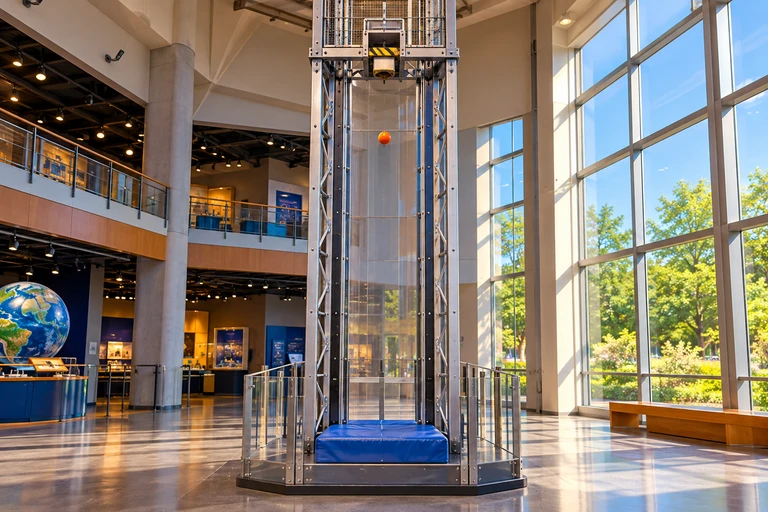 For height s(t) = 100 − 4.9t² meters, equal time intervals produce increasingly large drops. The model ends at ground impact, about 4.52 seconds.
Equal times, unequal distances
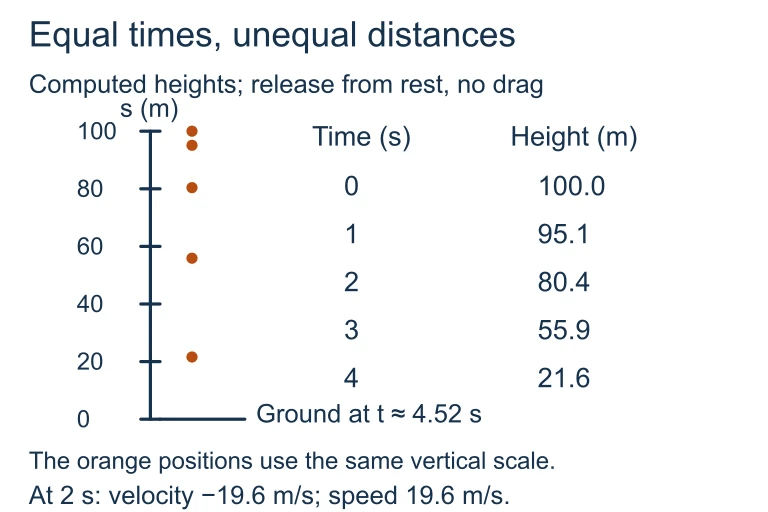 For height s(t) = 100 − 4.9t² meters, equal time intervals produce increasingly large drops. The model ends at ground impact, about 4.52 seconds.
A negative slope means downward velocity
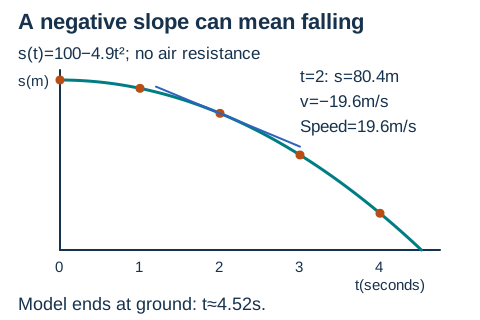 For s(t) = 100 − 4.9 t² meters, the point at t = 2 seconds has height 80.4 m and tangent slope −19.6 m/s. The negative velocity means downward motion; speed is 19.6 m/s.Open full diagram
How to Find the Instantaneous Rate
Example 1: \( f(x) = x^2 \) at \( x = 3 \)
Visualizing \( f(x) = x^2 \) at \( x = 3 \)
Example 2: \( g(t) = 18t - 5t^2 \) at \( t = 1 \)
A ball is thrown upward. Its height in meters after \( t \) seconds is \( g(t) = 18t - 5t^2 \). Find the instantaneous velocity at \( t = 1 \).
Example 3: \( f(x) = \frac{1}{x} \) at \( x = 2 \)
Estimating with Shrinking Intervals
When you don't have a formula, you can estimate the instantaneous rate by computing average rates over smaller and smaller intervals and watching the values converge.
| Interval | \( h \) | \( \frac{f(3+h)-f(3)}{h} \) for \( f(x)=x^2 \) |
|---|---|---|
| \( [3, 4] \) | \( 1 \) | \( 7 \) |
| \( [3, 3.1] \) | \( 0.1 \) | \( 6.1 \) |
| \( [3, 3.01] \) | \( 0.01 \) | \( 6.01 \) |
| \( [3, 3.001] \) | \( 0.001 \) | \( 6.001 \) |
Common Mistakes
Question 1 of 5
What does the instantaneous rate of change of a function at a point represent geometrically?
Question 2 of 5
What is \( \displaystyle\lim_{h \to 0} \frac{(5+h)^2 - 25}{h} \)?
Question 3 of 5
A car travels \( s(t) = 4t^2 \) meters in \( t \) seconds. What is its instantaneous velocity at \( t = 3 \)?
Question 4 of 5
The expression \( \displaystyle\frac{f(a+h) - f(a)}{h} \) is called the:
Question 5 of 5
As the interval \( [a, b] \) shrinks (i.e., \( b \to a \)), the secant line approaches the: