Fundamental Theorem
of Calculus
Discover how accumulation functions connect derivatives and integrals: the most powerful bridge in all of calculus.
What Is an Accumulation Function?
An accumulation function measures the total accumulated area under a curve from a fixed starting point \(a\) up to a variable endpoint \(x\). We write it as:
As \(x\) changes, \(F(x)\) grows or shrinks depending on whether \(f(t)\) is positive (area adds) or negative (area subtracts).
Visualizing Accumulated Area
Why Does This Matter?
FTC Part 1: The Derivative of an Integral
In words: the derivative of the accumulation function equals the original integrand evaluated at the upper limit. The integral "remembers" the function, and differentiation "recovers" it.
Follow the salt through a working mixing rig
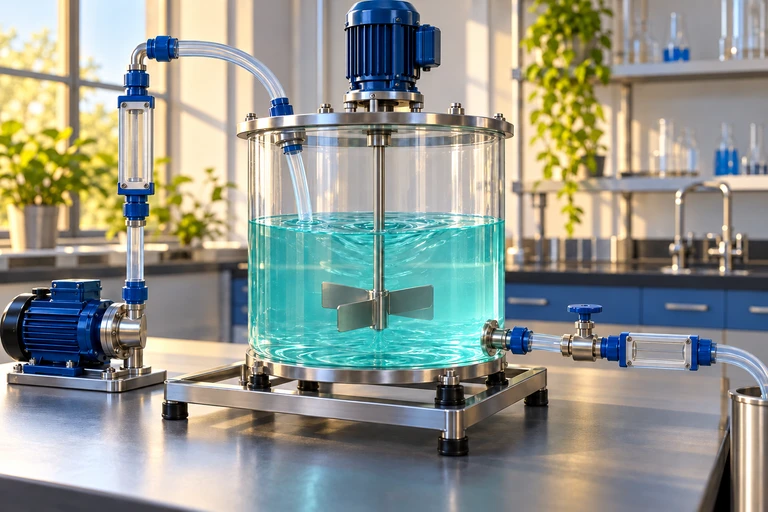 For net flow R(t) = 4t − t² gal/min and 10 gal initially, V(t) = 10 + 2t² − t³/3. Volume peaks at t = 4 minutes, when the net rate changes from positive to negative.
Signed net flow and inventory
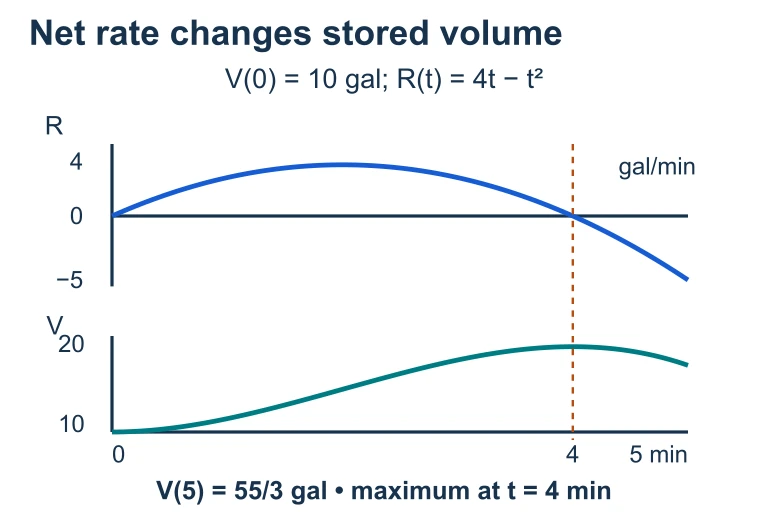 For net flow R(t) = 4t − t² gal/min and 10 gal initially, V(t) = 10 + 2t² − t³/3. Volume peaks at t = 4 minutes, when the net rate changes from positive to negative.
Why \(F'(x) = f(x)\)?
FTC Part 2: Evaluating Definite Integrals
Part 2 says: to compute a definite integral, find any antiderivative and subtract its values at the endpoints. No Riemann sums required.
Part 1 vs Part 2: Key Distinction
| FTC Part 1 | FTC Part 2 | |
|---|---|---|
| Statement | \(\frac{d}{dx}\int_a^x f(t)\,dt = f(x)\) | \(\int_a^b f(x)\,dx = F(b)-F(a)\) |
| Direction | Integral → Derivative | Derivative → Integral |
| What it finds | Instantaneous rate of accumulation | Total net accumulation |
| Upper limit | Variable \(x\) | Constant \(b\) |
| Result type | A function of \(x\) | A number |
When the Upper Limit Is Not Just \(x\)
If the upper limit is a function \(g(x)\) instead of plain \(x\), apply the chain rule:
How to Apply the FTC
Example 1: Basic FTC Part 1
Find \(\displaystyle\frac{d}{dx}\int_2^x (3t^2 + 1)\,dt\).
Example 2: Chain Rule Extension
Find \(\displaystyle\frac{d}{dx}\int_0^{\sin x} e^{t^2}\,dt\).
Example 3: Evaluating a Definite Integral
Evaluate \(\displaystyle\int_1^4 \left(2\sqrt{x}\right)\,dx\).
Example 4: Reading \(F(x)\) from a Graph
Properties of \(F(x)\)
Common Mistakes to Avoid
Summary Cheat Sheet
| Scenario | Formula | Key Detail |
|---|---|---|
| Basic FTC Part 1 | \(\frac{d}{dx}\int_a^x f(t)\,dt = f(x)\) | Upper limit is \(x\) |
| Chain Rule Version | \(f(g(x))\cdot g'(x)\) | Upper limit is \(g(x)\) |
| Flipped Limits | \(-f(x)\) | Lower limit is \(x\) |
| FTC Part 2 | \(F(b) - F(a)\) | Both limits are constants |
Question 1 of 5
What is \(\displaystyle\frac{d}{dx}\int_3^x \cos(t^2)\,dt\)?
Question 2 of 5
What is \(\displaystyle\frac{d}{dx}\int_1^{x^3} \ln(t)\,dt\)?
Question 3 of 5
If \(F(x) = \displaystyle\int_0^x f(t)\,dt\) and \(f\) changes from positive to negative at \(x = 4\), what happens to \(F\) at \(x = 4\)?
Question 4 of 5
Evaluate \(\displaystyle\int_0^{\pi} \sin(x)\,dx\) using FTC Part 2.
Question 5 of 5
What is \(\displaystyle\frac{d}{dx}\int_x^5 e^{t}\,dt\)?