Exploring
Accumulations of Change
Understand how definite integrals capture the total accumulation of a quantity, connecting rates of change to net change through area under a curve.
What Is Accumulation?
In calculus, accumulation is the process of adding up infinitely many small changes to find a total change. If you know a rate of change, such as velocity, you can accumulate it over time to find the total displacement.
Follow the salt through a working mixing rig
 For net flow R(t) = 4t − t² gal/min and 10 gal initially, V(t) = 10 + 2t² − t³/3. Volume peaks at t = 4 minutes, when the net rate changes from positive to negative.
Signed net flow and inventory
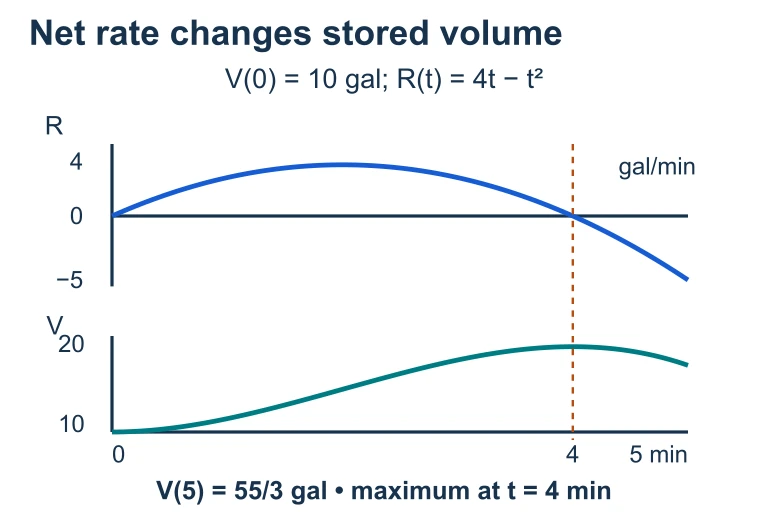 For net flow R(t) = 4t − t² gal/min and 10 gal initially, V(t) = 10 + 2t² − t³/3. Volume peaks at t = 4 minutes, when the net rate changes from positive to negative.
Visualizing Area Under a Curve
The accumulation of \( f(x) \) from \( a \) to \( b \) equals the signed area between the graph and the \( x \)-axis. Area above the axis is positive; area below is negative.
From Riemann Sums to Integrals
A Riemann sum approximates accumulation by dividing the interval into \( n \) sub-intervals and summing rectangular areas. As \( n \to \infty \), the sum becomes the definite integral.
The Definite Integral
The Fundamental Theorem of Calculus
The FTC connects differentiation and integration, providing a powerful tool to evaluate definite integrals without computing limits of Riemann sums.
Accumulation Functions
An accumulation function tracks how much total change has occurred from a fixed starting point \( a \) up to a variable endpoint \( x \):
Definite vs Indefinite Integrals
| Definite Integral | Indefinite Integral | |
|---|---|---|
| Notation | \( \int_a^b f(x)\,dx \) | \( \int f(x)\,dx \) |
| Result | A number: net accumulation | A function: family of antiderivatives |
| Bounds | Has limits \( a \) and \( b \) | No limits of integration |
| Constant | No \( +C \) | Includes \( +C \) |
| Interpretation | Signed area under curve | General antiderivative |
Understanding Signed Area
When \( f(x) < 0 \) on part of the interval, the integral counts that region as negative. The definite integral gives net accumulation, not total area.
How to Evaluate a Definite Integral
Example 1: Basic Polynomial
Evaluate \( \displaystyle\int_1^3 (2x + 1)\,dx \).
Example 2: Trigonometric Integral
Evaluate \( \displaystyle\int_0^{\pi} \sin(x)\,dx \).
Example 3: Velocity and Displacement
A particle moves with velocity \( v(t) = t^2 - 4t + 3 \) m/s. Find the net displacement from \( t = 0 \) to \( t = 4 \).
Properties of Definite Integrals
Common Mistakes to Avoid
Question 1 of 5
Evaluate \( \displaystyle\int_0^2 3x^2\,dx \).
Question 2 of 5
If \( \displaystyle\int_1^5 f(x)\,dx = 7 \) and \( \displaystyle\int_5^8 f(x)\,dx = -3 \), what is \( \displaystyle\int_1^8 f(x)\,dx \)?
Question 3 of 5
What does \( \displaystyle\int_a^b v(t)\,dt \) represent when \( v(t) \) is the velocity of a particle?
Question 4 of 5
If \( F(x) = \displaystyle\int_2^x (3t^2 + 1)\,dt \), what is \( F'(x) \)?
Question 5 of 5
What is \( \displaystyle\int_3^3 (x^4 + 7x - 2)\,dx \)?