Estimating Limits
from Tables
Learn to determine the value a function approaches by analyzing numerical data from both sides of a target point.
What Is a Limit?
A limit describes the value that \( f(x) \) gets closer and closer to as \( x \) approaches a specific number \( a \). We write this as:
The key insight: we care about what happens near \( x = a \), not necessarily at \( x = a \). The function doesn't even need to be defined at \( a \) for the limit to exist.
Why Use Tables to Estimate Limits?
Left-Hand and Right-Hand Limits
To determine whether a limit exists at \( x = a \), we examine the function from both directions:
The Existence Condition
When both sides converge to the same value \( L \), the two-sided limit equals \( L \): even if \( f(a) \) is undefined or different.
Limit Value vs. Function Value
| \( \lim_{x \to a} f(x) \) | \( f(a) \) | |
|---|---|---|
| Meaning | What \( f(x) \) approaches | What \( f(x) \) equals at \( a \) |
| Requires \( f(a) \) defined? | No | Yes |
| Can differ from each other? | Yes: a function can have \( f(a) \neq L \) | |
| In a table | Read the trend of nearby values | Read the row where \( x = a \) exactly |
Step-by-Step Strategy
Example 1: Estimating \( \lim_{x \to 2} f(x) \)
Consider \( f(x) = \dfrac{x^2 - 4}{x - 2} \). This is undefined at \( x = 2 \), but the limit may still exist. Let's build a table:
| \( x \) (left) | \( f(x) \) | \( x \) (right) | \( f(x) \) | |
|---|---|---|---|---|
| 1.9 | 3.9 | 2.1 | 4.1 | |
| 1.99 | 3.99 | 2.01 | 4.01 | |
| 1.999 | 3.999 | 2.001 | 4.001 | |
| 1.9999 | 3.9999 | 2.0001 | 4.0001 |
Example 1: Visualized
Example 2: When the Limit Does Not Exist
Estimate \( \lim_{x \to 0} \dfrac{|x|}{x} \) using a table:
| \( x \) (left) | \( f(x) \) | \( x \) (right) | \( f(x) \) | |
|---|---|---|---|---|
| \(-0.1\) | \(-1\) | 0.1 | 1 | |
| \(-0.01\) | \(-1\) | 0.01 | 1 | |
| \(-0.001\) | \(-1\) | 0.001 | 1 |
Example 3: Famous Limit \( \lim_{x \to 0} \dfrac{\sin x}{x} \)
| \( x \) (left) | \( \frac{\sin x}{x} \) | \( x \) (right) | \( \frac{\sin x}{x} \) | |
|---|---|---|---|---|
| \(-0.1\) | 0.99833 | 0.1 | 0.99833 | |
| \(-0.01\) | 0.99998 | 0.01 | 0.99998 | |
| \(-0.001\) | 0.9999998 | 0.001 | 0.9999998 |
When Values Grow Without Bound
Estimate \( \lim_{x \to 0} \dfrac{1}{x^2} \) from a table:
| \( x \) (left) | \( \frac{1}{x^2} \) | \( x \) (right) | \( \frac{1}{x^2} \) | |
|---|---|---|---|---|
| \(-0.1\) | 100 | 0.1 | 100 | |
| \(-0.01\) | 10,000 | 0.01 | 10,000 | |
| \(-0.001\) | 1,000,000 | 0.001 | 1,000,000 |
Choosing Good \( x \)-Values
The quality of your estimate depends on how close your \( x \)-values get to the target. Use a pattern of powers of 10:
A few readings leave the intervals unseen
 Separated measurements leave the behavior between samples undetermined. Two differentiable curves can pass through the same readings while having different derivatives between them.
A few readings leave the intervals unseen
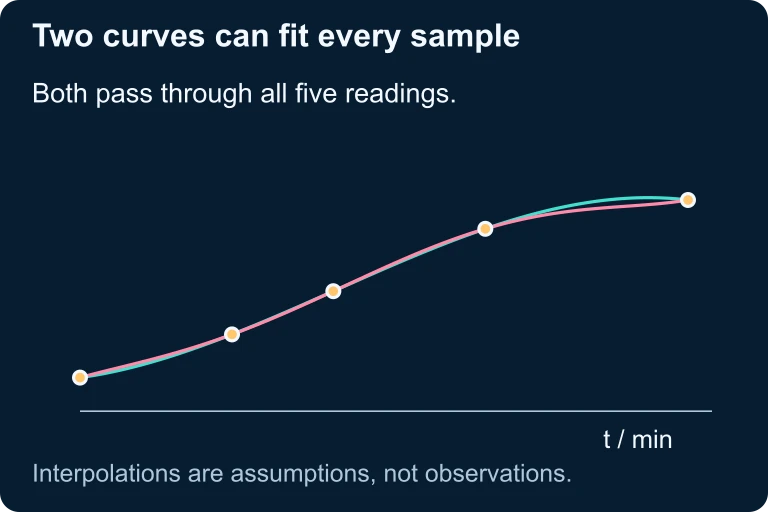 Separated measurements leave the behavior between samples undetermined. Two differentiable curves can pass through the same readings while having different derivatives between them.
One-Sided Limits in Piecewise Functions
Some AP questions give a table for a piecewise function. The left and right sides may follow different rules:
| \( x \) | \( f(x) \) | \( x \) | \( f(x) \) | |
|---|---|---|---|---|
| 2.9 | 5.8 | 3.1 | 7.21 | |
| 2.99 | 5.98 | 3.01 | 7.0201 | |
| 2.999 | 5.998 | 3.001 | 7.002 |
Common Mistakes to Avoid
Summary of Outcomes
| Table Pattern | Left-Hand | Right-Hand | Conclusion |
|---|---|---|---|
| Both converge to same \( L \) | \( L \) | \( L \) | Limit = \( L \) |
| Converge to different values | \( L_1 \) | \( L_2 \) | DNE |
| One or both grow unbounded | \( \pm \infty \) | \( \pm \infty \) | DNE (describe as \( \pm \infty \)) |
| Values oscillate wildly | No pattern | No pattern | DNE |
Question 1 of 5
The table below shows values of \( g(x) \) near \( x = 3 \):
\( x \): 2.9, 2.99, 2.999 → \( g(x) \): 4.7, 4.97, 4.997
\( x \): 3.1, 3.01, 3.001 → \( g(x) \): 5.3, 5.03, 5.003
Based on the table, what is \( \lim_{x \to 3} g(x) \)?
Question 2 of 5
The table below shows values of \( h(x) \) near \( x = 1 \):
\( x \): 0.9, 0.99, 0.999 → \( h(x) \): 2.8, 2.98, 2.998
\( x \): 1.1, 1.01, 1.001 → \( h(x) \): 5.2, 5.02, 5.002
What is \( \lim_{x \to 1} h(x) \)?
Question 3 of 5
A table shows that as \( x \to 4^{-} \), \( f(x) \to 10 \), and as \( x \to 4^{+} \), \( f(x) \to 10 \). Also, \( f(4) = 7 \). What is \( \lim_{x \to 4} f(x) \)?
Question 4 of 5
A table for \( p(x) = \dfrac{1}{x - 2} \) near \( x = 2 \):
\( x \): 1.9, 1.99, 1.999 → \( p(x) \): \(-10\), \(-100\), \(-1000\)
\( x \): 2.1, 2.01, 2.001 → \( p(x) \): 10, 100, 1000
What is \( \lim_{x \to 2} p(x) \)?
Question 5 of 5
If a table of values shows \( f(x) \) approaching \( 3.000 \) from both sides as \( x \to 5 \), but \( f(5) \) is undefined, what can you conclude?