Estimating Limits
from Graphs
Learn to read graphs like a calculus pro: determine what value \( f(x) \) approaches as \( x \) gets close to a target, even when the function has holes, jumps, or asymptotes.
What Is a Limit?
A limit describes the value that \( f(x) \) gets closer and closer to as \( x \) approaches some number \( c \). We write this as:
This means: as \( x \) gets arbitrarily close to \( c \) (from both sides), the output \( f(x) \) gets arbitrarily close to \( L \). The function does not need to equal \( L \) at \( x = c \).
Approaching vs Arriving
One-Sided Limits
When Does the Limit Exist?
Reading the Graph for Limits
Limit vs Function Value
| Limit \( \lim_{x \to c} f(x) \) | Function Value \( f(c) \) | |
|---|---|---|
| What it asks | Where is \( f(x) \) heading? | Where does \( f(x) \) land? |
| Requires \( f(c) \) to exist? | No | Yes |
| Graph clue | Trace the curve toward \( x = c \) | Look at the dot at \( x = c \) |
| Affected by holes? | No | Yes |
Three Scenarios on a Graph
How to Estimate a Limit
Example 1: Removable Hole
Example 2: Jump Discontinuity
Example 3: Vertical Asymptote
Infinite Limits vs Limits at Infinity
Graphs + Tables Together
When a graph is hard to read precisely, a table of values can help you estimate the limit by picking \( x \)-values that get closer to \( c \) from both sides:
| \( x \) | 1.9 | 1.99 | 2 | 2.01 | 2.1 |
|---|---|---|---|---|---|
| \( f(x) \) | 4.61 | 4.96 | ? | 5.04 | 5.41 |
A few readings leave the intervals unseen
 Separated measurements leave the behavior between samples undetermined. Two differentiable curves can pass through the same readings while having different derivatives between them.
A few readings leave the intervals unseen
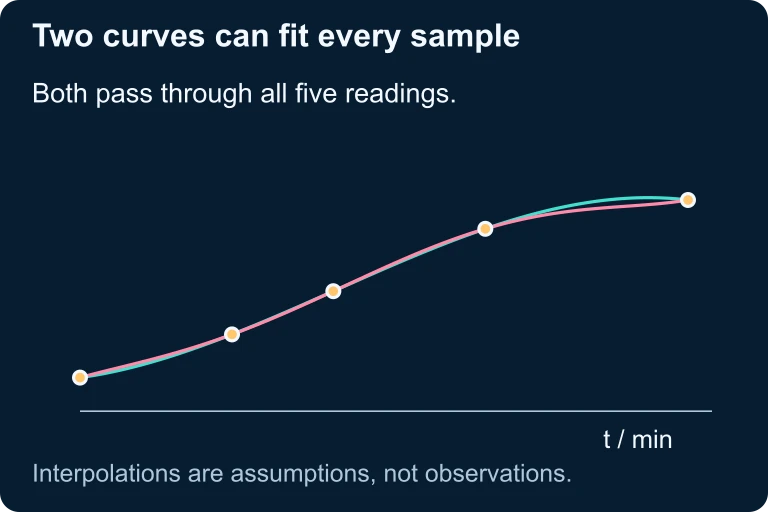 Separated measurements leave the behavior between samples undetermined. Two differentiable curves can pass through the same readings while having different derivatives between them.
Common Mistakes
Summary Cheat Sheet
| Graph Feature | Limit Outcome | How to Spot It |
|---|---|---|
| Smooth passage | Limit = \( f(c) \) | Curve passes through the point |
| Removable hole | Limit = \( L \) (may be \( \neq f(c) \)) | Open circle; both sides agree |
| Jump | Limit DNE | Curve "breaks"; sides disagree |
| Vertical asymptote | Limit DNE (unbounded, \( \pm\infty \)) | Curve shoots to \( \pm\infty \) |
| Oscillation | Limit DNE | Curve vibrates infinitely fast |
Question 1 of 5
A graph shows a curve approaching \( y = 4 \) from both sides as \( x \to 3 \), with an open circle at \( (3, 4) \) and a filled dot at \( (3, 1) \). What is \( \lim_{x \to 3} f(x) \)?
Question 2 of 5
On a graph, \( \lim_{x \to 2^-} f(x) = 5 \) and \( \lim_{x \to 2^+} f(x) = 5 \). Which statement must be true?
Question 3 of 5
A graph has a vertical asymptote at \( x = -1 \). From the left, the curve goes to \( +\infty \), and from the right, the curve goes to \( -\infty \). What is \( \lim_{x \to -1} f(x) \)?
Question 4 of 5
A table shows: as \( x \to 5^- \), \( f(x) \) values are 7.9, 7.99, 7.999. As \( x \to 5^+ \), \( f(x) \) values are 8.001, 8.01, 8.1. What is the best estimate for \( \lim_{x \to 5} f(x) \)?
Question 5 of 5
On a graph, the curve from the left approaches \( y = 3 \) as \( x \to 1 \), and the curve from the right approaches \( y = 6 \) as \( x \to 1 \). There is a filled dot at \( (1, 3) \). What is \( \lim_{x \to 1^+} f(x) \)?