Estimating
Derivatives at a Point
Learn to approximate \( f'(a) \) using slopes of secant lines, tables of values, and graphs: the foundation of differential calculus.
What Is a Derivative?
The derivative of a function \( f \) at a point \( x = a \) measures the instantaneous rate of change: how fast \( f(x) \) is changing at that exact moment. Geometrically, it equals the slope of the tangent line to the graph of \( f \) at the point \( (a, f(a)) \).
When we cannot compute this limit exactly, we estimate it: we replace the limit with a small but finite \( h \) and compute the resulting difference quotient.
Secant Lines Approach the Tangent
Three Ways to Estimate \( f'(a) \)
Uses the point to the right of \( a \).
Uses the point to the left of \( a \).
Uses points on both sides: usually the most accurate.
The Difference Quotient Formula
This is the average rate of change of \( f \) on the interval \( [a,\, a+h] \). As \( h \to 0 \), it converges to the derivative. In practice, we pick the smallest available \( h \) from a table or graph to get the best estimate.
Visualizing All Three Quotients
Average vs. Instantaneous Rate of Change
| Average Rate | Instantaneous Rate | |
|---|---|---|
| Formula | \( \dfrac{f(b)-f(a)}{b-a} \) | \( \displaystyle\lim_{h\to 0}\dfrac{f(a+h)-f(a)}{h} \) |
| Geometry | Slope of secant | Slope of tangent |
| Uses | Over an interval | At a single point |
| Exact? | Exact for that interval | Requires a limit (or estimation) |
Step-by-Step: Estimating \( f'(a) \)
Example 1: Table of Values
A function \( f \) has the values below. Estimate \( f'(3) \).
| \( x \) | 1 | 2 | 3 | 4 | 5 |
|---|---|---|---|---|---|
| \( f(x) \) | 2 | 5 | 10 | 17 | 26 |
A few readings leave the intervals unseen
 Using readings on both sides of 5 minutes gives a secant estimate of 4.4 °C/min. The times are unequally spaced, so the estimate uses their actual time difference.
A few readings leave the intervals unseen
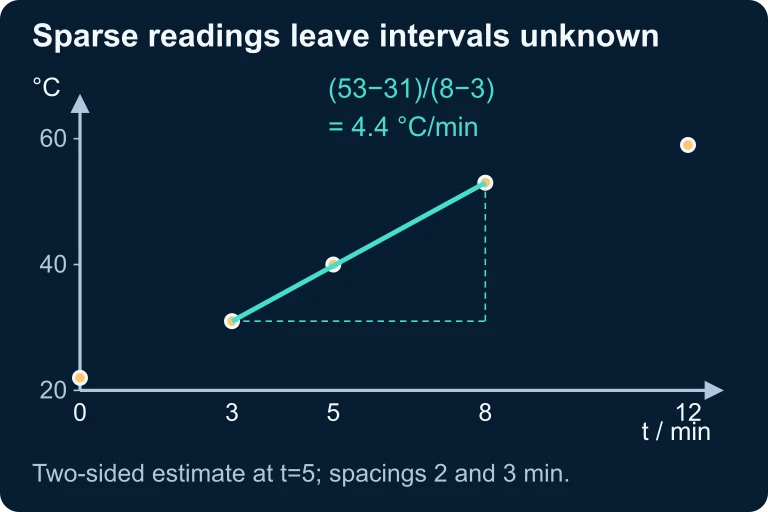 Using readings on both sides of 5 minutes gives a secant estimate of 4.4 °C/min. The times are unequally spaced, so the estimate uses their actual time difference.
Example 2: Reading a Graph
Example 3: Smaller \( h \) Gives Better Estimates
Let \( f(x) = x^2 \). Estimate \( f'(3) \) using different step sizes and compare to the exact answer \( f'(3) = 6 \).
| \( h \) | Forward Quotient | Symmetric Quotient | Error (Symmetric) |
|---|---|---|---|
| 1 | \( \frac{16-9}{1} = 7 \) | \( \frac{16-4}{2} = 6 \) | 0 |
| 0.5 | \( \frac{12.25-9}{0.5} = 6.5 \) | \( \frac{12.25-6.25}{1} = 6 \) | 0 |
| 0.1 | \( \frac{9.61-9}{0.1} = 6.1 \) | \( \frac{9.61-8.41}{0.2} = 6 \) | 0 |
Example 4: Applied Context
A particle's position \( s(t) \) in meters is recorded at specific times. Estimate the velocity \( s'(4) \).
| \( t \) (sec) | 0 | 2 | 4 | 6 | 8 |
|---|---|---|---|---|---|
| \( s(t) \) (m) | 0 | 6 | 18 | 34 | 52 |
What If Data Is Only on One Side?
Sometimes a table or graph only gives values to the left or right of \( a \). In that case, you cannot use the symmetric quotient. Use whichever one-sided quotient is available.
Estimating from an Equation
Even when you have a formula, you might be asked to estimate (not compute exactly) the derivative. This tests your understanding of the difference quotient itself.
Common Mistakes to Avoid
Summary: Estimation Methods
| Method | Formula | Accuracy | When to Use |
|---|---|---|---|
| Forward | \( \frac{f(a+h)-f(a)}{h} \) | Good | Only right-side data |
| Backward | \( \frac{f(a)-f(a-h)}{h} \) | Good | Only left-side data |
| Symmetric | \( \frac{f(a+h)-f(a-h)}{2h} \) | Best | Data on both sides |
Question 1 of 5
Given the table below, which expression best estimates \( f'(5) \)?
| \( x \) | 3 | 5 | 7 |
|---|---|---|---|
| \( f(x) \) | 10 | 20 | 36 |
Question 2 of 5
The symmetric difference quotient uses a denominator of:
Question 3 of 5
A car's position \( s(t) \) in miles is given. Estimate the velocity \( s'(3) \) in miles per hour.
| \( t \) (hr) | 1 | 2 | 3 | 4 | 5 |
|---|---|---|---|---|---|
| \( s(t) \) (mi) | 10 | 30 | 55 | 85 | 120 |
Question 4 of 5
If a student computes \( \frac{f(a) - f(a+h)}{h} \), what error have they made?
Question 5 of 5
Why is the symmetric difference quotient generally more accurate than the forward or backward quotient?